
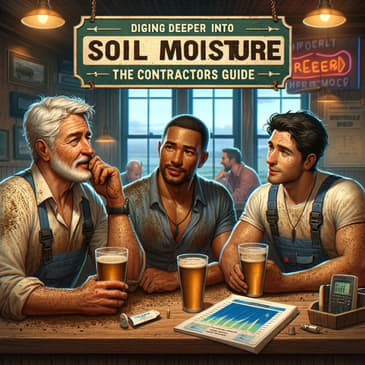
Three irrigation contractors walked into a bar...
3 irrigation contractors, experts in their field, decided to unwind at a local microbrewery after a long day's work. As they sipped their IPAs, they couldn't help but carry their profession into their leisure time.
"Did you guys see the irrigation as you walked in," asked the first contractor. "It looked like trunk slammers put that system in".
"I don’t know, it's probably due to the crappy soil in this part of town," said the other contractor.
"Really? I always thought the soil was pretty descent around here."
"Let's make a bet," boasted the 3rd contractor, always confident in his soil identification skills. "I bet the soil outside this brewery is loamy,"
The second, with a smirk, disagreed. "No way, it's definitely sandy soil. I can tell just by looking at the plants growing out front."
The third, not one to be left out, chimed in, "You're both wrong. That's classic clay soil if I've ever seen it, just look at all that runoff".
The banter continued until they decided to settle the bet: whoever was right would get free beer for the night. Excited, they stumbled outside, each scooping up a handful of soil. But as they examined their findings, they could not agree – each was convinced their assessment was correct.
In a twist of professionalism, they decided to send a sample to a testing lab for an accurate analysis. The suspense was intense as they had to wait A WEEK for the results.
Finally, by the next Friday, the lab results arrived, and to their astonishment, they were ALL wrong. The soil was a Unique mix, unlike any of the types they had argued for. A smirk of astonishment filled their faces as they realized not only their shared mistake, but also that no one would win the free beer!
[00:00:00] It was a night that started with a bet and ended with a groundbreaking insight, one that could potentially revolutionize the irrigation industry. In the end, they toasted to the complexity of weather-based irrigation controls and the idea that even experts have something to learn.
[00:00:23] If you are an irrigation professional, old or new, who designs, installs, or maintains high-end residential, commercial or municipal properties. And you want to use technology to improve your business to get a leg up on your competition,
[00:00:38] even if you're an old school irrigator from the days of hydraulic systems. This show is for you. Hey there my friends! It's your host Andy Humphrey. Welcome to Episode, I think Episode 148? Guess I should have checked. Welcome to Episode 148 of The Sprinkler Nerd Show.
[00:00:58] As always, I am super stoked that you are tuning in today. There are just gobs and gobs and gobs and gobs and gobs of podcasts out there. So the fact that you're choosing to listen to this one is awesome. Thank you so much.
[00:01:14] I hope I can fill your earballs with both trade information, maybe some thought leadership, some mind share, and just general positive vibes. So thank you so much for listening, wherever you are listening from. Really appreciate it.
[00:01:31] Today's episode I titled What is 30% and the reason that I did that is because it is just a... It's an amazing question. And it came up this week. I put together a training seminar for the Iratec Advanced Training Series and I titled
[00:01:55] it Digging Deeper, Basically The Contractor's Guide to Soul Moisture Sensing which is a kind of top level theory in thinking on soul moisture sensors, tying it all the way down to how do you use a soul moisture sensor to manage an irrigation controller i.e. start time,
[00:02:16] run time, day of the week, normal controller settings? And what I find most interesting about using soul moisture sensors and I say most, what I find interesting is that everybody wants to know what the numbers mean. It's a really common question and we want...
[00:02:36] Users tend to want to know what the numbers mean similar in a similar way to how we like to know what the temperature means. And I don't know the best way to explain temperature other than air is fairly constant. I guess it's constant.
[00:02:54] You can measure it and 70 degrees could feel like 65 or it could feel like 75 based on humidity and such but you can still measure the air temperature. And the same thing is true with soul moisture sensors.
[00:03:11] You can measure the volumetric water content also referred to as VWC, sometimes moisture content, VMC, the volumetric water content. You can measure it with a soul moisture sensor however you can't understand the meaning of the number all by itself.
[00:03:33] So if somebody were to say, hey Andy I just took a soul moisture reading and it says 30% is that wet or is that dry? The answer is I don't know. And that is because the percent of volumetric water content is mostly relative to the soil type.
[00:03:59] So I would need to ask a follow up question generally speaking and that would be what type of soil do you have? And if the user said, I've got pure sand then I would say okay well 30% in pure sand is very very wet. Very wet.
[00:04:18] However if the user said I have heavy clay then I might say alright well 30% in heavy clay you know is relatively dry. So isn't that interesting that the percent moisture all by itself is only one variable.
[00:04:37] It is only when you can add the soil type that you can make sense of wet or dry. And so looking at the number all by itself isn't that relevant and it is also hard to determine the soil type.
[00:04:55] And I'm going to share a story with you that I drafted up, kind of came up with the concept and then I used AI to help me with some of the creative pieces. So I'm going to read you the story but just tying it back to 30%.
[00:05:09] 30% is only relative to the soil type and soil is hard to determine the soil type. If five of us, and I'm getting ahead with the story but if five of us went outside and
[00:05:22] we all dug a hole and stuck our hands in the ground and we had to write down on a piece of paper what type of soil we may get five different answers.
[00:05:31] And so what I have found over time is one of the best ways to understand the soil moisture is to look at it over time on a graph. If you have a two week watering period and you have a heavy either irrigation event or
[00:05:48] a heavy rain event and you can see how wet the soil gets and you can also see saturation or the needle spikes on a graph. If you can see that over time and you can look at the dry down, you can find field
[00:06:02] capacity which is the when the soil is perfectly wet. You can find what that number looks like and that helps make things relevant. So by looking at data over time and looking at those numbers, that's the best way to
[00:06:18] decide if that I've seen if 30% is wet or dry. Let's look at it over time. Let's see what a rain event does. Let's see how much water this particular soil can hold and then we can make that relevant
[00:06:33] and this might be where us as an industry moves is away from trying to understand what the volumetric water content is and instead we recalibrate it to wet or dry because that's really what we want to know.
[00:06:49] So that's where the thought for this episode came from and then I thought I would read you the story that I did not share during the presentation. So when I gave the presentation to the ear attack training class, I teased the audience
[00:07:05] and said that you guys would have to listen to the podcast today in order to hear the creative story that I came up with that, you know, it's fiction but speaks a lot of truth and I hope you enjoy it.
[00:07:18] So I'll go ahead and start reading the story right now. It's story time. This is a story about three irrigation contractors walking into a bar and it goes like this. Three irrigation contractors, experts in their field decided to unwind at a local micro brewery
[00:07:41] after a long day's work as they sipped their IPAs they couldn't help but carry their profession into their leisure time. Did you guys see the irrigation as you walked in? Asked the first contractor. It looked like trunk slammers put in that system.
[00:07:57] I don't know, it's probably due to the crappy soil in this part of town, said the other contractor. Really? I always thought the soil was pretty decent around here. Let's make a bet, boasted the third contractor, always confident in his soil identification skills.
[00:08:14] I bet the soil outside this brewery is loamy. The second contractor with a smirk disagreed. No way. It's definitely sandy soil. I can tell just by looking at the plants growing out there. The third, not one to be left out chimed in. You're both wrong.
[00:08:33] That's classic clay if I've ever seen it. Just look at all that runoff. The banter continued until they decided to settle the bet. Whoever was right would get free beer for the night. Excited? They stumbled outside each scooping up a handful of soil.
[00:08:51] As they examined their findings, they could not agree. Each was convinced their assessment was correct. In a twist of professionalism, they decided to send the sample to a testing lab for an accurate analysis. The suspense was intense as they had to wait a week for the results.
[00:09:12] Finally, by the next Friday, the lab results had arrived and to their astonishment they were all wrong. The soil was a unique mix unlike any of the types they had argued for. A smirk of astonishment filled their faces as they realized not only their shared mistake
[00:09:35] but also that no one would win the free beer. After the surprising revelation from the soil test, the three irrigators returned to the bar, their moods undampened by the outcome. As they ordered another round of drinks on that Friday evening, again the conversation naturally veered towards their work.
[00:09:57] You know, began the first irrigator. I've been thinking about those weather-based irrigation controllers we've been using. I'm not sure I can really trust them. The second nodded in agreement, absolutely I've noticed that too. They often overestimate the need for water especially if you enter the wrong settings
[00:10:18] and where there's more rainfall. The third, always the one to ponder deeper, leaned in. What if we're approaching this all wrong? Instead of relying on weather predictions, maybe we should use soil moisture levels to control the irrigation. That way, we're responding to the actual needs of the soil
[00:10:39] and not just guessing the soil type, seeing as we suck at doing that anyway. The first irrigator raised an eyebrow. That's an interesting point. Soil moisture sensors could provide better data making our irrigation practices much more efficient. Yeah, added the second and it would reduce water waste.
[00:11:00] We'd be irrigating only when the soil really needs it and not just because the weather forecast said it might be dry. They all nodded recognizing the potential of this idea. It seems we've learned two valuable lessons today. The 30 irrigator said with a smile.
[00:11:17] Never assume you know the soil without testing it and maybe, just maybe, it's time to rethink our approach to irrigation altogether. Their discussion continued long into the night filled with ideas and plans for a more efficient soil moisture based irrigation system.
[00:11:36] It was a night that started with a bet and ended with a groundbreaking insight, one that could potentially revolutionize the irrigation industry. In the end, they toasted to the complexity of weather based irrigation controls and the idea that even experts have something to learn. So that's it.
[00:11:57] Hope you enjoyed that one. And again, as it relates to soil moisture, just remember that the number all by itself has almost no meaning. You have to know about the soil that it's buried in in order to determine if 30% is wet or dry.
[00:12:18] So with that, hope you guys have an awesome weekend. Please share this episode or whatever your favorite episode might be. Please share it with a friend, a colleague, your neighbor, your grandmother, you get the idea. Let's share the love and the enjoyment for what we're doing.
[00:12:38] And again, thank you so much. Have a great weekend. Catch you next week on another exciting episode of The Sprinkler Show.