
Recorded in January 2019 - Episode #1 has never been published, until now.
-----
What are you afraid of?
Are you afraid of failure?
Does the fear of failure trick you into believing that perhaps perfection is the goal?
Does fear prevent you from starting?
Why do people have great ideas, but do nothing with them?
I'd like to introduce today's episode as something that although was a bit of a failure at the time, was simply the first attempt. And I thought it would be important to show all of you an example for attempt #1. And to encourage you to keep trying at whatever it is you have a vision for.
What you are about to hear is Podcast Episode #1, that was never released. Why? Because it didn't meet my expectation, and I was embarrassed, or perhaps scared of failure, scared of what other people might think, those other people being you, and sometimes are not actually afraid to fail, we are afraid to BE SEEN failing. Think about that! It is not missing the shot that is scary, it is being seen missing the shot that is scary.
So, this episode is for me. It's my turn to be seen missing the shot. Even though this was my very first shot, I was too afraid to play it, so I'm going to lean in and play my failure for you.
This was recorded in January of 2019, before I knew anything about podcasting and I was just experimenting.
Before we jump into it. I have 2 thoughts that would encourage you to embrace.
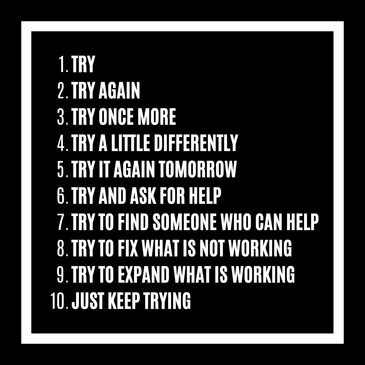
#1 is the concept of TRYING:
TEN STEPS TO INNOVATION!
- TRY
- TRY AGAIN
- TRY ONCE MORE
- TRY A LITTLE DIFFERENTLY
- TRY IT AGAIN TOMORROW
- TRY AND ASK FOR HELP
- TRY TO FIND SOMEONE WHO CAN HELP
- TRY TO FIX WHAT IS NOT WORKING
- TRY TO EXPAND WHAT IS WORKING
- JUST KEEP TRYING UNTIL YOU SUCCEED
#2 is to frame life as an experiment. How can you fail if this is just an experiment?
[00:00:00] and yet you got your hands dirty.
[00:00:02] And I still do. I appreciate it. It's one of the most important things to learn in this business is you have to see and feel how things work by doing and testing and failing and breaking.
[00:00:20] Oh yeah.
[00:00:21] Trying.
[00:00:22] If you are an irrigation professional, old or new, who designs, installs or maintains high end residential commercial or municipal properties and you want to use technology to improve your business to get a leg up on your competition.
[00:00:41] Even if you're an old school irrigator from the days of hydraulic systems, this show is for you.
[00:00:48] What are you afraid of?
[00:00:51] Are you afraid of failure?
[00:00:53] Does the fear of failure trick you into believing that perhaps perfection is the goal?
[00:01:03] Does fear prevent you from starting something?
[00:01:07] Why do people have great ideas, but they do nothing with them?
[00:01:14] I'd like to introduce today's episode as something that although what you will hear was a bit of a failure at the time, it was simply the first attempt.
[00:01:29] And I thought it would be important to show all of you an example for what attempt number one might look like and to encourage you to keep trying at whatever it is you have a vision for.
[00:01:46] So what I'm going to play for you, what you are about to hear is podcast episode number one.
[00:01:55] Four years in the making.
[00:01:58] This is podcast episode number one that was never released.
[00:02:04] Why?
[00:02:05] Because it I guess it didn't meet my expectations.
[00:02:10] Maybe I was embarrassed.
[00:02:13] Perhaps I was even scared actually yes, I was scared.
[00:02:17] I was scared of what other people might think those other people being you and sometimes not only are we afraid to fail.
[00:02:27] It's actually we are what we're afraid of being seen failing.
[00:02:33] So think about that it's not missing the shot that is scary.
[00:02:37] It is being seen missing the shot that is scary.
[00:02:43] So in this episode this episode is I guess it's for me it's my turn to be seen missing the shot even though this was my very first shot first one first time I'd ever put the ball in my hands and tried to make the shot.
[00:02:57] I was too afraid to play it.
[00:02:59] So I'm going to lean into that fear and I'm going to play my first attempt with you.
[00:03:06] Thankfully these other two gentlemen on the podcast are some of my closest friends.
[00:03:11] You will hear Chris Wright, VP of sales from baseline and Paul Bassett from Envo Corp.
[00:03:18] This episode was recorded in January of 2019 before I knew anything about podcasting.
[00:03:25] And this was just I was just experimenting got a microphone went out to Utah Paul came with me to go skiing one night put the microphone on the table, clinked our beers together and had a conversation.
[00:03:40] And that was my first shot of trying to record something.
[00:03:45] So the audio may not be perfect.
[00:03:48] Actually it's not perfect that's the point that's why I'm playing this for you because this is my first shot.
[00:03:54] And I think that let's see before I jump into it I have two thoughts that I want to encourage you to embrace.
[00:04:03] Number one is the con the concept of trying.
[00:04:07] And number two is to think about what would happen if you were to frame life as an experiment.
[00:04:17] How can you fail if this is just an experiment?
[00:04:24] And my friend Paul sent me a great text this morning and I it kind of encouraged me.
[00:04:31] Thank you Paul to put this episode out because what this what this concept is is it's essentially the steps to innovation.
[00:04:41] How do you innovate?
[00:04:42] What are the steps to innovation?
[00:04:43] Step number one try.
[00:04:45] Okay, so my first podcast episode I did step number one.
[00:04:50] I tried tried.
[00:04:52] Step number two try again.
[00:04:54] Step number three try once more.
[00:04:57] Step number four try a little differently.
[00:05:00] Step number five try it again tomorrow.
[00:05:03] Step number six try and ask for some help.
[00:05:07] Step number seven try to find someone who can help.
[00:05:11] Step number eight try to fix what is not working.
[00:05:16] Step number nine try to expand what is working.
[00:05:20] Step number ten just keep trying.
[00:05:24] It actually says just keep trying until you succeed and I don't think I don't actually believe that one because there kind of is no there actually is no success because you can't very hard to define success other than three your own lens so just keep trying as soon as you think you succeeded go back to step number four and try it a little differently and see what happens.
[00:05:49] That is the concept number one keep trying whatever is that you do whether you want to put this into your business practice you want to put this into your marriage or relationship with your kids project you're working on an invention it whatever it is the concept of trying just try it.
[00:06:07] Number two is to frame life as an experiment and I was thinking this morning kind of in a funny way about forest gump and how he says life is like a box of chocolates you never know what you're going to get or something like that.
[00:06:22] And oftentimes I think that similarly life is often just a big experiment and it's kind of like a perspective that holds profound truth if you think of it.
[00:06:36] Like an experiment life is filled with hypothesis is and you try things errors failures results in each phase is kind of a critical component of the journey the journey being.
[00:06:51] An experiment you are in the science lab every day trying learning.
[00:06:57] Discovering and that's the process and so this analogy I think you know thinking of life as a as a vast experiment just kind of mirrors our own experiences where each attempt each try and each try and try again becomes a stepping stone to sort of unforeseen outcomes and lessons.
[00:07:19] And so that's my intro here we're going to I'm going to play episode number one.
[00:07:27] And that's it I'm not even going to preface it with be nice to me be nice to Paul to Chris I'm just going to play it so that you can hear attempt number one so that maybe it will empower you to try something new put it out there in the world and don't be afraid.
[00:07:49] To try so here we go.
[00:07:52] Today's episode podcast number one.
[00:07:59] Hey Paul hey Chris welcome to the podcast cheers guys.
[00:08:03] Cheers.
[00:08:04] Awesome to have you guys with us today wanted to take this episode to talk about technology in the irrigation industry and all of us come come to technology from a little bit different perspective.
[00:08:19] And so I thought we could just talk about where technology has been where it is some of the strengths weaknesses problems that are out there and you know just kind of kick it off everything technology and irrigation related.
[00:08:36] So Paul why don't you tell us a little bit about your background in the irrigation industry.
[00:08:42] So I got in the irrigation industry before it was any technology.
[00:08:47] 31 years ago true.
[00:08:49] Remember that you were like eight back then true true.
[00:08:55] Paul was my first one of my first boss first mentor still mentor today.
[00:09:00] More than a coach than a boss but yes we appreciate that.
[00:09:04] I remember back when I first started in the irrigation business back in 1988.
[00:09:11] As a matter of fact in the first project I ever got into was a holiday in on the interstate route one Andy and 175 right by the Enviro Center.
[00:09:26] I don't know if you remember that.
[00:09:27] And for those of you listening that is in a Jessup in Baltimore Maryland forgot we were we were if you can't remember that.
[00:09:33] I can't tell by Paul's voice.
[00:09:35] He's from Baltimore.
[00:09:37] I'm from Baltimore.
[00:09:38] Yes.
[00:09:39] Ballmer.
[00:09:40] Ballmer as we say it back in the day.
[00:09:42] I sat in a valve box digging a hole replacing vowels on the side of route 175 and was enamored at all the pipes and the wires and dirt and the soil and was wondering is this for me.
[00:10:01] In retrospect.
[00:10:02] Now 31 years later I.
[00:10:04] Unequivocally have more gratitude man and you are one of the leading professionals in this space yet you got your hands dirty.
[00:10:13] And I still do.
[00:10:14] I appreciate it.
[00:10:15] It's one of the most important things to learn in this business is you have to see and feel how things work by by doing.
[00:10:26] And testing and failing and breaking.
[00:10:30] Oh yeah.
[00:10:31] Trying.
[00:10:32] Yeah.
[00:10:33] Things happen in the field that you would never imagine from an engineer's perspective when you're designing the product right.
[00:10:40] You can't account for field and anomalies that happen.
[00:10:44] So Chris we've got Chris Wright he's the VP of sales for baseline controls.
[00:10:48] When did you get into the irrigation industry.
[00:10:50] I got into the industry in 1997 going to work for Rain Bird as a contractor specialist in Utah and have been involved in several different capacities since then including working for weathermatic for a time was part of the team that brought the MP rotator to market through Walla Walla sprinkler company was eventually seen as a
[00:11:20] consultant to Hunter Industries went to work for distributor as a water conservation advisor for the Western United States and then came to baseline eight years ago.
[00:11:34] Awesome.
[00:11:35] Gosh man so between the three of us there is almost 50 years of irrigation knowledge because Paul's got half of that he's got 30 31 now this year.
[00:11:46] Right.
[00:11:47] And so that is from contractors because I work for a contractor Paul's worked for a contractor.
[00:11:52] I don't think you didn't know we've got contractor experience Rain Bird experience MP rotator experience distribution experience.
[00:12:03] I worked for Netafem and a distributor and baseline irrigation consulting experience performance based contracting experience.
[00:12:13] That's pretty insane.
[00:12:15] I've been around a lot of times.
[00:12:17] There's a lot of knowledge for sure sitting around the microphone today.
[00:12:24] We can all just be geeky with ourselves and then we just you know it's like we talk and we're the only ones that know what we do and understand what we do we just laugh at ourselves.
[00:12:33] You know I wanted to I wanted to share with you guys too that you know one of the newer technologies that is out there and I don't know if you've been exposed to it yet Andy is the the new ultrasonic flow center.
[00:12:46] A little bit.
[00:12:48] That's who makes it.
[00:12:50] Netafem makes one.
[00:12:52] I know they make that one but it's flow back.
[00:12:54] Flow back but it's they were they were the new product.
[00:12:58] Yes.
[00:12:59] I just put one of those in at the house to test it.
[00:13:03] I haven't had to test it yet because we're still freezing conditions but I'm sort of excited to see really what that does.
[00:13:10] I mean it really changes the.
[00:13:12] So what is the advantage of the ultrasonic sensor.
[00:13:14] Why measures the lowest flows and piping system where in the past if if say you had a two inch service line and two inch impeller.
[00:13:28] It would not pick up below five gallons a minute.
[00:13:31] So if you had a leak at two or three gallons a minute you would never it would never be picked up.
[00:13:37] Right.
[00:13:38] So now these things can pick up the lowest flows at quarter gallon a minute even at a two inch.
[00:13:44] Yeah many sides got a much broader range of flow resolution and then the accuracy of that flow resolution is much higher with ultrasonic than it is with an impeller.
[00:13:56] So I haven't really seen the values of that yet because I haven't had the chance to run my system because I live in Maryland and still cold and freezing.
[00:14:05] So right.
[00:14:06] I'm super excited at the end of the day to test it and see the resolution.
[00:14:11] Well and I think the real advantage to that kind of technology coming to our industry is that the controlled technology itself is advancing to the point where it is able to.
[00:14:26] See that resolution and respond to it in a way that it hasn't been able to before.
[00:14:34] So do you think do you think the customers want that type of resolution is that you know so in the past if would somebody look at the recordings the data off of an impeller flow sensor.
[00:14:46] And think they weren't accurate or wonder why they were reading the way they were if they had a two gallon a minute week and a manufacturer wasn't picking up would they play place blame on the manufacturer.
[00:14:55] You don't know what you're doing.
[00:14:57] You don't know what you don't know.
[00:14:58] So previously it was you know what was coming off an impeller flow sensor was what was actually happening because there wasn't any other known measurement that could be measured against.
[00:15:12] So now that that data is available whether or not the end user is qualified to interpret it and utilize it the right way has yet to be determined.
[00:15:25] So you're opening new doors essentially unlocking new data sets and raise the bar for water management.
[00:15:31] Well I think what what I've seen is if you're trying to analyze water consumption in a utility meter going into a facility and you're doing a water balance and you're trying to balance all of the outputs on a main meter and you're and you look at and go.
[00:15:49] I'm missing a million or two or three million gallons that I can't account for.
[00:15:54] Have you seen that before we are missing a million gallons more than a million.
[00:15:57] Yeah.
[00:15:58] So you know when we try to water balance.
[00:15:59] So what's it what's it tell us about a system where you'd be missing a million gallons.
[00:16:03] What does that look like how is that possible.
[00:16:05] So what happens is you know when you when you get a utility bill for the year and you analyze it and then you go and audit in the water system and you look at the toilets and you look at the showers and the urinals and the irrigation and you determine how much water is supposed to be going through all of them and you you balance it based on the utility bill and the utility bill says.
[00:16:27] I've used 50 million but I've only accounted for 45 million.
[00:16:33] You're just like a check in the balance.
[00:16:35] The bill says X and you're trying to validate where where did that water go.
[00:16:40] And potentially if you go and you look at an irrigation system that might have a flow sensor that has an old impeller technology and it never detected a two or three or five gallon a minute leak.
[00:16:52] I mean you know a one gallon a minute leak is 500,000 gallons a year.
[00:16:59] Right.
[00:17:00] Right.
[00:17:01] So if you've got a four gallon a minute leak you have a couple million gallons that you you can't account for right.
[00:17:07] So that's really where the granularity comes into is that you can now account for those smaller leaks that really do add up over time.
[00:17:14] Right.
[00:17:15] And as water sourcing becomes more finite and more expensive having that kind of resolution is more important as you're looking to manage the resource.
[00:17:27] You know it's interesting because I recall a statement that was made by Bob Rupar when I was working for MP Rotator when he was in a conversation with a specifier.
[00:17:41] And the specifier was asking him why if this technology was so revolutionary it wasn't available before and his response stuck with me and he said that it didn't exist before because the technology to manufacture to this tolerance didn't exist before.
[00:18:08] Right.
[00:18:09] So this technology advances and we become more sophisticated in what we're able to do with technology from not only a coding perspective but also from a manufacturing perspective.
[00:18:21] It's just raising the bar.
[00:18:22] Yeah it's not really a why didn't I think of this before.
[00:18:25] Even if you thought of it you couldn't produce it.
[00:18:28] So one innovation meaning manufacturing innovation then can lead to something in our industry like the precision of a high efficiency device.
[00:18:37] Correct.
[00:18:38] And the ultrasonic meters have been out for quite some time but they haven't been able to be produced to a level where it's been cost effective in our industry.
[00:18:47] Correct.
[00:18:49] So how would we describe an ultrasonic sensor for someone who's never heard of an ultrasonic sensor.
[00:18:55] Not that any of us are engineers here can describe it as an engineering man or but so why don't you just talk about how traditional.
[00:19:03] The traditional flow sensor has an impeller that is in touch with the flow of water going through the pipe that turns like a paddle wheel like a paddle wheel and it produces a pulse and you'd connected device to it and count the pulses and then you are able to interpret that data to see how much flow is going through that pipe based on the number of pulses generated from that paddle wheel.
[00:19:28] So an ultrasonic is different requires a physical connection between the paddle wheel and the pulse.
[00:19:33] And the water flow in a mechanical mechanical wheel in the water.
[00:19:40] Correct.
[00:19:42] As the water flows past it.
[00:19:44] Yep.
[00:19:46] So ultrasonic is using technology so that there is no interruption of flow.
[00:19:51] There's no friction loss.
[00:19:53] It's just straight through flow design and it's sending a pulse into that flow of water and is able to determine through the ultrasonic.
[00:20:05] A microprocessor inside of a chip set.
[00:20:08] Technology to see what the flow is.
[00:20:10] And it can measure the flow down to a quarter gallon even at highest pipe size six inch.
[00:20:18] Any movement of that water will be measured by that ultrasonic.
[00:20:23] It's going through a force field.
[00:20:25] Yeah.
[00:20:27] It's like an X-ray machine or something like that.
[00:20:29] Not X-ray it would be but an ultracyanin.
[00:20:32] I don't know exactly how it works but that's the way it is.
[00:20:35] Then it must compute it to a pulse.
[00:20:37] That's correct.
[00:20:39] It extrapolates that information to an output of what the irrigation controller can then decipher as flow rate gallons per minute.
[00:20:47] Down to the lowest flow which I appreciate.
[00:20:50] Because what I've seen in my career is even the two and three and four gallon per minute leaks are significant cost savings when you can identify what they are and where they are and get to that level of preciseness.
[00:21:08] So as it relates to control is measuring, monitoring and measuring the water the most important part to control system and water management?
[00:21:20] Yes.
[00:21:22] Absolutely.
[00:21:24] The data is the data and you got to have that measurement tool.
[00:21:26] Yeah.
[00:21:28] And Paul's perception of how valuable that capability is may be different from landscape designer or irrigation designers perspective because that ability to be able to read or see and measure a broader range of flow through a larger size pipe helps them to measure the water.
[00:21:50] And that's the way to design the system so that hydraulics perform better which ultimately emits the water more efficiently which will ultimately lead to better water management capabilities and conservation objectives.
[00:22:04] Well what I found in irrigation systems is you have a huge range of water flows that occur in a system especially when you have drip irrigation system tied with rotors.
[00:22:23] We're laughing because Cooper.
[00:22:27] We got a dog in the house.
[00:22:29] Cooper Canyon called me.
[00:22:31] The official baseline mascot was just coughing all the luck.
[00:22:32] It's bulldogs are great.
[00:22:37] But when you try to deploy multiple zones at a specific time, right?
[00:22:46] At the same time run them concurrently.
[00:22:48] Run a drip zone and a spray zone and a rotor zone to maximize your capacity of your mainline.
[00:22:55] You need to be able to detect when a low flow leak occurs.
[00:22:59] And you can't do that in a paddle wheel or a positive displacement meter situation.
[00:23:09] So it's more accuracy, better performance, better data logging.
[00:23:13] How does that correspond to say a professional irrigator or another professional service company making money providing a business and a service?
[00:23:23] How do you use that?
[00:23:24] Well it allows you mainly in the commercial setting but it could be in a residential setting too.
[00:23:32] When and we see it all the time when a break occurs or a valve sticks open, the system still operates and runs.
[00:23:43] And so you have multiple valves running at a time and the distribution informatics is poor because of you have a leak or a valve running.
[00:23:52] Well these one now can detect that excess of flow has occurred and it will now then send a signal to the control system to identify that there's a problem.
[00:24:07] So thinking about your business and how you work with your clients, manage the water, provide your clients with data and services.
[00:24:16] How often are you looking at the meter data?
[00:24:19] And do you look at it or do you wait to get an alarm? How do you use the data in your business?
[00:24:25] It's a daily, it's what we call the morning coffee analysis.
[00:24:31] I like that.
[00:24:33] It's the first thing in the morning when we brew the coffee and you pull up the reports.
[00:24:39] So just like somebody might pull up a financial report or a sales report or a labor report, you're pulling up water use reports.
[00:24:50] First thing in the morning over your coffee.
[00:24:52] And how many sites do you look at?
[00:24:54] I look at every site that I am responsible for the water on that site every single day.
[00:25:01] And then how do you know if it's a good day and you're going to have a great day because the date is good or if it's going to be a bad day.
[00:25:07] It's true.
[00:25:09] I mean you look at the data from the day before and you look at the data from today and you determine did we use less water yesterday than we did today?
[00:25:22] Of course it's going to change because some days the weather is going to be just as well.
[00:25:27] How do you determine the threshold, the baseline data that you're monitoring from one day to the other?
[00:25:32] It's a great question, Andy.
[00:25:34] It's certainly established through historical consumption and you look at last year's data from that day to today.
[00:25:44] And then the same thing as you look at it tomorrow, what did we use last year on that day and what do we use the same day this year to determine where our percentage is up or down?
[00:25:56] And that's all going to be evaluated based on evapotranspiration and rainfall.
[00:26:01] So there's variables.
[00:26:03] You want the number and you want the number to be repeatable but you're going to adjust it up or down based on the weather this year versus last year.
[00:26:11] That's correct. It's critical.
[00:26:13] And it is.
[00:26:15] It's about what we established as the baseline consumption of water.
[00:26:18] Perfect.
[00:26:22] It's kind of crazy.
[00:26:24] We're getting into the data weeds.
[00:26:26] Yeah. Well, it's interesting to note that there's effort being put into a visual or manual type evaluation of water use on a daily basis.
[00:26:44] What can automate that?
[00:26:46] So out of all the irrigation systems that are out there, you got mostly residential systems in terms of number of, let's say, controllers out there.
[00:26:54] And number of sprinklers.
[00:26:56] But of all the systems, residential, commercial, municipality, institutional, what percentage, if you had to guess, have a, are metered?
[00:27:04] What percent is the system recording the water usage?
[00:27:09] Probably way less than half.
[00:27:11] Less than 10%, I would think.
[00:27:14] Like how many homes monitor the water use through the control system?
[00:27:18] You're right.
[00:27:19] Less than 1%.
[00:27:21] Highly regional, but on a residential level, it's, you're probably right.
[00:27:26] But I think the focus is on the large water users versus the residential users to discover where true savings could be captured in conservation.
[00:27:43] So I think what we're sort of, we've been talking about metering water this whole time.
[00:27:48] And I think that, like you said, metering, measuring and monitoring the water is likely the most important aspect of an irrigation control system.
[00:27:57] And so it sounds like there's going to be a lot more metering happening if no residential systems have metering.
[00:28:03] Will there be a time when every residential system has a water meter on the irrigation system specifically?
[00:28:09] It's being monitored.
[00:28:11] Again, I think it's regionally because there's already areas in California where that's a requirement.
[00:28:16] So any new irrigation system that goes in is to be installed with a smart controller with a flow sensor associated with it, whether it's residential or commercial.
[00:28:26] Right. And then maybe there needs to be a standard just because you have a flow sensor.
[00:28:30] Not all flow sensors are even created equal or record the right amount of information or report the necessary data that's needed to make a decision.
[00:28:39] True. Which brings in to context the advancement of technology as it relates to the industry and the quality of data that you get from the new technology that didn't exist before.
[00:28:58] And I think too what happens is the cost of water is really attributable to the technology.
[00:29:06] When water costs are low, people really don't care so much about the flow data and the information.
[00:29:16] But even when we say low it's also in perspective because a residential home let's say in Michigan you could have a water bill that's over $100 for that month.
[00:29:27] It wasn't there the month before when there was no irrigation system on.
[00:29:30] So true. So true.
[00:29:31] It could really be $100 but when you get that bill you go, God dang $100.
[00:29:37] And maybe it only needed to run half the amount of time that was actually running because it wasn't programmed correctly.
[00:29:42] That if there was a way that on a daily basis you knew your spend on water you might decide to either get out your phone and make a decision or go to the garage and turn to die.
[00:29:54] That is very true. It's the daily dollar.
[00:29:56] I like it. I mean that's what I want to learn.
[00:29:59] It's the daily dollar.
[00:30:01] Think about it. What's the cost of your daily latte?
[00:30:03] You're going to start by saying you're paying over $5 for a latte and then it hurts a much more.
[00:30:10] I get my water bill and I'm paying $3 and I think 60 something cents per thousand gallons.
[00:30:18] But it's different when it's water and energy.
[00:30:20] Yeah, I know. But what's the real cost of our or the real benefit or the real value of our water resource that gets taken for granted?
[00:30:33] I know when I get...
[00:30:35] That brings up the whole discussion too of the cost of water is not high enough to make people care.
[00:30:42] Nor is the cost of water high enough to make those that manage the water resource in a landscape irrigation application care enough to understand and learn the technology that's available to help conserve that water resource.
[00:30:59] And I think that is a completely different discussion which we've touched on today.
[00:31:05] But the water agency is likely cost maximizing the cost of water right now so they can make the most amount of money based on cost involved.
[00:31:15] It's already been shown that these water districts they implement these conservation programs and rebates and cash for grass and all that to save water and then all of a sudden they're saving so much water they're not making money on selling any water.
[00:31:33] And then they're like oh shit gotta raise the price or we got to stop our conservation efforts because we're not making money anymore as a water agency.
[00:31:44] We're not even able to cover our expenses associated with the organization so it's all just it's all big business.
[00:31:51] Well they have to increase their rate of the water is what I've seen because they...
[00:31:57] The more you save the more the price is going to have to go up so it's a self fulfilling raise in price.
[00:32:04] Right and it's got to be a common commitment across the users across the purveyors across the manufacturers of technology to manage it etc. etc.
[00:32:21] So it's got to be a holistic approach that is difficult to orchestrate.
[00:32:25] Well here's what I've learned guys is I now have a device on my water meter that I can measure every gallon every minute every day.
[00:32:37] And what I see throughout the day is I can know when a toilet gets flushed in the house and I know when the dishwasher runs and I see when the shower runs and I see when the irrigation turns on turns off.
[00:32:52] But I also see and I saw when the toilet valve stuck on.
[00:32:59] Right so is the data changing your behavior?
[00:33:03] It's tremendously changing my behavior because now I see when that toilet valve stuck on for eight hours and it was running for five gallons a minute and it consumed a thousand gallons and that actually cost me twelve bucks.
[00:33:20] Well bucks.
[00:33:22] Yes in theory of course yeah it was a couple lattes but for me I know what my fixed costs are a month in electric and water and that's how I budget those things.
[00:33:38] And when it goes out of that it kind of disturbs me that I don't want to pay that so it empowers me to want to change.
[00:33:47] Interesting.
[00:33:48] I think for me it's a lifestyle because you know if you don't know you don't know but now you know and what I think we see is true.
[00:33:56] It sounds like a rap song.
[00:33:58] But really and I thought of this gosh probably ten years ago or more is that really what we need to do is give the homeowners more insight into really what they're using in a daily basis in their water so they can decide but they don't have that.
[00:34:16] Here's the question right so the reason why I'm willing to pay five dollars for a latte at Starbucks or any other coffee houses because when I go in I'm looking for the experience right.
[00:34:30] There's something about that experience of going into the coffee house laying down five dollars getting a sixteen ounce cup of coffee that makes me feel like I'm experiencing something beneficial in my life.
[00:34:46] And I'm not going to be a good day right so how do we turn water conservation and into the experience stewardship of the water resource into some experience that's compelling.
[00:34:59] It's the daily coffee maybe.
[00:35:01] It could be and it's a daily water consumption.
[00:35:03] You put a little module on the refrigerator that shows everyone in the household.
[00:35:08] And if you think about it you think about it.
[00:35:11] You look at what Apple has done recently with their report that you get on your phone that tells you what screen time screen time is right because they know you're down so they're making it a lifestyle thing making you aware of how much water you're using and whether that's a good thing.
[00:35:29] So we apply a little application drew to everybody's phone in the family that they all have access to and they now can look what do we use in water yesterday.
[00:35:39] What do we use today.
[00:35:41] What's our water consumption compared to John's household next door.
[00:35:45] And are you more efficient than they are.
[00:35:47] That's the key whether it's irrigation or water.
[00:35:50] Well that's does that right with their thermostat.
[00:35:54] It gives you a monthly report that tells you how you compare to other nesters in your area and whether or not you're running your furnace.
[00:36:03] Now we know the next business guys there it is.
[00:36:07] So you got to have the water meter or sensor to record some data and then you got to have a system.
[00:36:13] It doesn't have to be a controller.
[00:36:14] You got to have a system to report the data back to the cloud to have a device that can produce the data reports.
[00:36:23] Yeah or a combination of both where you replace you add you add a sensor and replace the control system.
[00:36:30] Or it could be one or the other we can then clone the existing.
[00:36:34] So why what's preventing nest from just adding a water sensor and then it goes into their report they're already producing the report.
[00:36:39] They just got to add more.
[00:36:41] Sure.
[00:36:42] So what's really beautiful is home automation becomes more prevalent in integrations and open APIs become more common place in technology development.
[00:36:55] You'll see more and more of that.
[00:36:59] I mean it's our turn.
[00:37:01] I mean it's right for us to take our experience and knowledge to integrate into home automation and change the way people look and feel and touch water.
[00:37:11] Yeah awesome.
[00:37:12] Well I've always said that Tuesday night at 8 p.m. is a shitty reason to water.
[00:37:17] You have.
[00:37:19] Yeah you clone that just just because it's on the program on the controller doesn't mean it's time to water unless that's the only time available.
[00:37:29] Otherwise it should be watering when it's time to water.
[00:37:32] Exactly.
[00:37:34] Not when the clock says it's time to water.
[00:37:36] Right.
[00:37:38] Awesome very insightful stuff guys thanks so much for being on the podcast today.
[00:37:40] You're wonderful.
[00:37:42] My best bros.
[00:37:44] Cheers.