
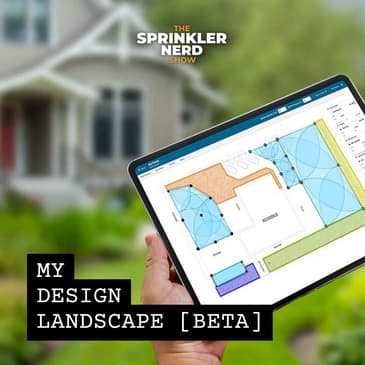
In this episode of The Sprinkler Nerd Show, Andy Humphrey is joined by Scott Allison from Hunter Industries to talk about My Design Landscape Beta, Hunter's new contractor-focused design platform for irrigation and landscape professionals.
Scott shares how Hunter has been building digital tools for contractors for years, from runtime calculators and site recommendation tools to lighting design software. Now, with My Design Landscape, Hunter is bringing that experience into irrigation design with a tool built to help contractors create better layouts, proposals, hydraulic plans, as-builts, and customer-facing presentations.
This conversation is about more than software. It is about helping contractors communicate value.
For many irrigation contractors, the biggest challenge is not just designing the system. It is helping the customer understand why proper head-to-head coverage matters, why one system costs more than another, and why professional design can protect water, landscapes, and long-term performance.
In this episode, we talk about:
- Why irrigation design is becoming a stronger sales and communication tool.
- How My Design Landscape can help contractors create plans faster.
- The value of visual design when explaining coverage, zones, valves, controllers, and drip irrigation.
- How contractors may use as-built drawings as an added service.
- Why beta users have a chance to help shape the future of the software.
- How better visuals can help justify price, professionalism, and system quality.
- Why technology may help level the playing field for everyday contractors.
Scott also walks through the beta version of My Design Landscape, including image upload, scale setting, hydrozones, sprinkler placement, drip layout, controllers, valves, sensors, project summaries, bill of materials, and PDF exports.
If you are an irrigation contractor, landscape professional, designer, distributor, or anyone interested in where irrigation design software is headed, this episode is worth watching.
Learn more about My Design Landscape from Hunter Industries: https://www.hunterirrigation.com/my-design-landscape
Subscribe to The Sprinkler Nerd Show for more conversations about irrigation, water, technology, contractors, and the future of the green industry.
[00:00:00] What we're trying to do is create a speed to design process where we can cut it down to 20 minutes or less. You can put just as much information and detail into this as you need or just as little. So we don't have you walk through every step in order. You can quickly just place products over your landscape, like identifying where the valve box is or where the controller is.
[00:00:25] And if all you're doing is maintaining a system or doing a spring startup and you want to record where things are at, you can absolutely start your design and fill in the pieces later just by creating an ASBIL.
[00:00:42] If you are an irrigation professional, old or new, who designs, installs, or maintains high-end residential, commercial, or municipal properties, and you want to use technology to improve your business, to get a leg up on your competition, even if you're an old school irrigator from the days of hydraulic systems, this show is for you.
[00:01:05] Today I'm joined by Scott Allison from Hunter Industries. Scott is the Director of Consumer Software at Hunter and has spent more than a decade helping create tools and resources for contractors, irrigators, and landscape professionals. At the recent Hunter contractor training event in Grand Rapids, Scott shared something that really caught my attention. A new contractor-focused platform called My Design Landscape.
[00:01:32] It's designed to help contractors create irrigation layouts, proposals, hydraulic plans, and ultimately help their customers better understand what they are buying. Today, we're going to talk about where irrigation design might be headed, how technology is changing the contractor experience,
[00:01:54] and why the future may be less about putting flags in the ground and more about drawing plans and helping people tell the water story. So Scott, for those who may not know you, tell us a little bit about your background and how you ended up at Hunter Industries. Thanks for having me on, Andy. Just want to start there. And yeah, you introduced it well, My Design Landscape.
[00:02:22] Something I'm very excited to talk about today. My experience at Hunter and in the green industry really began 14 years ago when I applied to an open developer position at Hunter. Since then, I've been traveling the country, learning more about the ins and outs of landscaping and the challenges that exist out there today.
[00:02:47] And Hunter's always instilled in me a value of partnering with the professional and developing tools and providing resources to help improve their daily business processes. We're really invested in helping people be successful out there in the field. And My Design Landscape is the latest innovation that we've applied to that strategy.
[00:03:14] Awesome. And I can't wait to learn more about My Design. And maybe before we do, you said you've been a hunter for 14 years. So I would like to ask what changes you may have seen in the way that contractors design, sell, communicate the irrigation projects, if you will. Technology is the biggest driver, biggest evolution, I would say.
[00:03:39] When I started looking at our web analytics, it was mostly desktop computers. And technology wasn't as prevalent as it is today in the green industry. Since then, the modus has shifted that mobile devices have taken over. And I would say a younger generation has come into the industry that are more technically savvy and expect better technology.
[00:04:09] I mean, even with the introduction of Wi-Fi controllers and smart homes in that last decade and a half has really become prevalent. And a lot of contractors today are Wi-Fi network diagnosticians. They just are. It's trying to figure out why Wi-Fi signals are low or how to improve connection of the controller. So true. I think these guys never realized they would be home network technicians. Yeah. So they've had to learn quick.
[00:04:37] And the customer expects more as well. They expect better visuals. They expect a technology experience with their contractor. So smart homes have grown in popularity and it continues to grow. So this is a tool that helps sort of bridge that technology gap. And from what I understand, this is not yours or Hunter's first design tool.
[00:05:02] There were some other design tools and there are some other design tools that existed before this. Could you kind of take us through, like from the beginning, what was the first software and how did it get to my design landscape? Yeah. When I started, the first thing that I was a part of was called our Hunter's Runtime Calculator. And it allows you to enter in information about each zone, build out a schedule. It'll break it down into different programs and give you watering start times and durations.
[00:05:31] And we had a place for the contractor's logo. So you could brand these door cards and provide it to your customer. We evolved that with specifier level information, with watering usage reports and daily watering budgets. And from there, we moved into a tool called SiteRec. This allowed you to create a checklist. It's really focused around spring startups and retrofits.
[00:05:55] You could add your company branding, tell a story about your business and introduce the services that you offer. From there, we built MyDesignLighting. And this tool allowed you to take a picture of the landscape, place products with landscape lighting over top of it, and then dim the lights and turn on each fixture, controlling independently the intensity and direction of lights to show your customer the design that you were planning on.
[00:06:24] And that laid the groundwork for an irrigation-focused design tool that would create a proposal to help you go to the market faster. That's so good, because I think it's important for listeners to know that this is not your or Hunter's first stab at a design software. You've already learned a whole bunch of things earlier, and perhaps that has helped you build MyDesignLandscape, which we'll get to in a minute.
[00:06:50] I have a question for you, mostly about the why. What is there a particular problem that you were looking to solve with this software? This is not the first design software available. There are lots of really great solutions out there today that have been helping businesses complete their projects. And we're not trying to invade that space.
[00:07:17] What we identified was that there's a bit of a gap where the project is simple enough or straightforward enough, and the software then becomes too cumbersome or too time-consuming for that project. And when you don't need a stamped plan and architectural sign-off, those steps, the benefits of doing a complete design are lost.
[00:07:43] And we wanted to level the playing field to bring the benefits back to those that could really find that useful in their day-to-day. So there's those smaller projects, residential spaces, small commercial, that don't see a lot of design work being done. And so we want to help the world save water and provide a better service to their customers
[00:08:10] by creating an easy-to-use design tool that cuts out some of the extra complexities that's easy to use and helps contractors realize those benefits. I'm glad that you said that because I don't know this to be true, but I feel like maybe it's the 80-20 rule, meaning 20% of projects need, as you mentioned, an architecturally approved, stamped, et cetera design. But maybe 80% doesn't.
[00:08:40] So it might be that a tool like this is actually a fit for 80% of the market, and your higher-end, more technical software that exists today is better suited for the 20%. And I don't know that to be true. It just was a thought that came across my mind as you were speaking there. Yeah, I know that it's easy to walk around and plant flags. And when you have more or less cookie-cutter homes, that works. You'll achieve the result you need. Plants will thrive, and you can go on to the next job.
[00:09:10] However, the customer, if they need more information or are asking for more information or would be willing to pay for an as-built as part of their leave-behind, that would be an incredible value that these contractors can add to their business. So there's more to it than just planning out irrigation. There's providing a better value, a higher value that you can charge for, and making sure that you're optimizing the system through visuals that identify
[00:09:37] where you could have dry spots, where you're overwatering, and finding the best product for the landscape. I personally have a bit of a soft spot for irrigation design because it's actually how I got started in irrigation. I was trained as a landscape architect, and then literally my first day on my first job, a metal gentleman named Paul Bassett. He was actually on many previous episodes, but he was the first person that sort of, what's the right word,
[00:10:06] planted a seed about irrigation just by coming to me with a hand-drawn sketch from a property, and then I would draw it up in CAD. And I know firsthand how tedious the process can be, but I also know more than anything the value when you are sitting with your client, and you have this plan, this drawing to talk about. It helps communicate.
[00:10:32] So in many ways, I feel like the irrigation plan could be, if it's not already, like the best communication tool for a contractor to communicate with their client so they know what they're going to get and not get, as well as be able to maybe, if there's multiple contractors bidding on a job, ask contractor B and C, well, are you doing this? Are you doing that? So that they can understand the price and understand the value,
[00:11:00] and that contractor can position themselves in a really professional way. So roundabout way, do you see this design tool also as a communication tool? Yeah, you're so right, Andy. This is, when you have a design completed, you unlock all those benefits and the increased efficiencies of communication with your customer. They can see what you're talking about on paper, but to get to that, right, there is a lot of tedious work today.
[00:11:26] And so there's a lot of roadblocks to unlock that better customer value. Um, I went through several classes focused on, um, earning a CID with the Irrigation Association, certified irrigation designer. Uh, took both exams, definitely very difficult, um, lots of studying. Um, it opened my eyes to so many aspects of irrigation that even at, I think I was at maybe 11 years at Hunter at that point. Um, 11 years in the green industry.
[00:11:56] I thought I knew a lot because Hunter's manufacturers products for just about every system component, but there's a lot more that are, that professionals are doing out there that I didn't know about. So it's so crazy. Yeah. I mean, the contractors need a lot more credit. I'm giving you guys who are listening tons of credit because I, it's hard to name another industry in, in anything, electrical, plumbing, HVAC,
[00:12:22] you know, decks, roofs, you name it that were, that have the number of complexities that go into an irrigation system in terms of hydraulics, electric plant. Like it's, it's freaking complicated. It is. And it's hard for contractors to explain that to their homeowner who thinks they could just go out and do it themselves. Why are you charging me this much? I could literally do this in a weekend. And the contractor knows, no, you can't. I don't know why you're saying that you can, but it's hard to communicate that, that message sometimes. Yeah.
[00:12:51] If you want to choose the cheapest pipe on the shelf and go with half inch for your main line. Yeah. But you're going to be calling that professional to come out and fix your mess. And that can be very costly. So, you know, showing the value of a better service is really going to help people understand what they're paying for. And, you know, going through those classes and learning proper irrigation design. And I didn't realize how much math is involved. There is a lot. They quiz you on every equation in the book.
[00:13:21] And I used to joke with my math teachers that, you know, the very common, like, well, when am I going to need to know algebra in my life? All I need to know is how much to tip when I play pizza. And what we're trying to do is do all the math for you in this tool so that we can make it as easy as possible. Yeah, that's a good point. And I think if a contractor, let's say someone just does cookie builder homes. There's a thousand homes in this neighborhood and they're all going to be, let's just say,
[00:13:51] four zones. It's quite possible that it is rinse and repeat. These guys just know I'm going to put this number of heads on a zone. I'm going to do it this way over and over again. And they might be thinking, I don't need to know all this stuff because I just do it the same way every time. And they're not wrong. That is true. Until someone asks them to do a system that is bigger, is different, that falls outside the norm.
[00:14:15] If they don't know some of the foundational design principles, then you can't just rinse and repeat again. You have to design it one way or another. And so I do believe that there are some contractors, if not many, that just say, I put three heads in every zone. This is what I use. This is how I do it. And that works until it doesn't work. Right. Yeah. I've been on a job site where we had everything planned out.
[00:14:42] We even had a design and we were, I think that we were just under by like five PSI on one zone and with flow by and, and, uh, pressure regulated heads requiring just a little bit extra. I think it was up to 50 or 55 PSI that we needed. We just had like one too many heads on that zone. Things wouldn't pop up. And we sat there scratching our heads.
[00:15:08] Somebody then had the idea to place their foot on the sprinkler head to prevent one from popping up and the rest popped up. So we quickly had to, uh, thankfully there was an extra valve on the manifold. Like we knew, uh, or somebody didn't put pipe it together correctly, whatever it was, but we were able to quickly, you know, resolve that seeing the math and some of the alerts behind, you know, those numbers, like we can surface that information to you so much
[00:15:34] sooner so that when you get out there, you're able to confidently start your installation. From your experience so far, correct me if I'm wrong, is the software still in beta? It is in beta. Yeah. So we have a limited number of features right now. Um, we're probably within a few weeks of today, at least of, of launching some of the next features and soon be out of beta. Yeah.
[00:15:59] So have you experienced any contractors who have signed up for beta and used it that were not using any design software previously? I asked because I'd like to understand what is the barrier to entry for somebody listening who might say, first of all, I don't do designs. I just walk around and flag it. And then I get my proposal. What's the barrier of entry like to get started with my design? Yeah. I've absolutely talked to customers that aren't currently doing design work today.
[00:16:27] They're planting flags or they're pacing things out or, uh, you know, it, it's, as I mentioned earlier, it takes time out of the day. It's when you do the numbers, you look at the number of projects you have, the number of leads and the crews that you're running per day. There doesn't, there isn't a lot of extra time to add an hour or two hours per job. And if you have one foreman that's splitting between several crews, you know, it can be really
[00:16:56] inefficient to, uh, create a design. And so what we're trying to do is create a speed to design process where we can cut it down to 20 minutes or less. Uh, you can put just as much information and detail into this as you need, or just as little. So we don't have you walk through every step in order. You can quickly just place products over your landscape, like identifying where the valve box is or where the controller is.
[00:17:24] And if all you're doing is maintaining a system or, uh, doing a spring startup and you want to record where things are at, you can absolutely start your design and fill in the pieces later just by creating an as-built. I'm so, you've got me so excited. I can't wait to check it out. I have one more question before you share your screen, then we, uh, go through the software. And I'm going to have to maybe pause for a second to remember my question. I had it there, this darn 47 years old thing. What the heck, Andy?
[00:17:54] I thought I was good. I thought I had all my nutrient supplements this morning to keep my brain firing. The question was, actually, it's not a question. I was going to make a offer statement that you could, um, maybe respond to. And that is, I believe an irrigation plan of any sort, you should be able to either close more sales. So let's say you close 10% more. If your normal close rate, I'm just going to make this up is five out of 10 proposals.
[00:18:24] Maybe now you can close six out of 10 with, with the software that might be one possible great outcome, or you can raise your price by some amount. Let's say it's 2%, 5%, whatever it is, then that would be the other outcome. And that should pay for your one hour more time. You said 20 minutes, but let's say, let's just say it takes somebody two hours. And if their rate is, um, $150 an hour, then they should be able to at least get $300 more
[00:18:52] for that job because they put in the design. So for those listening, this isn't just about having a record of where the sprinklers are. It's help. It should be to help you improve your business so you can close more projects and maybe charge more or get your value. Yeah. Well, I think you can absolutely charge that same $300 for two hours of work for an as-built that gives the customer a detailed schematic of where everything is on their property.
[00:19:21] It's something that they're asking for today. And if it only takes you 20 minutes or 30, if you're extra detailed, um, you know, I think it's something that adds a lot of value to each job. We just need to be adding that into our projects as a line item so that we can make sure that we're compensated correctly. And now you just planted another seed in my mind. Let's say a contractor has 500 accounts. And let's say they're in a part of the country that it shuts down for the winter.
[00:19:49] You could offer an as-built service to those 500 customers. And now you have winter work. You might have more than one winter's work if you're going to do 500 designs, but what is 500 designs worth? I mean, that could be 50 grand if you can do 500 designs or more. Absolutely. Sign up now. Spring startup special. Yeah, it's the middle of winter.
[00:20:16] And before you're able to get in the ground and check out all the components, go out there for 30 minutes, an hour or less and map everything out. That way your spring startup is already lined up. Yeah. Never, never had that thought. It's not just for new construction, sell more jobs, but it's a service you can offer to your existing clients. Yeah, absolutely. And you don't have to pay for marketing on that. You already have them. And I bet half would want it if the price matched their needs. Okay. Let's get to the fun stuff.
[00:20:45] Can you share your screen? And you can start us in any way that you would want to. I'll just let you drive and ask questions as we go along. Okay. Can you take us now to the PDF or what the presentation might look like? Yeah. So again, to get to the PDF, I click back up here in the top left. That's going to get me to my project summary. Also from my dashboard, I can just click on project here.
[00:21:15] And that also takes me to my project summary. So there's really like three steps. You have your dashboard, your project summary, and your design. And you can navigate any which way using this back book. So just click on download PDF. We're going to have options for you guys in the future. With this PDF, you'll be able to select how much detail you want to share. Like, I'm willing to take a good bet that you're not going to share your bill of materials and pricing with your customer.
[00:21:44] It's not what they're going to pay. It's not what the pricing that's going to be shown in here is also just list pricing to help you calculate your discount from your distributor. So you'll have options on what you want included. And you'll be able to enter a custom proposal as well. And I think there's pros and cons. I'm not always a fan of someone listing the exact models and quantities because that is also something that can be shared with contractor B and say, Hey, I just got this great design from this contractor.
[00:22:14] Here's a complete list. Can you quote against it? Right? So I'm hit or miss about providing that information to the client. Provide the design, but you don't have to put all of the parts and pieces. They can count it up if they want to count it up. That's right. Yeah. So you want to share that version of the PDF with your distributor and your installers. You don't want to share that with your clients.
[00:22:38] So you want to make it as flexible as possible to give you what you need without spending the extra time to create different versions manually. So from here, could you zoom in for us just to even though I realize the whole page isn't going to fit on the screen. Excellent. Yeah. So you'll have your branding up here. Your logo will be here as well. The name of your project, which we customized in that first step. And then just an overview image of the property. In the future here, you'll also have your custom proposal.
[00:23:06] You'll add some information if you want to include it about the project. Perfect. So there's more coming here while you see a lot of white space today. It'll be filled in nicely in the future. And then as we continue through, you'll see here's now my legend with the number of products. I have this drip area with HDL and that's all completely laid out. Again, you can choose to include this page or not in the future. But this is our full plan. That's great.
[00:23:36] I'll zoom out so you get a full picture of that. And then zoom in a little bit so you can see some detail. So exactly what we built. We have our hydro zones there as well. And then let's see a version without. So hydro zones only. Let's have that conversation. Mr. And Mrs. Homeowner, you're going to need different irrigation zones because this side is shady and this
[00:24:01] is not easy conversation about why there's an extra zone over the competing bid that you received. Continuing on to the next page, Mr. and Mrs. Homeowner, here's our system coverage. Here's why we have more heads. We're doing proper head to head coverage. We're going to make sure you have the most efficient system possible and that you're not wasting water. And then finally, we're just going to show where controller sensors and files are located.
[00:24:29] This is the most visible portion to the client, right? They're going to see where valves are located, potentially some valve boxes, the controller and sensor. Let's not overwhelm them with a complete design full coverage view. Let's show them exactly the stuff that they want to see. Okay. There is a conversation about having the controller in the garage or place somewhere else. You know, now's a great time to highlight that. And yeah, that's what we have today.
[00:24:58] Wow. Wow. I, uh, my gut tells me this is going to be widely adopted and probably quickly because of all the things you've mentioned with how easy it is and how visual it is and how helpful it will be for contractors to communicate what their objectives are with their client. Finally, in a way where they're not having to justify themselves.
[00:25:26] They still will have to justify themselves, but now it is going to be much more clear what they're doing and then they can talk about why they're doing it. Yeah, absolutely. Thank you for saying that, Andy. I think that this is going to give you the required ammunition that you need to confidently go into any conversation and provide a better value to, to the client. They're asking for more and we only have so much time in the day.
[00:25:53] So we're trying to give you more without asking for more time. And if we can make things more efficient, that's what we're interested in. We have a feedback button in here. We're asking for feedback. That's the reason behind why we're calling this a beta version. So we can get it in your hands earlier this season. I want to hear what's important to you, how we can provide you a better product here in my design landscape. And if somebody wants to sign up for it, where do they find a link or how do they get into
[00:26:23] this beta launch? Yeah, just visit hunterirrigation.com and you'll see my design up in the top right. Okay. And this might be a self-fulfilling question, but you have talked with lots of contractors all over the country. And if you had a magic wand that could solve a contractor's biggest frustration, what is the frustration and how might you solve it? Oh, wow.
[00:26:52] I wouldn't begin to pretend that I understand how much work contractors go through and how much effort they pour into their business. It's something that they care passionately about. It's the reputation and the livelihood of all of their crew members. So I don't know if I can really answer that well, but I think time and labor is a huge concern I hear about all the time.
[00:27:21] And if this helps solve one or two instances of those being pain points, then I'll say that I'm satisfied that we're doing a good job. So I honestly think, and I just was thinking this through as you were going through the design software, is that justifying the price and justifying their value is very difficult and historically has been because sometimes a homeowner just thinks they need to see some water flying
[00:27:49] and they want it at the lowest price possible. And so I think, and I don't know if that'd be totally true, but I think that one of the hardest things for a contractor is helping understand, helping their client understand the difference between, let's just say a $7,500 irrigation system and the competitor that says they can do the same thing for five grand. How do you know it's the same thing? And it's incredibly frustrating for a contractor to have to justify their professionalism and what they do on a daily basis.
[00:28:16] And I honestly think this will really help with that. Okay. Any final last words of wisdom, Scott, that you want to share with the world? No, I don't think so. Andy, thank you so much for having me on the show. Long time listener, first time caller. And it was great speaking with you today. I hope those that are listening find value in what you were able to learn today.
[00:28:45] We're absolutely open to your feedback. So that feedback button again is in that bottom right corner when you're in there. Let us know what you think. Yeah. Thank you so much, Scott. And just a reminder for you guys listening, there is something called first mover advantage and I'm a believer in it. And so I would say, you know, be an early adapter, get in on this beta program, use it to your advantage because not every contractor in the world is going to be doing it. And so oftentimes if you're the first person to get out ahead with something, there is an
[00:29:14] advantage to that for you and your business before everybody catches up. And this is the time to take advantage of that being a first mover. So make it happen. Sign up for the beta. Hit the feedback button and help Scott design the future of this software. So thank you so much, Scott, for joining me today. Thank you. Have a great one.