
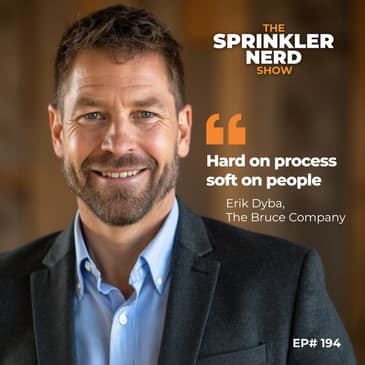
What does it actually take to turn around and grow an irrigation business?
In this episode, Andy sits down with Erik Dyba from The Bruce Company to talk about his journey through the industry. From learning irrigation in the mountains of Colorado to rebuilding and scaling a department at David J. Frank from a few hundred thousand dollars to over $1.5 million.
We get into what really moves the needle: building the right team, investing in training, creating systems that actually work, and leaning into partnerships with organizations like the Irrigation Association.
Erik also shares his perspective on water conservation, why education is one of the biggest opportunities in the industry right now, and how his experience in both irrigation and snow removal has shaped the way he leads.
This is a conversation about doing things the right way—and what happens when you commit to getting better over time.
[00:00:00] Bruce, I had the silver bullet answer, but I think a lot of it just comes in fundamental process. So if that process includes hiring, if it touches on training, if it touches on bidding, it's a process that's repeatable, that's scalable. Work on a process. I was heard and was taught hard on the process, soft on the people. So as previous discussion about the after actions, it was always a ground rule to, you know, we're talking about a situation and not a person.
[00:00:29] And I think it's the same thing when you're looking at business, you're not necessarily writing an SOP that Larry is going to send it over to Julie. You're going to say that, you know, the admin assistant is sending it to the schedule coordinator and create, you know, positions and systems that can be repeatable, that can be interchangeable. So that as you're going to lose good people, you're going to gain new people and having the flexibility to be able to adapt to that, I think is crucial.
[00:01:03] If you are an irrigation professional, old or new, who designs, installs or maintains high-end residential, commercial or municipal properties, and you want to use technology to improve your business, to get a leg up on your competition, even if you're an old school irrigator from the days of hydraulic systems, this show is for you. Today, I'm joined by Eric Diba from The Bruce Company in Madison, Wisconsin.
[00:01:32] Eric has one of those rare careers that bridges multiple worlds, irrigation, lighting, aquatics, snow removal, leadership, and training.
[00:01:42] He started his career with the David J. Frank, spent nearly 20 years in Colorado learning irrigation in the mountains, then returned to Wisconsin where he helped transform an irrigation department with a few hundred thousand dollars in revenue to more than 1.5 million through better systems, better people, and a deep commitment to training and excellence. Along the way, Eric has become passionate about water conservation, sustainability, and helping raise the bar for the industry.
[00:02:11] He serves with the Syma Foundation, works closely with the Irrigation Association, and has seen firsthand how education, great vendor partnerships, and the right team can completely change the direction of a business. So today, we're going to talk about growing people, building systems, water conservation lessons from Colorado and Wisconsin, and what it really takes to create an excellent irrigation business. Eric, welcome to the show.
[00:02:39] Thanks, Andy. Thanks for having me. I'm excited to talk with you today. Absolutely. So for anyone listening who may not know you yet, let's just start simple. Where are you from? What are you doing today with The Bruce Company? And how did you originally find your way into the irrigation industry? Sure. I grew up in Milwaukee, Wisconsin.
[00:03:00] I enjoyed golf and learned to work in the landscape industry by working at a country club to pay for golf and decided to stay with that. And did move out to Colorado and got to learn really a lot of interesting and industry-leading kind of technology on water conservation and different areas like that.
[00:03:25] And ended up coming back to Wisconsin before my father was getting ill and chose to come back to be with my family. So what was the other question? I'm sorry. Yeah, well, good choice, man. Family first. I'm a big believer in family first. So really just give you kudos for making that decision. Yeah, no, I appreciate it. That makes me curious, you know, Colorado, back to Wisconsin. What are some of the differences that you noticed between those two markets?
[00:03:53] Yeah, sure. So I think one of the biggest differences is just the amount of precipitation, right? So in Colorado, it's arid. Even in the mountains, like everything is, the irrigation really is not the supplement. And it's the primary water source. And that's kind of reversed out in Wisconsin here, where it's really just a supplement. I'd say in Wisconsin, more plants are stressed from overwatering than underwatering. Now, obviously, the symptoms look the same and it's hard to tell sometimes.
[00:04:21] So I think one of the big takeaways that I've had is really just putting the right plants in the right spot. And then also designing irrigation systems with hydro zones that complement the water needs of the groupings of plants that you have. I like what you said about the right plants in the right spots or the right places. I can definitely at least, you know, see how that's important. And it's a reminder that, yeah, you want to put a plant where plants can be happy and thrive.
[00:04:48] When you think about Colorado and conservation and sustainability and your passion for conservation and sustainability, was there any particular single project or multiple projects that kind of kicked you off in that direction? I guess it's, you know, I really started, I was down in Denver working and this was probably early 2000s. And the drought was, you know, and coming out of a drought and water surcharges were in,
[00:05:17] kind of full of factors starting to scale up. And, you know, the pricing, I was working with a nice mix of clients, but doing some high-end residential stuff, you know, a couple acre turf areas. And the amount of water, the cost of the water was just so astronomical that it started to really just lend for, you know, being innovative on how to reduce water.
[00:05:41] So that started in with wet checks and just getting a system that's functioning properly or as designed. If there were, you know, inherent design flaws, then looking at that in a separate light. But then we started in with different smart controllers and just the ability to manage the water output differently than it had been before. Really just to reduce cost at first. And then it's just apparent, I guess, in what I've experienced over time, how precious water is.
[00:06:10] And they're going to see it now out west. The snowpack is so limited or so low. There's going to be restrictions and all kinds of stuff. And I just think anything we can do to save water in the landscape area is really going to be beneficial for everybody. Could you, you mentioned wet check, and it makes me curious, were you either in Colorado or now, what does a wet check look like for you? Can you walk us through that?
[00:06:36] And I guess that's something that maybe some folks don't do as much or some clients. But in our world, most of our clients have multiple seasonal adjustments or what we call wet checks, where you would go through and you would operate the entire system zone by zone, and you would be looking for misaligned sprinklers, clogged nozzles, any kind of leaks, obviously. Anything that would basically increase the efficiency of the delivery of the water.
[00:07:06] Were there any particular patterns that you'd see over and over again? Yeah, I think all systems need it, and it's required. I guess I equate it to find a nice car and, you know, taking it in only when you hear a noise or something breaks, which is kind of the MO for irrigation, right? A lot of people just, there's a leak, they call their irrigation sprinkler guy, and he comes out and fixes it and then walks away. And so I think the pattern that I saw was as, depending on the age and I guess the level of the original install,
[00:07:36] there's just a standardization period that's needed. And through that standardization period, once you get it, once you get the system up and running and the fine tuning of it, it really requires less and less than every, you know, year after year. So it's not necessarily this thing that you have to do all, all like, the cost is manageable after the first initial one, if it's, especially if it's an older property that hasn't been neglected, I don't want to say neglected, but hasn't been necessarily up to those standards.
[00:08:04] So that was something that we found really beneficial. And then that's where the savings comes in for water and then just plant health, right? Because you have the right delivery of water. And sometimes those checks are just visual checks you're driving through. They say there's no substitution for, you know, a human person in the smart controller world, right? So you do need to go and you need to walk these sites. You need to look and see how it actually, how the plants are reacting. And even within hydro zones, you can have microclimates in different areas
[00:08:31] that would be affected differently that you might need to do something with. So that's two things that have been really kind of stand out for me. Yeah, that makes a lot of sense. And what I'm hearing is that there might be a tune in period. If you pick up a new client and it hasn't been serviced in a while, or maybe it hasn't been serviced to the level that it could be or should be, there's like this tune in period. And once you get it tuned up, then you're on the right track outside of any, you know, breaks or physical damage that could be caused. Does that sound right?
[00:09:00] Yeah, absolutely. And then it just, you know, I guess you're shifting from being reactive to proactive, right? And then that's where I think we've seen in both in my business at Dave Frank and then at the Bruce company now, that once you're in that mode, you really start to gain a lot of trust because you're not having brown spots, you're not having leaks, or you're catching them soon enough where you can make a difference, you know.
[00:09:25] And I guess then to couple that, we've always done, I've always been involved in landscape maintenance with the irrigation. So I've never done a property that's just standalone irrigation, or I guess I shouldn't say that. We did the state capital in Wisconsin that we didn't do the mowing on. Otherwise than that, it's that symbiotic relationship between grass cutting, shoot growth and water, right?
[00:09:51] And when you get that figured out, you can make a significant impact in efficiency. And again, just the overall visual aesthetics of the property, right? You're not mowing tires, you know, you're not leaving tire marks, you're not having wet clippings all the time. Too much water is usually what's, I would say, a less experienced company or, you know, certainly when I was less experienced in irrigation, I just put a lot of water on it, you know. And then I started learning over time. This is, you know, I'm just being real honest and I didn't want things to die.
[00:10:19] I did a new installation and, you know, I just, I thought that was the right way to do it. And slowly I learned that that can cause just as much, if not more damage than not enough waters. Yeah. And thanks for being honest, because I think pretty much everyone listening to this can probably relate because a little bit of fear or unknown, yeah, I'm not sure. I'll just add a little bit more time. We've all done it. Oh yeah. Especially, yeah, especially out in Colorado.
[00:10:47] I mean, there was, I remember a particular client we had that had a wedding lawn area. There was a large resort and they always had, you know, events out there and we were constantly and they wanted it perfect. And of course, so, you know, we're putting us, what we thought was the right amount of water. And then all of a sudden we get the call and it's like, all the women's high heels are sinking into the, to the ground. You know, it's like, oh no. So yeah, it is definitely a balance. And, and it is, I love smart controllers. I love the technology, but again, walk, going out and walking.
[00:11:16] And I think you see it a lot in, in, in the golf course superintendent world. I love golf and I spend a lot of time playing golf and trying, aspiring to get to the higher end courses. And when you look at places that are really well maintained, you always see everybody out there walking. They're just like walking and they're actually feeling just the squishiness or that kind of, that natural feel of what the landscape looks like and feels like. So I think that really is really important. So let's shift the conversation just a little bit from when you left Colorado, came back
[00:11:45] to Wisconsin and you were working with Dave Frank. I know from what you told me earlier that you came back to a division that was rather small and needed some changes and you're able to navigate that and really boost up the company. And I'd like to kind of learn what it was like when you came into that company. Yeah, sure. Um, so I came back and, you know, David J. Frank had a really strong irrigation company
[00:12:11] when they, back in the, I guess when I worked there the first time in the mid nineties, early nineties, mid nineties, they were, I think top 50 irrigators in the United States and they lost a key guy and it was just, you know, years of not really having the right person on the bus. And so I got there and I, there was, you know, some house cleaning to do and just new expectations that needed to be set. I think the, one of the biggest challenges we had there or they had there was they had
[00:12:36] an internal sales force of 18 or 20, 20 different team members and they lost confidence in the irrigation. And I think that was driving a lot of the, the old irrigation irritation kind of thing. Right. So, um, it was really driving the sales team to kind of avoid it at all costs. And so that was the very first hurdle, I guess, was to find and develop a team. But in that same stride, I guess, I was also trying to build the confidence of team members
[00:13:05] that were out there in the sales force customer facing to be able to win back the value and the credibility of the department. And I'll just interrupt you because that's a really interesting dilemma. Typically we think about building trust with our clients and customers, but it's not often that someone thinks about building trust internally within their own company and organization. Yeah. And I, I think, um, if you could keep it on the honesty piece, uh, it's a lot of people
[00:13:35] would probably agree that it's harder to sell something internally than it is externally. I feel that, um, rolling out a new process or especially in leadership, when you're trying to set up a new initiative, it, uh, it, it is, it is challenging sometimes to get the internal teams to do it. You know, I've, I learned, uh, from a young age that there's two types of customers. They're both equally important as the internal and externals. Um, you know, treat somebody that works that you work with in a day-to-day operate, you know,
[00:14:02] a transaction at work, the same as you would a high-end customer. And in that kind of theory of no one's really different. Everybody deserves great respect and quality, uh, uh, conversation and, and effort. It really does apply and, and it, and it works. Was there anything specific that you did either intentionally or accidentally that helped build that internal trust? Yeah, sure.
[00:14:27] So I think in the beginning, it was really just making myself available and offering and, and fulfilling the obligation of being the kind of technical expert that would go out and be a liaison during these sales calls. You know, we'd have a customer that, that was interested in the kind of, you know, I don't know, I don't want to say excuse, but it was like, well, I don't know irrigation. Well, Hey, you don't need to know irrigation. Cause one, you know, half the time you're talking to a customer that doesn't know irrigation either.
[00:14:55] So you can say things like, Hey, well, you know, we got the right stuff and the right staff and we'll get you in touch with the right guy. I've learned over years. So I'd go out on these calls and I learned over the years that, you know, it's great talking technical and talking about head to head coverage and all this to people, but really it's just relating in value and service and, and, and dependability, right? So it's that kind of process of going along with, and then really just getting to know people fundamentally, like off out of work, you know, just what makes them as a person.
[00:15:25] I think often you're, I certainly am task orientated. So I like to go, go, go. And it's like, and, and did some leadership training through, through that organization. And it was really interesting to find out that building relationships with people. And it seems so simple when you say it out loud, but it's, it's so hard to do in a seasonal business when, you know, the phone's ringing, well, three different phones are ringing and it's, it's, you don't even know which way to go. Right. And to take time to stop and say, Hey, how was your weekend? Was something I learned that that really goes a long way. Wow.
[00:15:56] Hey, it's Andy. A quick little aside here, my friends. If you're enjoying this episode, one of the best ways you can support the show. It's by helping it find the right people, subscribe, share it with a friend, or send it to one person in the industry who might find it useful. It's kind of like buying me a beer or a coffee without actually having to buy me anything. And one more thing. Thank you for being curious. That's really what keeps this whole thing going. All right, back to the episode.
[00:16:26] So you say you came back and the, and the division had lost trust internally. I think you said, or maybe I'm just assuming that it didn't quite have the technical expertise. It didn't have the irrigation team wasn't what you needed it to be. How did you set out and hiring the right people to join your team? Yeah. So, you know, we did a full promotional campaign of hiring and was, you know, and through the
[00:16:52] interviewing process, I was just fortunate to be able to get to select some candidates that, that developed into really good team members. And I think a lot of it is the respect and, and the engagement that we had and fostered as a team. So I didn't really solve problems necessarily. I gave facilitated the opportunity for, for others to learn and to make mistakes in a safe place. Cause I think that's important as well. And as that trust developed, we certainly spent a lot of time talked in the upper management
[00:17:21] to sending us to, or the owner sending us to the IA conferences. And that was, I think really the start of the real trajectory of, you know, moving in the right direction. So we came back from that conference and I think everybody pretty unanimously thought, wow, this is, there's one, there's a lot more to irrigation to, this is a pretty cool thing that we're doing. And, and there was just an amount of pride that started to build. And I think that was a big motivator for success for a lot of the guys.
[00:17:48] It was, I kind of had, you know, came back from Colorado, like, wow, they don't know irrigation here and, you know, just younger and whatever. Right. I've changed my mind a little bit on that, but developing or understanding the right way to do things. So as we talked about, you know, head to head coverage or just installing the right components or understanding why things work. I think that was another big thing, right? So a lot of people are talking the what and the how, and I really tried to investigate and to tell the why behind things.
[00:18:18] So as the team developed and understood the why behind things, I think it made a lot more sense and there was full engagement. Wow. That's great. I love how you mentioned making mistakes. I kind of have my own soft spot because that's, people say that's how you learn. It makes sense, but I just know personally that is literally how I learn. And I tend to be one, I might try and learn and make an adjustment, try, learn, make an adjustment. And everybody has a different threshold of making mistakes.
[00:18:43] And in some organizations, it's almost like you can't make a mistake, which is in some ways maybe poor leadership. I'm curious if you used making mistakes in the hiring process in terms of, were you looking for candidates that were okay making a mistake versus those that would want, that would never want to fail per se? Yeah. I think, and I guess just my history or luck or however it's been, we've ended up always
[00:19:11] hiring people that had some experience, but not towards the end of their career or to the point where they thought they knew it all. And I'm not, I just think that finding the right attitude in somebody and the willingness to learn and the willingness to say, like, tell me versus I know, you know, you get a lot of people, I know, I know, I know. And it's like, well, actually you don't know. And I think that the overall arching kind of, I'd say, how would you say this?
[00:19:39] I guess our theme with the team was that we would do after action reviews and you would have weekly standup meetings and that's where the technicians would share, you know, the wins and the losses, right? And that's, that's where a lot of the real learning happened was in those kind of organic, you know, discussions between, between them. And again, I was just facilitating and Hey, tell me, tell me what worked and what didn't and ask a few questions and just that organic kind of conversation. And as that team developed, they really became a team as far as calling each other.
[00:20:09] So I wouldn't really get calls until everybody, if it was going through the line, like they would, one tech would call another tech who would call somebody else to ask them or they'd call somebody and, you know, somebody they knew. And it was a real way of them trying to figure things out on their own. And I think that gave them a lot of pride and motivation. That sounds like a culture that you built. Every leader and then manager will have a different culture. And it sounds like you provided the platform.
[00:20:35] And as you said, using your own words, the safe space for that. So that's fantastic, man. Yeah, I appreciate that. When we talked earlier, you mentioned Hunter Industries and I'm curious how Hunter has played a role in your personal career path with clients and projects, as well as maybe something that they've done to help facilitate the growth of the businesses that you've been involved with. Yeah, Hunter Industries has been great.
[00:21:05] You know, I came from coming out from coming out West. It was a little more Rainbird prominent out in Colorado, or at least, you know, through the sources I was at. And I remember going to my first vendor down in Wisconsin and kind of mentioned, you know, hey, I'm from Colorado and Rainbird. And he said, well, out here, here, Hunter kind of owns this market and they got the best customer service. So I said, OK, I'll give it a shot. And I got to meet the sales rep, Mike Boettcher.
[00:21:34] And from that day forward, he gave me kind of that. I'll help you. We want we want you to grow. We want you to succeed. That's what we're here for. And they really have lived up to that. Even they were just out here at the Bruce Company last couple of weeks ago, putting on demonstration and field training on the FX luminaire lighting systems and did some hydroize training with the team a couple of two months ago. So they've been instrumental in always making themselves available.
[00:22:01] I've been out to San Marcos, which is their headquarters out in California, I think four times on different trips to learn different things, lighting camp, irrigation design camp, you know, just different ways to get better and to better understand their products. And I really had a really good success with with that partnership and truly a partnership where it's not just feeling like you're getting sold something or, you know, it's the overall long goal of succeeding.
[00:22:31] Yeah, I can totally, totally see that's good to have vendor partners, especially companies and products that that you trust and that you believe in. Or what does the role of smart controllers play in your business today? Yeah, so in I guess in both in both situations and now today at the Bruce Company, we're in a transformation of switching over a lot of legacy controllers into into smart controllers. We're using the hydroize. We do use some baseline on some university projects that that require it.
[00:22:58] But if we have a choice, we're using the hydroize or central systems through Hunter and it's going well. There's obviously always a little pushback from people with technology and, you know, security reasons and so forth. So it's been good to see that they've had other options with the cell kit and some other ways to not have hookup with the ethernet or with with the internal systems. So it just depends on where you're working and who and what the IT folks feel security wise is.
[00:23:28] But overall, I think it's been it's been great. We couple them with water meters and, you know, kind of the full the full experience and have really seen, you know, water savings. But then again, just just response and understanding what how the systems are performing when you're not there all the time. If you'd be willing to share, I think it's it's always interesting to know what percent of controllers that you guys might manage or or projects or clients have you converted over
[00:23:57] to we could say smart. Let's just say like remote remotely accessible controllers. Yeah. So I would say we started out at the Bruce company here. We were just a couple, a couple and we're probably about 20 percent now in a year. So we're ambitiously looking at probably doubling at this year every new install. And I think that's where we do almost 20 million in new installs in irrigation and landscaping.
[00:24:24] So so as we get to these projects, that's we have changed specs with all of our general contractor partners just to include smart controllers, water meters, sometimes moisture sensors, just depending on where where and what we're doing. But that's been a good trend of ours. We pick up quite a bit of a new business that way through we design it, we install it and then we maintain it. So that's just helping that switch over. But we have and a lot of it takes time. Right.
[00:24:51] So a lot of the commercial, we do almost all commercial work at the Bruce company. So it takes a couple of years to get into building a relationship with the new clients or sales and then understanding budgetary and capital expenditures and getting on the right sequence. So you can't a lot of times you can't just go in there and say, hey, I got this bright idea. I want to do this. Oh, OK, here's five grand. Let's go do that. So it takes that. I saw that in previous two. It takes 18 to 36 months to kind of get these things pushed through.
[00:25:20] And some of our larger properties, right, where there's five or 10 controllers. So we're saying, hey, this is the CapEx plan for the next five years or these are some standardizations that we need to do throughout your system, including this, this and this at these time periods for this cost so that they have an understanding of what the cost implications are and can plan for it. Has smart controllers changed the way you price service contracts? Maybe you charge more, maybe you charge less, maybe you charge different services. Has it changed at all?
[00:25:50] Yeah, not really. We haven't been in the monitoring phase enough to really get into that. Again, we're doing wet checks and seasonal adjustments a lot on our kind of Class A flagship properties. We could be out there every two weeks to every four weeks. And so we have project coordinators and different people that are qualified, say qualified parties that are on site at least once a week that are kind of monitoring things for us.
[00:26:16] So we haven't necessarily gotten into that end of it where we have somebody full time watching, you know, the alerts and responding to them. But in certainly in the industry, I know we had some last IA show we were down with Hunter and put on kind of a peer-to-peer conversation where there certainly are, that is the trend these days is to get into a monitoring system, you know, not primarily super expensive, but just some kind of cost to be able to, or some kind of price to be able to recover your
[00:26:46] costs in monitoring it and having somebody available to do that. Let's see. You mentioned that you manage irrigation. Let me make sure I get this all correct. Yeah. Irrigation division, lighting, aquatics. You can tell us what that might more, what that might mean and snow removal. What's it like to balance all of those different divisions? Yeah. So I'm fortunate I got a lot of good team members and good managers in place right now that I work with.
[00:27:12] So, you know, it's certainly a transition period from cold to warm and we're kind of in that right now. But I think what they all have, so just to answer your question about aquatics, aquatics is water features, ponds, any kind of fountains, waterless, pondless features. We do a variety of different kinds of installations and maintenance throughout central Wisconsin.
[00:27:38] And lighting obviously is kind of a very close scope or industry to the irrigation. Snow, they all have service is really what ties them all together. So I run a department called specialty services and it really is focused on the care and maintenance of things. If it's your irrigation system or your snow plowing contract or property during those times. So we just have call systems and different ways to be able to monitor the quality control
[00:28:07] and customer experiences. So when I'm going to ask you a question about snow, if it's a big dump, it doesn't matter what it is. It could be 12 inches, 24 inches. So let's say a big dump is coming. How do you decide where you're going to send your trucks first, second, third, et cetera? Sure. Yeah. So that's a good question. And we had two large snows this year. And actually, we were fortunate to win a spot on Storm Chasing, which is a docu-series on YouTube. So come check that out, Storm Chasing.
[00:28:36] And they were out filming us. So you get to kind of see it firsthand. But sometimes I'd like to think we have it really planned out. And sometimes it's just pure luck, I guess. But we do have routes. We do have service partners. We have subcontractors that work with us throughout the city and counties, eastern counties, to be able to provide the service. We do a lot of hospitals and larger institutions that require high priority, low tolerance sites. Most of the sites have dedicated equipment.
[00:29:05] Very few have what you'd be like in a route where you'd go to one to two to three. So that's really kind of been the key to our success. And then in that, we use a variety of different methods and tools in our toolbox from frying and pre-wetting things to brooms and different kinds of features that allow us to reduce chloride. That's kind of my other passion. And just saving water and putting less salt down are probably the two things I spend most of my time on.
[00:29:34] So who manages all the phone calls that come in that either say, you guys should have been here already? Or they say, you know, you're not supposed to come here unless it snows four inches and it only snowed one inch and you guys were here plowing. Who manages all that customer service? Yeah. So we have a team of people that do that. Then we're, you know, it's around the clock. So depending, we have a snow phone that our clients are allowed to call. It's really the same for irrigation and during the season.
[00:30:01] So it's kind of a 24 hour customer service, get a live person. They're dispatching or getting the notes to on-call operation people. And then there's a ticketing system that we use, proprietary software that our IT department builds, which is actually really good. And that's surprising because most proprietary software that I've been involved in three decades has been suboptimal. So kudos to them and they work hard doing it. But it's a ticketing system that just allows us to be able to write down the information,
[00:30:29] send it out to the appropriate parties, and then to follow through and kind of close the loop at the end, you know, all the way to an email to the client or phone call, depending on the status of the client, I guess like you'd say. It really is a full team effort in doing that because there's just so much. And it's such a relief because, and same thing with summer too, right? When you're out in the field and you're getting calls from clients, like that's the last thing you want to really kind of deal with.
[00:30:54] It's very hard to multitask and troubleshoot a difficult irrigation issue and try to take a customer service call when you're, you know, so separating those two out. And we're pretty good about, you know, having the clients. And we have good clients too that respect that boundary, right? And so they call through the office and they know that following the process that we set up is their best way to, for success, right? So that really has been kind of a key driver here at the Bruce company.
[00:31:23] And it's something that, you know, we spend a lot of time and focus on is getting that process down, making it and making it standard through all the departments, right? So if you call in, if you have a lighting kind, we have a lot of multiple scope clients that have multiple scope services with us. So one of the biggest goals that our CEO wanted was that same kind of service line. So you're not having multiple silos and personalities and different response times that it's uniformed and, you know, moving to the best customer experience we can provide. Awesome. Yeah.
[00:31:54] Might as well offer more services to the same client and make those as seamless as possible. And then you're not having to advertise market to new customers, right? You already have the customer, you've already acquired them. Maybe they landed with a cutting and fertilizer and lawn care. And now you're moving them into other aspects of your business until now you're full service, offering every scope you have to the client. Yeah. And it's funny you mentioned that, you know, currently both in our snow and in our, you know,
[00:32:23] specialty service division, the only way to, we don't take on new clients and haven't for many years. We only do if you've been, you know, an existing client or if you're looking to bring over a portfolio of services, including landscape maintenance and snow level year round, then you would, you know, we would offer bid packages. But the Bruce companies have remarkable. Really what brought me here was their kind of history and legacy. This is their fourth year.
[00:32:51] And, you know, we've eye office with a gentleman who's third, fourth generation. He's 47 years at the company. And that just, and there's so many that are in that 20 to 30 year mark, that tenure, that it's just, it's really amazing to see an organization these days have that kind of loyalty. And, and then second and third generation, right? Where we're, you know, talking about a crew, senior crew leader with 25 years and then his son's got eight years.
[00:33:17] And, you know, it's, it's just, it tells a story that, that really you don't have to say. It's just, it's just implied that, that it's a great place to work. So you're going to have to correct my pronunciation. Is it the Saima Foundation or SEMA? Yeah. Which one? How do I say it? Saima? It's Saima. The Snow Ice Management Association. Okay. So I know that you've been involved with the Saima Foundation and on the advisory board for Irrigation Association, I believe for Wisconsin. Is that correct? Yeah.
[00:33:46] For, yeah, for, for Saima, it's the, I'm on the board of directors for the foundation and for the Irrigation Association, I'm an advisory group for diversion, I'm sorry, diversity. Okay. What do you think is, what do you think the Irrigation Association needs to improve on in the next couple of years? And the reason I ask is because I find that sometimes, let's just use the word contractors, contractors are all in with the IA and they do everything.
[00:34:15] Always go to the IA show, take all the classes, and then others don't do anything. So it's kind of sometimes it's like this black or white, you're with the IA or you're not with the IA. And I'm just curious, since you have relationship with the local IA there and perhaps national, you know, what should they be working on the next few years? Yeah. I mean, I think they'll do a lot of good stuff right now. And I, what's on the radar is just, is really opening it up for, for, for more participants, right?
[00:34:41] Like increasing the pipeline, opening it up to people who don't speak English as their first language. You know, people that come from diverse backgrounds, that, that really is the key to one of the keys to success, I think, in, in, in most anything we do these days. And then I think another thing is, and currently doing that right now, there's a call for proposals for new education seminars or modules, you know, for, for next, for this year's show. And they have these smaller 25 minute talks that you can put in a proposal to, to, to be able to do.
[00:35:11] So they're really trying to be more diverse in the education. I think over the years, it's been the same, the same teachers, certainly since I've, I've been in the organization and, which isn't a bad thing because there's a lot of experience a lot of really great classes, but you're taking the, you know, CIC class, you're taking the CLIA class. There's these, the certain classes that you're taking. So in this, in this upcoming show here, the, in the education show, they're opening it up
[00:35:36] to, to some different classes that are going to be really, I think a, a fresh breath of, of, of air to, to kind of expose some other people. And, and just to speak on your comment about if you're in or not. Yeah, it is. It's amazing. It's the same thing. I think in a lot of industries, cause I see it in the snow, in the snow world too. And I'd also have to say that the most, in my opinion, the more successful and, and the companies that are blazing the trails or having the best customer experiences are the ones
[00:36:04] that are attending or are involved in the organizations, in the industry organizations. And I would say also too, that it is what you make it right. So if, if you have something that you want to share in any kind of industry, be a part of it's easy to, to say what's wrong and not be a part of the solution. So being a part of the solution is a great thing. And, and all of these organizations are always looking for people to volunteer or to share ideas in a solution orientated fashion.
[00:36:32] And that might lead into my next question, which is, I'm sure there's a lot of people listening that want to grow their contracting business. It might be irrigation. It might be landscaping. It might be service construction, whatever, whatever it is. My guess is that there's a lot of people that want to grow their business. And when you came back with the Dave Frank company, they were doing a couple hundred thousand and then you grew it to, you know, a million and a half or so. Where should somebody start in terms of growing their business?
[00:37:00] There's things like technology and training and hiring and business and software. Where should someone start? Yeah, it's a good question. First, I had the silver bullet answer, but I think a lot of it just comes in, in fundamental process. So if that process includes, you know, if it, if it touches on hiring, if it touches on training, if it just touches on bidding, it's pro it's a process that's repeatable, that's scalable work on a process. I was heard and was taught hard on the process, soft on the people.
[00:37:29] So as you know, in previous discussion about the after actions, it was always a ground rule to, you know, we're talking about a situation and not a person. And I think it's the same thing when you're, when you're looking at business startups and growth that you're not necessarily, you know, writing an SOP that Larry is going to send it over to Julie. You're going to say that, you know, the admin assistant is sending it to the schedule coordinator
[00:37:54] and create, you know, positions and, and, and systems that can be repeatable, that can be interchangeable. So that as you're, you're going to lose good people, you're going to gain new people and having the flexibility to be able to adapt to that, I think is, is crucial. Hard on process, soft on people. That's a really good writer downer. I made a note cause I just love that, that expression. That's a good one. Yeah. Do you remember where you heard that from or who taught you that?
[00:38:25] It was from, I believe it was from David J. Frank himself. Yeah. Yeah. Fantastic. It was the founder. Technology is obviously changing just crazy fast. What technologies do you think contractors should really be paying attention to and which technologies do you think might be more of like a distraction to them? Yeah, that's good. I don't know. I'm pretty favored in technology. I think there's a place for all of it.
[00:38:51] We certainly capitalize in GPS technology for fleet servicing, for routing efficiencies, for all kinds of different things. I think AI is certainly making its way into almost everything. Certainly you can learn how to prompt and understand it. I think it's like anything, right? You can either kind of just go with the flow and accept it, or you can really be curious and try to learn and try to elevate yourself. And I use AI quite a bit.
[00:39:21] We've brought it into training and SOP writing. Now we're not asking it to write the SOP for us. We're explaining and using, again, understanding how to prompt, right? So we've loaded in different stuff, started a project with history, and then go through and have live training seminars that are recorded and then transcripts brought back into AI and then kind of using that as the platform to be able to write it all down real neat. Most people could do that, but it would just take an absorbent amount of time. You can do this talk.
[00:39:51] We could punch in and 13 seconds, it'll tell us what the 12 great points were of the conversation. It's like, oh, wow. So I think that's really what we've been using the most of. And I see probably the biggest growth. And I think the AI in drones and I think in agriculture and just in a lot of different applications, you're going to see different things that are going to really be applicable or efficient in use or take things to the next level.
[00:40:18] So it's going to be a kind of exciting time over the next decade here to see how things change. And you started by saying GPS. I would love to know what that means inside your company and actually, how do you use it? What do you do with a vehicle that has GPS on it and how does that help you? Yeah. So we use it in several different fashions. One is, well, one is the obvious, right? Where's my equipment right now? Which is good to know.
[00:40:46] We have a pretty high trust factor here and really good culture. So we're not necessarily looking to see where you go and what you're doing more as looking for equipment. For example, things are, you know, we have 40 some skid loaders. So all of a sudden we're like, hey, where's you can find it? And then there's the telematics, right? Where you're looking at driver scores, you're looking at a whole different gamut of safety. So you're looking at the driver scores would include speeding, obviously fast break, hard cornering. Idle time is another big one.
[00:41:15] So you can look at a fleet of 150 vehicles and say, wow, we had, you know, 3000 minutes of idling last month or week or whatever that is. And it gives you ability to set goals and to manage to them, right? So if you're not managing something, or I'm sorry, if you're not measuring something, you can't manage it, right? So the driver score thing has been a really good way to kind of quantify what our safety looks like in the vehicles. And it was usually one of our big liabilities or exposures is going to be the vehicles with the
[00:41:44] size and number and amount of time it's spent on the road and throughout different applications. That's, I think, probably the point. And I, just thinking through that, definitely a way to like manage the business better, differently, efficiently. And those might be considered like internal benefits, right? Benefits to you and the company. What, if any, benefits does GPS offer like externally to your customers? Do you show them where the driver is?
[00:42:13] Do you let them know the driver will be there in approximately 30 minutes? Is there anything external with GPS? Yeah. So yeah, we do that. I mean, so in that call center, you know, especially in, I guess in all of those worlds, in the service worlds, snow and irrigation, you know, they're calling, they're saying, hey, you know, we haven't seen our tech and, you know, he's 10 minutes late or whatever. We give time. So it's, it's people have expectations maybe that are, that are more challenging to manage than others.
[00:42:39] So, you know, in eight to 11 arrival time at 8.07, somebody might call and say, hey, I haven't seen your tech. We still have three hours, but yeah, he's down the street, you know, so the ability to be able to look at that. And then GPS, I guess, in an external fashion, certainly for the ability to prove that we were somewhere. So as much as everybody doesn't, or, you know, tries their hardest not to be a part of them, there are litigations that are involved in snow and ice management.
[00:43:06] And through that litigation process and depositions and discovery, it's pretty awesome to be able to say, hey, these were the seven pieces of equipment. These are, they're red crumb trails of, you know, we have technology through the GPS that's tracking the amount of materials we're putting down and where and how and temperature and road. I mean, so there's a lot that goes into that, that really just backs up into a full package of documentation. And I think that goes into irrigation too, right?
[00:43:34] We have a timekeeping system that's proprietary, but it's much like, I'm a big fan of hindsight and they have a system that's much like it. It's just their own version of it that was built before I was here. But, you know, you can take pictures, you can load them up. It's that whole kind of documentation and assessment portion of the business. I think the more information you can have of things like that, the better off it is for everybody. Kind of goes back to those systems and allowing people to interchange.
[00:44:01] So you don't have a technician that's, oh, well, Johnny, you know, Johnny did this property for the last six years. No one else can do it because he knows where all the half buried stuff is in the property. We go, we spend a great deal of time and effort, you know, discovering those, marking them down so that technician one through seven can go out there and have a fighting chance of being successful. So you dropped a nugget right there that I'm going to pick up and ask you another question. You mentioned that you are a fan of the hindsight software. Yeah.
[00:44:31] Do you guys use hindsight right now in the business? No, we do not. And it's unfortunate. And like I said, I'm a huge proponent and fan of it. Our system does work well. It's a proprietary system. It's, it's much, doesn't have the scheduling capabilities, but it has the emailing and, and, and kind of data site details and, and kind of site visit history logs. But hindsight has been a really, is a really good thing. I guess going back to the new, the new person or the person that wants to scale their business,
[00:45:01] picking a software and, and, you know, picking a software that's mainstream. I, my advice would be something that, you know, isn't too complicated. Like you don't have to make everything super. I think a lot of people, certainly me, right. In my business in Colorado, I felt I was terminally unique that no one else had a business like me and I had all these challenges, right. Turns out everybody has the same kind of challenges and simplicity is, is a really good thing. And I think those would be, you know, just kind of bouncing back to both of those comments.
[00:45:29] And a, and a software like hindsight is a, is a perfect platform to, to grow your business. So you could do it at, you know, an owner operator with, with, you know, a hundred thousand or $150,000 of revenue to a multi-division company that's doing $36 million. So I would use the David J. Frank and had really great success with it. Awesome. Let's see. Couple more questions. One, you've been doing this a long time. You've been doing it in different markets.
[00:45:56] Are there any either best practices or maybe another word would be non-negotiables that you would recommend to other contractors in terms of the way that you would service a system, design or install a system. And if your client, let's say, wanted a lower price, you wouldn't budge on doing, uh, to maintain the integrity of the system that you want to maintain or install.
[00:46:25] Yeah, that's a good question. I guess I, in my experiences, it's always been in a higher level. So I think we've had a niche in, you know, the companies and the markets that we've been working in. And I think quality has always been the number one driver. I think service dependability and value is all tied into the price, right? And the price is relative. You spend X on a system and you don't get the best quality. You don't have head to head coverage.
[00:46:52] You get into a drought scenario, you're playing contractor B now, you know, Y to be able to fix it. And, and through all of that and frustration and plant health, most of the time you would have been cheaper off or less expensive. Just, just going with the first contractor the first time. I think my biggest takeaways are designing any system, no matter where you are, what it does, you know, as far as what region you are, what the annual precipitation is that you design it head to head and that you design for worst case scenario.
[00:47:22] And then you use scheduling, uh, the correct way and you put down the amount of water that's needed throughout the season. So I think often, and I've seen it a lot in the Midwest where you'll get, you know, well, it doesn't rain that much. Just put one here and one there. And then, oh boy, then it starts to get a six week drought and you're standing in front of a customer and it's like, I've never had the experience because I've been fortunate to, you know, we just design systems through the IA standards, the best practice. And it was certainly a change when I got to the vendors here.
[00:47:51] They were like, well, why are you putting so many heads in? They never do this. You know, so yeah, like putting them in the corners and all the good things that you learn. I just think those are, are fundamentals that you use. Another big one for me is just always upsizing the main line, especially on smaller projects, just a little bit. Um, I think over time, a lot of the components leak a little bit, the wiper seals and so forth, or you can add something to a system or add another thing or whatever. Having that flexibility is crucial. And I guess. Yeah. Yeah. That's a main line.
[00:48:21] Cause it's easily overlooked and often forgotten and will be more costly upfront, but likely better in the long run to do it that way. And I, it seems like one of the common themes that I see is systems not designed for the peak six weeks and, or, or the peak six weeks that happens once, only once every five years where either the water source wasn't big enough, the main line's not big enough, and you simply
[00:48:48] cannot apply enough water across the entire site because it's hydraulically not possible. Right. Yeah. And I think that goes into a, to a cost analysis and it depends on the site and where you're at. Um, you know, you get into some of the new software land FX has, has some really great software out there where there, you can figure out, you know, your total amount of usage, everything to be able to understand what the sizing is.
[00:49:16] And then you just need to make a decision on the overall project budget. You know, what exactly to your point, right. Are you going to be able to, to truly do worst case in certainly in the Midwest, when you're dealing with smaller systems, a bumping something up from, you know, an inch, inch to an inch and a half or something like that. Sure. There's a cross to it, but I think if it's sold correctly and it's understood the value or explain the value that most people are pretty, pretty open to it. And, um, a lot of the customers we have here, we're putting in second systems.
[00:49:45] You know, they were 25 year, 30 year customers that, that have had a first system in that are looking for some kind of upgrade. And, and now we're getting into new renovations and things like that. We're just, we're just planning for the future. And it's just made me think it's a good reminder. Not every customer is looking for the lowest price. If perhaps not, not any customers looking for the lowest price. They're looking for the best value based on their own, you know, value propositions.
[00:50:11] And sometimes something like increasing the size of the mainline, whether you, it's absolutely necessary to do it, or you think it's a good recommendation might set your company apart. If you're bidding on a job with three or four other contractors and no one else is doing that and you have a good explanation, then you're showing some level of expertise, value and differentiation. Yeah. And I guess one other point I would say that is, is I learned the hard way again for, for
[00:50:38] the honesty piece is depending on where you're at and depending on how and widely used or common irrigation is, make sure you understand the true operating or the true pressure, the true static pressure of your water purveyor at the time that you're going to be irrigating. So it always looks good at 10 in the morning when the water restrictions are on and no one's using anything, but at, you know, four 30 in the morning or three o'clock in the morning when 60 to 90% of systems are running.
[00:51:05] That's a, that's something that I've seen a lot in, in just doing audits and different kinds of assessments through properties all over the country that it's like, oh wow. I'm an early riser. So you're coming out early in the morning, throw a pressure gauge on it and you're like, wow, you're 40%, 30% less water than you thought you had. So, um, game journey. Everything we've talked about, to me, that is one of the best things that you've said because I see it all the time and I see it now because I'm making some wireless, long
[00:51:34] range wireless pressure sensing devices that can track data over time. And it's rare to be able to see pressure over 24 hours, let alone over a couple days, over a week, over a month. And that really opened up my eyes because pressure doesn't, isn't stand still. It's different, you know, like you mentioned. And one of the thoughts I just had in my mind, because let's say you wanted to know the pressure at 4am, because that's when you're going to run the system, for instance, or 6am.
[00:51:59] Maybe you leave a pressure gauge with your client if, residentially speaking now, because no one's at a commercial building at 4am, but you could say, hey, at 630, when you wake up, I need you to put this pressure gauge on this hose bib and you should turn it on. And if you could please take a picture of it and send it to me. And then you know what it is and you have the metadata on that picture to say, yeah, they did it. It was 631am. 631am. Here's the pressure. All right, good. I got a pressure reading. Yeah. I mean, you can get it in a variety of ways. It just depends on where you're at.
[00:52:27] But yeah, I think understanding what you got to work with is crucial, right? It's just, it's certainly, I've seen it. I saw it a lot in Colorado and, you know, in certain areas around here, you'll see it too, where it's just high areas of, you know, properties that are irrigated and just have a different amount of water sources. And all the way to just asking when you're scheduling a controller at a small residential, like, hey, what time do you take showers? You know, that could be a pretty easy question to avoid a service call of, you know, my system
[00:52:56] every morning I come out and, you know, my shower doesn't work or whatever. I mean, that's probably the worst part, right, is the guy saying, I got the client saying that they had a really hot or really cold shower experience because the mixing valve isn't working correctly because you're, you know, using a portion of that. And it doesn't take much, you know, like five PSI difference can make or break the performance of a system or it could be the difference between there being, just picking up a number five sprinklers on the zone to be in four. Yeah.
[00:53:26] Right? Yeah. It doesn't take much. It doesn't take much. Yeah. All right. Well, my last question, if you, you know, knowing what you know now, if you could leave one piece of advice for irrigation professionals today or someone maybe just starting out their business, what might that be? I guess I would say, you know, do something that you love and find serenity or peace in what you do.
[00:53:52] For me, I guess I truly enjoy what I do every day and it very seldom feels like work even through treacherous snowstorms or, you know, the startup periods of irrigation out here. It really is a passion and it's something that, that I've, I've really grown to just absolutely love and it makes getting up and going to work. You know, it's fun. It's something that I enjoy doing. That's brilliant. The only way that you are going to last as long as you've lasted, if we want to use that word, is you got to love it.
[00:54:21] So that's great advice. So I guess what you're saying is if you're starting your business right now and you're not really liking this irrigation thing, you might want to think of something else. Yeah. Or go work for somebody else before you, you know, invest in buying your own system. Yeah. I just, we did a, you know, just to kind of wrap up here, we did a, I was fortunate to do an interview with the founder, Lee Bruce. And he said that if you do what you love, you'll never work a day in your life.
[00:54:46] And I thought that was a really great comment and something to hold true to certainly to what I want to do. Yeah. Fantastic. Well, thanks for sharing openly with me today, Eric. Thanks for being a leader in the irrigation industry and leaving a trail for those coming next. Yeah. Thank you very much, Andy. I appreciate it. Have a great day. Yeah. You too. Thanks.