
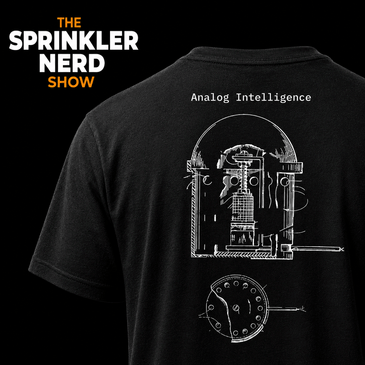
In this episode, Andy shares a few simple, real-world ways he used AI this week — from organizing messy data into CSV files, turning commercial property energy bills into a clean PDF, vibe-coding the SLIDE App with Codex in Visual Studio, designing gateway stickers, and creating irrigation patent t-shirt concepts for Sprinkler Supply Store.
But this episode is not about letting AI replace your voice, your experience, or your creativity. It is about using AI as a tool — more like a nail gun than a hammer — to move faster, stay curious, and turn ideas into action. Andy also shares why he still wants his writing, emails, podcast, and message to sound like the real Andy, imperfections and all.
[00:00:42] Just pretend because the more I use AI, the more I find myself thinking, almost thinking AI first, and that sounds cliche. I don't even like the way that sounds. I'm not thinking AI first because it's not really how can AI replace me. It's more like how can AI help me with this task? So if I have something I need to do, it's like, alright, is there a way that I could use AI to improve this process, make this more efficient?
[00:01:09] Because I think there's a difference between AI helping you with a task versus AI replacing you. So one example from this week was data cleanup. I had a big messy set of data that was on a website. So it was actually sensor data. So it has some sensor IDs and some values, and it's this big table. And I didn't have a way to export it. And sometimes in this case when I was copying it
[00:01:39] and trying to paste it, it just wasn't organized. So I copied all of the text. It was a couple thousand lines. And I asked ChatGPT to just help me organize it into these columns. And I wanted these columns to have specific header values. I pasted it in. It looked like a blob of text. A couple minutes later, there was the CSV just like I needed it. And could I have done that on my own? Absolutely.
[00:02:06] It would have taken me probably 30 minutes or an hour. And this took me five minutes. So there you go. I saved myself 30 minutes or an hour. It's nothing groundbreaking, but it's useful. Another example, I'm putting my commercial building up on the market for sale. And my agent asked me for some of utility bills like, you know, heating, gas, electric, trash, those sorts of things.
[00:02:32] So I took my energy bills and I uploaded a PDF that had, let me think about this. I uploaded, I downloaded every month. So 2025, every month's bill, January, February, March, April, et cetera, for all utilities, uploaded all those PDF data sets, and then asked ChatGBT to organize that into a professional
[00:03:00] presentation document that would summarize and explain the energy costs to own and operate the building. And in that particular example, just blew my mind. I mean, I'm going to get to an idea that I have for you guys as it relates to that and irrigation here at the end of this episode. But that was like just a huge time saver.
[00:03:24] I mean, 12 documents for each utility bill all uploaded, then organized. And it just nailed that. So that's just another awesome example of something that, yep, I could have done it manually. It probably would have taken me a few hours. But it did it for me in, I can't say two minutes because it did take a little while for it to run. But it was super, super fast.
[00:03:54] Another example. So I've been vibe coding. If you want to see the first app that I vibe coded again, it's slide.sprinklernerd.com. And it's a way to calculate the plant water demand and then the irrigation requirements based on the efficiency, based on historical ET rainfall and zip code. So first of all, highly recommend that you check out the app slide.sprinklernerd.com.
[00:04:20] But I've been using codecs inside of Visual Studio connected to the GitHub repo. And it's been pretty awesome to be using the chatGBT codecs in terminal inside Visual Studio to do things so quickly for coding, which allows me to sort of live and operate in my sweet spot, which is the creative design architectural side of things,
[00:04:47] but not get caught up in missing a comma somewhere in a code element. And maybe at some point, just having this thought out loud, maybe at some point, or if you're interested in learning how to vibe code, send me a text message. Maybe I can get a group of people together virtually just to kind of learn the basics of vibe coding. And I can just share with you what I've learned. And if you're interested to learn how vibe coding works, yeah, send me a text message.
[00:05:18] Just say, hey, this is John. Listen to the episode. Love to learn about vibe coding. Or just send me a text and say, hey, Andy, what's going on? Thanks for offering up your contact. We'd love to learn about vibe coding. Whatever it is, shoot me a text. We'd love to share. And again, it just, it helps me be willing to experiment, to try things out. And I think that's, that's maybe what I like the most about AI. Yeah, the results are fantastic.
[00:05:45] But I love having the thought, I wonder, I wonder if AI could do this for me. I wonder if I could use the tool like that. And so it just helps me in many ways sort of lower the friction between an idea in my head versus trying the idea. So I do think that that the AI is like the, it's the action. You know, we have way too many ideas in this world. Ideas are free. They're floating. Ideas almost have zero value. It's those who can take the idea and turn it into something or take action on it.
[00:06:14] That's where the real value is. And I think that AI is just really helping with that. All right. Third example I wanted to give to you is I needed a new sticker design. You could call it a label to put on specifically a Laura Wann gateway. I wanted the logo or wanted the sticker to have the harmony logo. And I wanted an empty box underneath the logo where I could apply a future gateway ID sticker to the device. Yep. I could have gone to Photoshop.
[00:06:44] I could have probably designed this up in 30 minutes or I could have used Canva. But instead I took the logo, gave it to Chad GBT, told it what I wanted. And it nailed it. I think on the third try, I only made a couple of tweaks. So again, I think AI really helped me get there faster. So when you start to compound these things, if you can save 30 minutes and you do that eight times a day, there's four hours saved. There's half a day.
[00:07:11] And I know for me, it's not that I'm working four hours less. It's it's that I just got four hours more work done. And in many ways, AI reminds me or a simple analogy would be, would you rather put build a house with nails and a hammer? Or would you rather use a nail gun? I mean, think how much faster it is to use a screw gun and a nail gun to build something instead of a hammer.
[00:07:41] Silly analogy, but for me, it helps make makes things clear. Oh, I wanted to tell you also, I used AI to remove backgrounds from images. Yes, there's, you know, background removers online and they're free and you can use them. But I'm using Chad GPT and I'm doing this with my daughter. We're making a new apparel section of Sprinkler Supply Store that's going to have, I would say, pretty nerdy irrigation T-shirts and such.
[00:08:10] And the first concept is we're taking patents, old irrigation patents. And you can find patents on Google patents or USPTO.gov. We're taking old irrigation patents and removing the background and then taking that device, that device patent and putting on the back of a shirt. And it's like, who would want to wear a T-shirt that has the original rain sensor patent drawing on it? Not many people, except for maybe you guys listening.
[00:08:37] Just because you know what it means and it means something to someone. And maybe somewhere will somebody somewhere will stop you and say, what is that gizmo on the back of your shirt? And now you can have the opportunity to have a great conversation. You could also tell someone why you wear it. Ah, I'm in the irrigation business. I do X, Y, and Z. So what's fun about this T-shirt is, yeah, we're taking the original rain sensor patent and then across the top of the back of the shirt, it's going to say analog intelligence.
[00:09:06] So aren't those like two contrasting terms, analog and intelligence. I just think that the rain sensor is just such a fun device to use as an explainer because, yeah, it's got some smarts, but it's a switch, right? It's an open and closed switch. There isn't anything digital in the actual sensor. So it's very analog. Anyway, hope you appreciate that one. Makes me laugh.
[00:09:34] Man, now I got to get back to my train of thought. Where am I in my train of thought? Oh, I know what I wanted to say. Of all the ways that I told you that I use AI, what you didn't hear me say was I use it to write my emails. I use it to send my text messages. I use it to build LinkedIn posts because I don't.
[00:09:54] And I'm just not a fan of AI potentially causing me to lose my voice. I feel like my original voice is what makes me, me. and I think your original voice is what makes you, you. And I think it's okay not to be perfect. Sometimes AI is making us think that if we just use the tool, this email that maybe didn't sound like
[00:10:24] it was written by someone with perfect grammar now will, but you know what? You might not have perfect grammar and that's okay because that's what makes you, you. It's okay not to be perfect. I think that is what being human is all about, living in the imperfections. And as I say that, actually, I might need to record an entire episode on that sometimes. I kind of like that concept, living in the imperfections. I will use AI to help organize my thoughts.
[00:10:52] I will use it to clean up my thoughts. I will use it to help me structure an idea, kind of like structuring this podcast episode. I can type a whole bunch of thoughts really fast, almost like I'm dumping my entire brain onto a page and then I can use AI to help me organize it. But I still want it to sound like me. I want to speak my own words with my own timing, with my own weird examples,
[00:11:20] my own weird sense of humor. I want to be me. I want to be real. I don't want AI to be me. I want you to know that this is the real Andy. So with that, let's get back to that intro song for a second. Just yesterday I had, and this actually happens quite a bit, but yesterday I had a super frustrating experience with my Amazon Alexa. And I cannot wait till Amazon Alexa
[00:11:50] has some sort of AI built into it because maybe they'll actually work more than 50% of the time. And you can say the same thing with Siri. Actually, I don't use Siri that much because I just don't think it works. And I know once Apple introduces their new hardware AI and AI is living on the edge and it's living on the device and you don't need the cloud, it's probably going to be the most amazing device we've ever seen. But until that time, I don't think Siri is worth a shit. So any case, last fall I stumbled across this band
[00:12:18] called Almost Monday. They were the warmup band for another band called the band Camino. Maybe you guys know the band Camino, but I've become a huge fan of this band, Almost Monday. It's just super catchy, peppy, not really happy music, but kind of. And I kind of like all their songs. So go check them out, Almost Monday. You heard them in the intro and the song was Can't Slow Down by Almost Monday, which is almost apropos for this episode and AI because AI allows us to do so much so fast sometimes.
[00:12:48] Like, I can't slow down, I got to keep going. And this particular podcast episode, which is strange, is probably easiest one that I've recorded because I feel like my words are just coming out like I can't slow down. So in any case, this whole can't slow down thing is really coming out in real time right now. So the Amazon Alexa would not play Almost Monday when I ask. I'll say, Alexa, play Almost Monday everywhere. And shit, I'm on my couch right now and she might go do it, but I hope not.
[00:13:18] Alexa, off. Alexa, off. Now you're getting to hear me in real time without edits. But she wouldn't play Almost Monday. Instead, it would play things like Cypress Hill. Why Cypress Hill? Well, I did just listen to Cypress Hill not too long ago, but it's not related. It doesn't sound anything like Almost Monday. I was so frustrated. Honestly, I wanted to pick up this echo, which I have an echo in every room.
[00:13:47] That way I can ask, I'm not going to say the name again because I don't want it to come on. I can ask it to play everywhere and then the music will come on on every single echo device. So if you haven't done that, that's killer. Probably the best upgrade I've done is just put a $30 echo in every room. And yeah, it's great. So after the third or fourth time, I wanted to throw it across the room. I actually wanted to like punch the wall. I'm like, how can it be 2026? How can AI do all these crazy things
[00:14:17] yet Alexa and Siri are still, still feel terrible? And maybe it's, maybe it's because they're really built on 2010 to 2015 technology. Maybe. I don't know. Anyway, it blows my mind. I can upload a pile of messy data and have it organized in seconds. I can build a web app. In minutes, vibe coding, I can create sticker layouts from patent drawings. I can organize energy bills. I can do all this stuff, but I can't reliably play the right band
[00:14:46] on my speakers. Craziness. So there you have it. A few ways I use AI in my daily life. It's nothing groundbreaking. It's nothing magical. Although sometimes it does feel like magic. And the more I use it, the more I think about daily tasks differently. Ask yourself, how can you use AI to help you? Not make everything perfect.
[00:15:15] Not replace your own thinking. Not replace your voice. But just help you be a little bit more efficient. Kind of like I said, with the nail gun versus the hammer. The hammer still works. You can build a whole house with a hammer. But would you prefer framing walls with a hammer or a nail gun? I think we know the answer to that. So I wanted to end with an idea that I had for you
[00:15:42] that I actually just conceptualized while I was taking notes for this episode. And I don't know if this would work. It's literally just an idea that I had. And I thought, I'm going to share it and maybe somebody will try it out. Or maybe somebody's already done it. And they can report back and tell me or tell us how it went. So here's the idea for you. The next time you're visiting to do a proposal, this could be a residential, commercial. It could be a proposal
[00:16:10] for cutting the grass, fertilizing. It doesn't matter what it is, a new deck, whatever. Next time you're going to propose an estimate, and it could be for service repairs as well. Or it could be after you've made a service repair. I want you to try this. As you walk around the site, as you make this service repair, I want you to take notes. And when I say take notes, I'm not saying write something down or type something in. Voice notes. I have found for myself,
[00:16:39] it's much easier to just talk to myself than it is to type. And you can do this much faster. And even while you are, let's say, repairing a valve manifold, you can set your phone down and put your AirPods in, whatever. And you can record what you are doing using audio. Okay? So take some audio notes as you walk the property. Describe everything you see when you're making that repair. Just talk through the problem. Mention, you know, what you're doing and just kind of put as much details as you can as if you were going to describe
[00:17:09] everything you did to your client. While you're doing that, take pictures. You don't have to take a lot of pictures. Just take pictures of the important parts of the property or the important parts of the repair that you made. Okay? When you're done, take your audio that you have and transcribe it into text. I'm not going to give you all the tools for that. Just Google it. Audio. Free audio transcription. And there's a million of them.
[00:17:39] Upload the transcript and the photos to whatever AI tool that you are using like ChatGPT and then ask it to create a professional PDF document for your customer. Okay? And if it's a proposal, you can tell it to format it in a way that you want to that would speak to, you know, a sales-like proposal. And if it's a service estimate, you can do the same or a service estimate or service invoice. You could do that as well and see what happens.
[00:18:09] I think you'd be surprised. I think you'd be surprised how easy it is not to necessarily have to go back to the office and spend a couple hours drafting up a proposal and da-da-da. But you just take notes in the field, take your pictures, transcribe it, and you might be able to email that PDF to your customer before you even back out of the driveway. So just give it a try. Maybe AI'll nail it on the first try. Maybe it doesn't. Maybe you need to upload your logo.
[00:18:39] Maybe you need to change some formatting. Maybe it takes some tweaks. But I think that either way, you're going to learn something useful. I think if you keep experimenting in this way and you keep using AI as a tool and you keep asking yourself questions about what can you do with it? How can you make it work for you? It will change the way you work. And again, I just believe it's not about the perfection. I don't have my expectation that AI is going to be perfect. My expectation is
[00:19:07] have no expectation. Try something with a little experiment, see what happens, and then make a little improvement. I don't think AI is about perfection. But I do think it helps us move faster and come up with new concepts faster and differently than we have ever been able to do in the past. So I think it's just it's as powerful perhaps as you want it to be.
[00:19:38] And that's it for today, my friends. As always, thank you for being the most curious audience in the green industry. Keep asking questions. Keep trying new experiments. Keep moving forward. I appreciate all of you. Happy sprinkling. We'll see you on the next episode.