
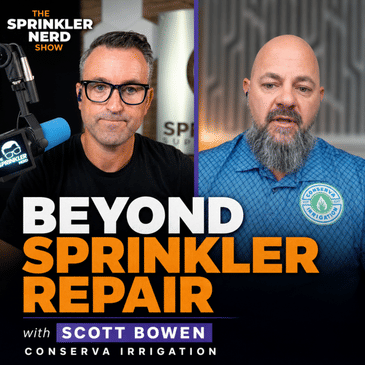
In this episode of The Sprinkler Nerd Show, Andy talks with Scott Bowen, Commercial Irrigation Manager for Conserva Irrigation, about what happens when irrigation becomes more than service calls and sprinkler repair.
Scott shares his 30-year journey through golf irrigation, sports turf, distribution, manufacturing, consulting, design, and commercial water management — and explains how that background shapes the way he sees irrigation today.
The conversation explores Conserva's move into commercial irrigation, water management, training, site assessments, flow sensing, smart controllers, high-efficiency components, and the growing need for irrigation professionals to think beyond repairs and toward long-term system performance.
Andy and Scott also dig into the future of the irrigation technician, the difference between fixing sprinklers and managing water, why soil health matters, how commercial clients think about water use, and why training, certifications, and networking are essential for contractors who want to become more professional and more valuable.
This episode is a great reminder that the future of irrigation is not just about putting water on the ground. It is about understanding the system, the soil, the technology, the client, and the bigger responsibility of managing water well.
[00:00:00] I mean, the sky's the limit. So I think people are going to start learning, leaning into the AI piece a lot more and it's going to change the game a little bit. But there are human factors. They still need bodies on the ground. So, you know, we were working on some stuff within Conserva that is AI based and some apps and some stuff like that. But you still need, you still need that human touch, which is great for irrigators. And that's why I tell these younger, the younger generation, because they're like, oh, AI is going to take all the jobs. I'm like, they can't, you know, you can't, I can't go out and fix the sprinkler. You know, they don't have
[00:00:29] eyes, you know, they can give you an idea of what the problem might be based off of Google searches within their, their platforms. I said, but they can't, they can't go out and actually do the work. I said, so you guys are still safe as far as that goes. So, and I think that the controller companies and the sprinkler heads and stuff like that is just going to continue getting better, you know, but I think it's more of what, how we push it out.
[00:00:56] If you are an irrigation professional, old or new, who designs, installs, or maintains high-end residential, commercial, or municipal properties, and you want to use technology to improve your business, to get a leg up on your competition, even if you're an old school irrigator from the days of hydraulic systems, this show is for you.
[00:01:20] Before we jump into today's episode, I realized something recently. There are a lot of new people listening. First of all, thank you, but I've never really reintroduced myself properly. And this can be a little awkward for me. I sometimes don't like to talk about myself, but I do think the context matters. So for those of you who don't know me, my name is Andy Humphrey, often referred to as the Sprinkler Nerd.
[00:01:44] My path into this industry started back in 2002, right out of college from Montana State University as a landscape architect for Chapel Valley Landscape Company in Woodbine, Maryland. Chapel Valley hired me, not because I was some great landscape architect, but because I knew AutoCAD, and I helped Chapel Valley build their first AutoCAD system.
[00:02:07] And at the time, I didn't have any master plan. I just had my first job, and I was curious, but I learned about irrigation, and I did have a vision. And that path wound me through working for an irrigation distributor in Maryland. This was during the Toro slash Icon days, and Icon was a technology company that Toro purchased out of Colorado that became the Sentinel, central control product line.
[00:02:37] And I worked for the distributor doing all their specification for Toro Sentinel sales, support, all that kind of stuff, working with contractors, municipalities, landscape architects, irrigation consultants. And at that time, I discovered, let's see, this was 2004, first discovered the Baseline product line, had a ton of success bringing Baseline over to the East Coast.
[00:03:00] And I had an opportunity to move to Michigan, worked for NetFM, covering 13 states as a regional sales manager, 140 distribution locations, before Baseline came knocking and said, hey, we need someone to help us develop sales and sales channels on the East Coast. So at that time, I helped Baseline build their first distribution channels, their first specification channels, working with contractors, training mostly on 2Wire, which I do think is interesting.
[00:03:28] Yet here we are 20, more than 20 years later, and we are still teaching the industry about 2Wire. Kind of crazy, but hey, that's what it was. So back in 2004, it was really curiosity that led me as well into the online business. And I started building some e-commerce companies to help support my young family. I eventually had the opportunity to pitch one of them, which was EcoMowers on Shark Tank.
[00:03:55] And then I took my e-commerce knowledge, partnered it with a large distributor on the East Coast, Atlantic Irrigation, to build sprinklersupplystore.com. And then sensors happened, and then LoRaWAN happened. And honestly, I'm still not entirely sure where all this is going. But maybe that's the point. Because in many ways, this podcast has become a record of that journey.
[00:04:20] Not me pretending to have all the answers, but learning in public and inviting you all along as we try to figure out where irrigation and technology in this industry is headed next. So whether you've been here since episode one, or this is your first episode, thanks for being here. Let's get into it. Welcome back to the Sprinkliners Show. Joining me today is Scott Bowen, the Commercial Irrigation Manager for Conserva Irrigation.
[00:04:47] Scott has been in the irrigation industry for 30 years. He started in landscape irrigation and golf back in 1994, and since then has worked in golf construction, golf maintenance, professional sports field maintenance and construction, distribution, manufacturing, irrigation consulting, and design. In 2016, Scott moved into working with HOAs and commercial water management, where he's been focused ever since.
[00:05:16] He is also a certified golf irrigation auditor, a certified irrigation technician, and holds a sports turf management certification from the Ohio State University. Today's conversation is about what happens when irrigation becomes more than service and repair calls. Perhaps it becomes a process, maybe a program, a way to save water, a way to train people, a way to build a more professional business.
[00:05:45] So with that, Scott, welcome to the Sprinkliners Show. Thank you. Appreciate being here. Absolutely. Absolutely. And we're going to get started. I want to ask you my new favorite question, and that is, what have you been nerding out on recently? So it's been a number of things, actually. But definitely trying to get this irrigation thing up and running for Conserva has been a major load on my brain.
[00:06:15] But I always, I have a black belt in Brazilian Jiu-Jitsu, so I'm always nerding out on watching videos and looking at new techniques and seeing what everybody else is doing and that kind of fun stuff. So that's typically, if I'm nerding out on something, I'm probably watching that. Killer. And it's something I don't know much about other than it's some type of a martial art. And is that a sport or hobby that you could get injured doing?
[00:06:45] Yeah, I mean, you could. So Brazilian Jiu-Jitsu is more of the ground side of fighting. There's a bunch of traditional martial arts like karate, kung fu, and stuff like that. But as far as Jiu-Jitsu goes, for me, I think it's the best martial art on the planet. You know, if you're looking at it from a street fight situation, everything ends up on the ground anyway, or most of the time. So that's a, you know, if you can fight on the ground, you're one step better than the person jumping on you.
[00:07:16] So how is that similar or different than, let's just say, wrestling, which in my mind, I picture two guys on the ground? It's very similar. I mean, the bases is, I mean, wrestling is very, I mean, like I said, it's very similar. The difference is, is wrestling, they pin you to be blunt and Jiu-Jitsu, we're breaking your arm. So yeah, you can get hurt. You can get hurt. I was thinking, you know, bruises, black eyes and stuff with karate and kung fu and whatnot.
[00:07:44] But hey, if you're breaking someone's arm, that's pretty serious. Yeah, there's a, we can, we can tear up some, some joints for sure. Well, thank you for, for sharing that. You're the first one to, to share that. So appreciate it. And I think what I'd like to do, I have not spoken with anyone from Conserva yet on the show. So before we kind of maybe get into your background and what you're doing with Conserva, could you just kind of share maybe that 10,000 foot view of what is Conserva? You know, why do you guys exist?
[00:08:14] Where do you exist? And just a little bit about the company. So Conserva is a, is a, a branch of the Empower Brand company. Empower Brand has JanPro janitorial services, which is the largest janitorial services in the country. We're also, we also have Superior Railroad Fence, who is the largest fence company in the United States as well. And then we have, you know, installation and roofing and we have Canopy Lawn.
[00:08:42] We have OLP, which is outdoor lighting perspective. So it's Christmas lights and landscape lighting and stuff like that. We have Archadec, which does like outdoor living spaces and stuff like that. So it's a big brand and Conserva is just a piece of that as well. Conserva as a whole has been known for residential irrigation installation and maintenance. I think, don't quote me on the number, but I'm, we were somewhere between 60 and 65 million last year in residential installs.
[00:09:09] Very light commercial is what I would call it. Almost Rescom where it's, it's, it's still a commercial property in a sense that it's an HOA, but it's still front yards. So that's what their, their big focus has been. In early, well, I should say late of 25, Russ Junt, who created Conserva, approached me to come take a look at the commercial side of things for them and helped them build a bigger, a bigger brand with, you know, adding in the commercial and sports and some other stuff that we're going to be digging into in the next few years.
[00:09:40] So that's how I got into the loop and they picked up my company and we moved on and it's, it's been great ever since. So still early, you know, we're, I just started officially with them in the beginning of February. So I've been floating around trying to figure out, you know, who knows what, where, why, and where we can, we can push this commercial initiative out quickly. But yeah, we're, we're jumping heavy into the commercial side of things. So it's going to be fun. And that's been, that's going to be my task for the next, you know, however long I'm here.
[00:10:09] And we're going to talk about that here because I'm curious as well. Hey, it's Andy. A quick little aside here, my friends. If you're enjoying this episode, one of the best ways you can support the show is by helping it find the right people. Subscribe, share it with a friend, or send it to one person in the industry who might find it useful. It's kind of like buying me a beer or a coffee without actually having to buy me anything. And one more thing. Thank you for being curious. That's really what keeps this whole thing going.
[00:10:39] All right, back to the episode. And there are listeners that are in the residential, you know, some that have thousands of residential clients. And that's what they focus on, probably similar to Conserva's base business. For those that are in that space, is there anything that you would, could share about Conserva that makes it unique, different? Maybe somebody wants to purchase a Conserva franchise, if I'm using the right words. Maybe could you just speak to that a little bit before we move to commercial?
[00:11:08] Yeah, Conserva's great. So, you know, basically what we do is we'll come in and we help you set up your company. The franchisor support is next to none. I mean, everything is pretty much handed to the potential buyer to be successful from the start. It's a low investment initially. I think it depends on the number, but I mean, it's probably somewhere around $150K, I think, to get going. So it's not a huge thing.
[00:11:38] You know, we're pushing heavy, you know, water management. We're pushing heavy efficiency on sprinklers and how to save water and push that to the market. It's a very big marketing brand for us to be able to push that out. So we're the number one company in the United States that does irrigation only as a franchise. So we're big across the board. Profits are pretty high. But, you know, one of the things that I was talking to our franchise development manager, his name is Matt Newman.
[00:12:06] He said that we're the number one franchise for women owners. So Franchise Review Magazine ranked conservative number one for female owners. So that's a pretty cool thing, too. I don't know why in my mind I would think they would buy a slushy franchise. I'm sorry if I'm stereotyping. It's not good of me, but that's what comes to mind, right? Something like that. Yeah, something a little simpler.
[00:12:30] But yeah, it's definitely, you know, we've got some pretty high-level female owners throughout the market. Yeah, and then I'm curious because, again, I don't know much about Conserva's model. If you own or you purchase a franchise, how are those areas divided up? Is it by zip code, city, state? Yeah, so typically they jump in through zip code, which is pretty interesting how it works out. It doesn't lock you in.
[00:12:59] Like if you buy a couple of zip codes, you can still branch out and hit other areas. The only time it gets tricky is if another franchise jumps into that area, then you can't go into their territory anymore. So we regulate it pretty well. I mean, I haven't been here long, but I haven't heard many issues of people crossing territories and causing anything like that. Everybody's pretty respectful. The franchise owners, they have a great group of people.
[00:13:24] They have committees that can, you know, help assess and do things for franchise owners that are new to help them get up to a higher standard. We have franchise business coaches that are, for lack of a better term, holding their hand through the whole process. And those business coaches stay with them, I mean, from zero dollars coming in to, you know, a couple million plus a year. So they just shuffle through different ones for different levels.
[00:13:53] But yeah, we, it's a great company to work with. I mean, they, everything that they do here is, is very, very dialed in, very strategic. And then, you know, success for our franchisees is, is number one for, for us, obviously. So they're the ones that carry our name, carry our brand and, you know, making them successful is, is definitely a benefit to the, the franchisor.
[00:14:16] Can, and I might be asking a question I'm not going to assume the answer to, but rather than assume, I was going to ask you, can somebody purchase additional areas? So let's say I'm just, well, let's say you start out and you're in Dallas, Texas, and you have however many zip codes come with that territory. Do you see franchise owners expanding and then purchasing larger and larger and larger areas? Yeah, definitely. So they can expand in their city if they want to, they can expand to other cities.
[00:14:44] I mean, we have, we have a couple of them that have ownership in different states, different cities. Our guy in Columbus has Cleveland, a couple of areas in Columbus. He's got one in Florida. He's got Virginia Beach. I think he just bought Charleston. So if you're aggressive and you want to get after it like Aaron is, then, then by all means, you know, they, they, they let it fly. You know, our goal is to open up as many as we can, obviously. And if we have franchise owners within the mix that, that want to grow in those regions, then, then we support it and let it happen.
[00:15:14] And then there, the other kicker is you can also do other brands as well. So we have, we have some guys in the, in the Virginia market that own different levels. So they own like a, the installation and the roofing piece as well. So you don't have to just stick to the irrigation side. You can branch out into outdoor lighting. You can branch out into the, you know, the canopy lawn piece if you wanted to, if you just like the landscape.
[00:15:38] If you want to do more building stuff, then you can jump into, you know, Koala and Bumble and get all those things moving as well. So there's really no limit to what you can do once you get in the door. Wow. And how might that work? I'm just thinking, let's just stay, stay with lighting. Cause that would be, you know, similar to what other companies who aren't part of Conserva would do. Maybe some irrigation and lighting versus roofing. How would that work in terms of marketing, branding, trucks, staff?
[00:16:07] Like can, can a Conserva franchise start installing lighting under outdoor lighting perspectives? Do they need different vehicles? How might that work if they wanted to? So about 100% sure on how that works. I've, I, I want to say, I mean, they're going to have different vehicles obviously because, you know, you don't want irrigation technicians going out and doing lighting. So it's a, it's a separate company. It's just under the same, you know, same umbrella.
[00:16:35] Um, I, I, they can probably co-brand if they wanted to, but I haven't seen that, that I've also really been looking for it either. So it's, but it's definitely, they're definitely separate companies, maybe in the same office, but they're definitely run completely different than, than each other. Yeah. And I didn't assume that you would know all these answers because you were tapped to build the, the commercial side of the business. And that's what we're going to talk about today.
[00:17:00] And I know that, you know, just reading a little bit about your history and all the different aspects of the irrigation industry that you've worked in from golf to distribution and manufacturing to design, you know, how has that variation in your background? How does that help you see the industry today? So I actually had this conversation yesterday. I'm at the, the BOMA International Trade Show right now, conference in Long Beach. And somebody asked the same question.
[00:17:29] For me, my, my background's a little unique because I started in the golf industry. There's not a whole lot of us that start in the golf and move back towards, you know, residential commercial type work. If you're in golf, you typically stay in golf is, is what it entails, you know, for most people. So on the water management side and the, it's sprinkler efficiency and, and all the stuff that I focus on, it's, it's, we were, we've been doing that. I mean, golf's been doing that since the fifties, you know, superintendents have been watching water fly and making sure that it's accurate.
[00:17:59] Always. So we just, we look at it a little bit different coming from that perspective and moving back into the, to the landscape side of the business and the residential and commercial side of the business. Where on the flip side, you'll have, typically you'll have like residential technicians, you know, getting better at their job. And then they're moving up through the commercial and then maybe into sports at some point and then, and then moving in that direction. So very rarely do you see somebody moving backwards.
[00:18:24] And we are already coming in with all of the concepts and all of the, the mindset of, of how to be efficient and how to irrigate properly. Not that they're not doing it properly now in the landscape industry, but I'm just saying we, we'd look at it different from the golf and professional sports side of the business. Because our turf is number one, you know, grass dies, then so does our career. So we're, we're, we're very dialed in when it comes to water conservation and how things work on the, on the sprinkler side of the business. So. Yeah.
[00:18:50] And so, you know, when they tap you to help develop, let's use that word, develop this, the commercial side of Conserva. Can you tell us what does that look like for you today and what might that division look like in the future?
[00:19:08] So when I first came in, we were looking heavy into installation and, you know, maintenance contracts, national contracts, you know, getting in with some of these bigger groups and being able to help them on their maintenance side of things, which is still the goal. My goal now is, is kind of shuffled a little bit. But the installation piece is, is a big deal.
[00:19:30] And having the bandwidth or subs in those areas to help, you know, get some of these bigger projects moving is going to be a work in progress, you know. So, so right now I'm kind of focused on more of the water management piece. I want them to understand the, you know, putting the controllers out, making sure that, that we're getting everything out on our properties that we need to have to be successful with saving our clients water. I mean, essentially the reoccurring revenue of a maintenance contract like that for irrigation is big. I mean, that's what we're looking for.
[00:20:00] That's what we push for. I've tried to move that into fruition with other companies and, and some's worked, some hasn't. So it just depends on, on the focus. And for me right now, that focus is, is water conservation. I mean, we're going to push out hard. We've got some great partners with manufacturing that we're going to be, we're going to be hooking up with and that we are hooking up with. And we've got some big national contracts that we're going to be pushing that thought process and the water management and the monitoring and all that stuff into the, into the market with them as well.
[00:20:30] And is this new division operating under the same organization of franchises or is it, you know, not, not to call Conserva a factory, but is it Conserva Direct or is it going to be franchise model as well? Yeah. So this will be, so what we're doing right now is, is Conserva Direct. We're going to train and push everything into the, into the franchises as we go. Some's going to be ready to go immediately. Some are going to need some training, but training is going to be a big, big thing for us. You know, knowledge is everything.
[00:20:59] And I don't think the industry trains enough, even though, you know, you see like on LinkedIn that there's companies out there that's throwing out trainings all the time and we're doing this with our people. I still don't think that's enough. I think it needs to be, there's a lot of things that have to happen hands-on.
[00:21:15] I feel like now, you know, the, the older guys, you know, that's been doing this for a while, you know, we started in the field with a shovel in our hands and we were in a ditch and some of these, some of these, the younger generation coming up now, they're, I won't say they're smarter, but they're more used to the technical and the technology side of things. So there's a gap that the, some of the newer technicians that are coming into the industry versus some of the older guys that are in the industry.
[00:21:41] And I've got to figure out how to fill that void to get them up to speed with what we're trying to do as well. Irrigation is awesome. I mean, I, you know, I went in, I wanted to be a golf course architect and I talked to a company out of Columbus, Ohio, where I'm from and it's Herds and Fry. And, and Mike Herds and said, Hey man, you got to have some field experience too. And then I, so I was like, all right, well, I'll just look for a golf company in Ohio. And I jumped in and then I never left, unfortunately.
[00:22:08] Well, you just took the next question I was going to ask you because you said something like us, the old guys, but you use the word we. And I was like, yeah, cause we, you know, we're both getting to be more of the older guys after you've been doing something for 20 years. And then I wanted to find out why irrigation in 1994, how, how, how'd you pick that? So you wanted to be a golf course architect. Yeah. I wanted to be a golf course architect. So I, I was, I got hurt playing baseball when I left college.
[00:22:36] And then I just jumped into the job that I had, which was a summer job at the Columbus airport in Columbus, Ohio. And with doing landscaping and irrigation there, I just liked it. And then when I was going to go back into school for landscape architecture, that's when I made a phone call over to Herds and Fry and, and started asking some questions about a career path.
[00:22:59] And, you know, they gave me a path and it was, you know, a degree in landscape architecture or civil engineering, and then a master's in one of the other. And then they wanted you to have like one to three years experience in the field. So I was like, well, I need to work. So I'm going to get the field experience now as I'm going to school part time. And, and that's what I did. So I jumped into the only company that was in Columbus, Ohio was Irrigation Systems, Inc. And I jumped in with those guys and never looked back.
[00:23:28] Well, it sounds like you've seen a thing or just a little bit, which is extremely important because that's how you learn. Like you're just saying, so these texts that are, that are coming out that you, that either don't exist, that you need to find and train or the ones that do, you need to get them exposed to as much hands-on field knowledge as possible. And I could not agree with that more.
[00:23:50] Sure. I think it would be helpful, even if it's just for me to understand, and maybe you could share or give an example of a type of client that Conserva, that might contact Conserva for your help, services, repair, install, whatever that looks like. And then we might be able to go through, here's the type of client, here's, and here's what we do when we show up and here's what we offer and how we offer it.
[00:24:15] So one of the main focuses I think right now for us is municipalities, school districts, and large, large school chains. One that we're working with now is National Heritage Academy. They have 90 plus locations, great company to work with. And those, those are what we're looking for. You know, I've seen too many situations where school districts don't, don't have the right people in the right places. And it's not that their employees are doing things wrong.
[00:24:44] They're just not built for what we're trying to do. You know, it's, they're just not, they're, they're janitorial services for the most part. And, you know, some of them like to get out and mow grass and have a little bit of fun that way. But as soon as you put a shovel in their hand, when it's, especially in Phoenix, when it's 115 degrees outside, they're like, yeah, I don't want to do this anymore. So we want to be able to get in and help schools. A lot of injuries happen. I mean, I tore my ACL my senior year of going to, going into my football season, going into my senior year. So it's, it, it's a hold to close place to me.
[00:25:14] You know, we looked at a field in, in the Phoenix market that was horrible. The skin was dropped off, like I would say a good eight inches from the, from the actual dirt to the outfield. And, you know, we looked at saying, hey, let's, let's get this together. Let's get this fixed, get the irrigation right. And they didn't have the money at that point. And then someone got hurt. So we want to be able to help in those situations.
[00:25:35] But I think schools are, are, are a very good spot for us just because we're, we're massive to the point where we have franchises everywhere. I think that's a client that we're looking pretty heavily into. And then we also want to get partnered with, with large HOA property management companies as well, because, you know, our, what we do and what we look for helps. You know, we're not looking to do any landscaping. So we want to partner with landscape companies.
[00:26:01] We want to be able to say, hey, you know, let us come in and monitor and help do the water management piece of things here. But if, you know, if the bouts are breaking or whatever, and there's some issues out here, then we'll pass that work back. You know, I mean, if they, if they want it. And, and the, the, the learning curve for me is, is, and for everyone realistically on the commercial side of things is the East coast is completely different from the West coast. You know, HOAs in the East coast are front yards and not a lot of green belts.
[00:26:29] There's some, there's some green belt areas in between the homes and stuff, but there, you don't see, like if you come to Phoenix, there's massive parks. I mean, there's, you know, 25 acres of turf in some of these HOAs. So it's just, it's just different. It's a different mindset. It's a different way of laying things out. It's a different way of management. So, but I mean, we're looking at anything and everything. There's nothing that we won't touch at this point. So you, you, you hand it, we'll, we'll go after it. With my background with golf and professional sports, it doesn't, we're not limited to anything.
[00:26:57] And then I have a pretty solid staff that I've had with me for years that we're going to be dragging in as well and, and helping out. So, you know, it, it doesn't, it doesn't give us a whole lot of limitations of what we can handle or go after on the, especially on the water management and the monitoring side of things.
[00:27:13] And what does a, let's say a relationship, a client relationship with Conserva look like in terms of, would you, would, would Conserva be interested in just going out and repairing one valve manifold? Or do you need to have this HOA or school district under management for all parks in order to do any service work? No, they'll, they'll do, you know, a lot of our franchises are, are, you know, fairly small, you could say as a, as a footprint.
[00:27:43] And that's, they're cut out perfect for the, the onesie twosies type of things. So like there, there's nothing that they won't, there's nothing that we won't take a look at. We just got one today actually from, from, from Husqvarna that we need to go take a look at troubleshooting, you know, a small valve at a house. So it's, it's not a big deal. You know, I mean, it's, they'll take whatever they can and then we just grow it from there.
[00:28:07] For me, the, the, this industry is big on relationships and expertise and, and, you know, knowing, knowing who to lean on when you, when you don't know the answers. It's a, it's a big place. And I, and I think that I wouldn't have any issues if I had a, had a problem with something, you know, calling a Chad Sutton with Sperberg or, you know, some of my other buddies, Andrew Chase with Davey.
[00:28:31] You know what I mean? So like the, the industry is so, I think tight at this level with irrigation that the camaraderie is, is everything. And it doesn't limit us to doing one valve or 300. So I think it's a, it's, we, we just, we take what we can at this point and then, and then grow from there. And let's, if you, if you are open to sharing, are there certain procedures that Conserva has that, again, are either unique or different or that you see working?
[00:29:01] In the field as it relates to your water management programs. And that could be making sure everything has a flow sensor, using one type of controller, doing a certain type of audit. Is, are there these sort of checklist procedural things that you guys are developing that helps you be successful at it? Yeah, we have a, we have a software that we created on the residential side that is, it's called SES.
[00:29:26] It's, it's a, it's pretty slick actually, but it basically lets us go on site and we can do a site assessment. Not necessarily an audit. That one's a fine word for me because if I'm thinking audit, I'm thinking throwing cans out and doing, you know, precip rates and efficiency testing. So, but the, the software that we're using for this is, it's pretty slick. You know, we go out, it'll build out whatever issues we have in the system or whatever we're seeing in the system and they can put a quote back together and then we can punch it out from there.
[00:29:55] We're very thorough on the, the site assessment piece. I mean, we go through these properties pretty, pretty heavily and it's anything from, you know, spaghetti plugs that are, that are, or the spaghettis that aren't plugged and there's no plants to wire splicing and how old the valve is and just stuff like that. We're looking at anything and everything that could make the system faulty. We do a lot of that for, for DMG and Lowe's right now on their properties.
[00:30:22] We're going through a lot of their stuff to try and get them up to speed and get them back into, you know, operational form. But as far as, as far as the, the audit piece of it, like I said, we, we stay back on that. Something we're going to, we're going to definitely charge for and take a deeper look at. But all of our technicians have volt meters and wire locators and everything that they would need to find a problem. They, if they have to go dig in their truck and get it. So they're pretty, they're equipped pretty well.
[00:30:51] We don't have, we don't have any, any problems with supporting them on trainings and stuff like that either. So we try and do, you know, a couple of big trainings a year and we're going to grow that piece as well. So it's a, it's, it's a, yeah, there, there's not a limit to what we can, we can push out and what they're, what these guys are going to look for. And are there, so the site assessment, we'll just call it that, not, not audit. Audit can mean a lot of things to a lot of people. I agree with that. And they don't have to be detailed audits like a catch can. You could have a, just a 10,000 foot audit.
[00:31:21] Yeah. Are there certain aspects of your assessment or procedures as it relates to water management that, that you guys are finding success with that you're going to, you know, either bring into the commercial or move from residential into the commercial and sports side? I would say, no, I'd say we're going to bring in, we're going to bring in stuff that we're finding on the, on the commercial side back into the residential.
[00:31:45] Just because we don't have a whole lot of trouble with it, but we've, I've been on sites that, that, you know, nozzling's messed up. People's capped heads, you know, so now the distribution's way off. That's the kind of problems we're looking for when we step on site to do these assessments.
[00:32:03] Because we're, you know, if we're not the ones installing it, then we have to figure out what somebody else did 10 years ago or five years ago, or some of them, what they did three weeks ago when they, when they had somebody come in and do a renovation on their yards or at their, at their HOA. So one of the biggest things I find is just nozzles, nozzles.
[00:32:22] Nobody ever puts the right, if they, if they pull the nozzles out of the box, that's the nozzle, whatever's in it is what goes out, you know, and it doesn't matter if it's a quarter or a half or a 360, it's the same 2.0 nozzle. You know, so that's one of the things that I'm pressing hard on them to start looking for, you know, figuring out what the pressure is. But definitely, definitely pushing flow into the situation is a major piece of what I push out.
[00:32:47] Now I've worked with other companies that, that just want to put the controllers up and just let's, let's, let's just let it fly this way. And, you know, it's hard for me to manage water and save you money if I can't see what the water is actually doing. So flow senses are big for us. That's a big deal for me and my team. And then, and I know that our franchise owners are pushing those things out too. So even on the residential side, we're, we're trying to get flow sensing in the mix as well. Yeah. I, yep. And it doesn't have to be there for finding breaks.
[00:33:15] It can literally just be there to know what you're using. I mean, really, that's, it's extremely valuable data. We've had some situations where that I was in, I won't mention names. I want to get sued. But basically we had some flow sensing that we installed to check water usage at a massive property in Arizona. And the water bills coming in were different than what we were showing going out.
[00:33:42] So we questioned it and then come to find out that there were some issues with the meters that nobody really knew about and they weren't checking them properly. And because we had flow sensing on, we caught that problem before it got way out of hand and cost everybody thousands and thousands of dollars or more. So I think flow sensing is a no brainer. I typically won't give you that option. I'm just going to build it into the price and say, Hey, this is what we got to do. And then this is what's going to happen.
[00:34:10] So master valves and flow sensors are pretty much a given for what, for what I bid. Yeah. Are there, maybe we could talk for a second about, are there different client expectations? Meaning on one division, you've got the homeowner, they're the client. And on this commercial division, you have your, maybe it's a sports turf manager. Maybe it's the school facilities manager. Maybe it's the HOA board.
[00:34:37] How are the client expectations different in the commercial and sports side than the residential side? Well, they're, I mean, they're going to be different in between the commercial and the sports side. So sports, those guys are pretty dialed in. They know what they're looking for. I don't want to say that they're, they're irrigation experts by any means, because some of them are, some of them are, some of them are heavy turf experts.
[00:35:01] There's some great ones in the Phoenix market, in the, in the MLB side of things that are super savvy in irrigation and in turf. So I think those guys are probably on their own little, little island. As far as commercial, I think it depends on the property. Some commercial property management companies and some commercial property managers are dialed in on the water side. I mean, it's, if it's an issue in their property, they're probably pretty dialed into what their problems are. But for me, it's still, it's an education piece. None of us really know the answers to everything.
[00:35:31] When it comes to water, I mean, even the water, even the providers are, you know, they don't know all the answers. People in Colorado are fighting over water right now and it's their water. One of my questions I was going to ask you is, do clients typically know how much water they're using? They, I would say the board would know and the property manager would know. The rest of the community probably has no clue unless they read the, you know, they read the, the paperwork that the HOA is sending out.
[00:36:00] But it's a big deal. I mean, if you, if you think about it in the, in the, in the sense of an HOA's largest budget number is their landscaping. And within that landscaping budget, the biggest number that they pay out is water. And everyone knows that in their situation. So water is always a, it's always a touchy subject and it's always a big deal.
[00:36:22] And our goal was just to get in and figure out what's the best answer for them and what they can afford to get them the savings that they need to move forward. You know, maybe they, they, they can't afford the, the Ferraris of irrigation controllers, but they can afford the Cadillac. You know what I mean? So I've never been a guy that will push anything that the property doesn't need. You know, I'll lead with it. But if, if it's not, if it's a money thing for them, then we'll get them a product that can work.
[00:36:50] That'll, that'll operate like they need it to for what they can afford for sure. And then I would, I would like to ask you in addition to, do they know how much water they're using? Let's just pick a number. Let's say this HOA used a million gallons. Do they know if that was exactly the right amount of water, meaning they nailed it? That's, that's what they should be using. Or maybe they should have only used a half a million or maybe they should be using 5 million. Do they know if that 1 million gallons is relevant to what they should be using?
[00:37:20] So the state gives them a, an allotment, an acre foot allotment. And when you say the state, which state, pick a state, which. So like, I'll just use Arizona because that's where I live. So I know, I know Arizona Department of Water Resources gives you an allotment for your site. So the state will track it, but the cities track it within, within their own cities as well. You can get fined. You can go to jail if you, if you blow that budget out of the water for too many, too many times in a year. So, or too many times in years, I guess I should say.
[00:37:49] So there's been some situations where people has been, been slapped on the hand by the law because they've overwatered and overwatered and overwatered. But so, yeah, I mean, they would, the state gives that. Now, whether that information gets to the, to the residents, I have no idea unless it's us pushing that information out. But the city will, it's public knowledge. So the city will give anyone any of that information. If you call and ask them, they'll tell you.
[00:38:13] And then let's just, you know, using this Arizona or Phoenix as an example, how do they come up with this number? And it's not relevant to this conversation about conservative, but I'm just curious because I don't know how they would, how do they come up with that allotment number? I would say that it's probably based off of some kind of calculation with evapotranspiration off of ET.
[00:38:32] So what that 10-year model looks like, what the, you know, versus, so what ET says versus what you have in square footage of turf, square footage of plant, you know, your density. It's just like everything else in irrigation. It's probably an algorithm or an algebraic equation that they figure it out with. But I would say the majority of it's based off of plant type and square footage is what they're looking at to get that calculation. And that's a big thing with using ET.
[00:39:02] I mean, we've, you know, golf and professional sports, we don't, we're aware of it. We know what it is, you know, what ET looks like for that day. But we're not going to, you know, ET is going to give you just enough water to keep your plants and your grass alive. It's not going to have it look like a, you know, like the Scottsdale TPC. You know what I mean? So it's definitely, it's definitely used on a daily basis for all types of irrigation. So I think that's probably how they calculate it.
[00:39:31] And I would assume that's probably where they get those numbers from. And, you know, based on your years of irrigation and golf and working on HOAs and commercial properties, do you see any patterns as it relates to where the most consumption is happening? So if somebody is over, can't even say over applying, let's say they're using twice as much water as they should be. Are there any patterns to why that's happening? Yeah, I think so.
[00:39:59] And I feel like that's what kind of separates us from the rest is how I look at it and from what I'm seeing. And that comes from, you know, my experiences in, you know, higher level turf. It's a soil thing. If, I mean, if you can't, if you can't put, if you can put a bunch of water on a piece of concrete, it's not going to go anywhere. And the soils and some of these areas that with all the compaction and stuff like that, if they're not doing proper, you know, cultural practices as far as airification and the proper fertilizer
[00:40:29] and doing the things that they should be doing to get the water to penetrate into the soil so the roots can actually take a drink then and like search for some water, then that's what their problem is. I think that if we were smarter on the soils and turf side when it comes to irrigation, that we would probably save them a lot more water than what we are at this point. And there's some great companies out there saving tons of water.
[00:40:54] But I think that, I think that if we don't start focusing on some of the other stuff in the industry, that we're just going to, we're going to keep doing the same thing over and over and over and over again. And do you think that, let me just try to frame this up, to amend a large property, to amend the soil in a large property is not inexpensive, right? Either to do it during the construction or to do it now is not inexpensive.
[00:41:19] Do you think that water is still not priced high enough that it's not worth making that soil investment today because the water's not expensive enough? Or if water was 10x, then somebody might say, well, let me make the investment over here in the soil because now my water's so expensive. Yeah, there are some companies that are doing that. You know, there are some companies that they're looking at the price of water versus the price of a plant.
[00:41:46] So if, you know, if a plant costs five bucks to throw a five-gallon plant in the ground for just round numbers, then in a gallon of water costs them, you know, or a thousand gallons of water costs them $750. You know, why would they, you know, they could just turn the water off and then plant? You know what I mean? So there's different, there's definitely different ways to go about it. That's not necessarily how I look at it.
[00:42:15] I want to be able to keep everything healthy and alive as we're moving through. Not saying that the other ways are wrong because if you're looking at money savings and water savings, then, you know, that can work as well. So I think you just need to be dialed into it and paying, just paying more attention. But you need to be also doing other things to the soils to make it, to make the plant and the area around you healthy as well. And you just planted this idea that I, I'm just going to, it's related, but I'm like, okay,
[00:42:44] you were just talking about the gallons per plant and what that might cost. And in my mind, I thought, man, if you're at a nursery buying a plant on that nursery tag, it should tell you like the water cost to water that plant. And of course, it's going to be different depending on the area of the country. But at the same time, that's almost like a water sense product where you buy a sink, shower, toilet, refrigerator, microwave,
[00:43:10] whatever, and it tells you this, this refrigerator is going to cost you $2 per month to operate. How fascinating would that be if on the plant tag, not, not gallons per se, but dollars. And then you might see two plants and go, wow, this plant's going to cost $10 a year. This plant's going to cost $1 a year because of water requirement. Yeah, I mean, for sure. I mean, if they could, if they could figure out how to, how to calculate it into the areas that they're going to be pushing it into for sure. And it's, it's still, it's a journal number too. I mean, you don't have to be perfect on it.
[00:43:40] You can say it's approximately going to cost you, you know, $75 to grow this plant in. I mean, I know that there's like, okay, there's this sun plant, a shade plant, medium sun. Right. And I think on some of the tags, it might say high water, you use plants, like a wet area, likes a dry area. But there's something interesting about turning energy, which water, right? Water and energy into money makes a different, make someone have a different decision process. Yeah.
[00:44:09] Because I don't think gallons, people don't equate gallons to dollars. And I don't either, because it's like, unless you're buying a bottle of water, you know what it is. But when you start talking into thousands of gallons, that's just like way over most people's head. We don't know how much it costs. Right. Yeah. It'll blow right past them and it can add up fast too. That's the scary part. Yeah, totally. You know, so let's say today and historically we have irrigation technicians and we've been seeing for many years now,
[00:44:38] this movement towards water managers. Do you see or do you think the future irrigation technician will evolve into being a water manager? I think there is a very fine line. So how I structure my guys is I have water operations managers and then water managers. So for me, a water manager is going to be monitoring and he's the overseer of the big picture.
[00:45:07] The water operations guys are the ones that are water managers, but they're in the field on the regular. They're not sitting behind a computer staring at a screen. They're on their iPads. They're out in the mix. So that's how I structure mine. I think it's worked well for me for many years. And it gives them the confidence to say, hey, I can move up into a position where I'm a water manager, even though if I am in the ops side of it, because realistically, it doesn't matter what we do.
[00:45:35] If ops isn't strong, you don't get more work. So you have the best sales reps on the planet. And if operations don't get it done, then you're kind of SOL, you know. So, you know, being able to train those guys into the water manager versus water operations manager. I think it's their similar positions and they have to know the same things. But I think the water manager is more of he's more wrangling that group of operators out there in the field.
[00:46:03] Yeah. And I ask because I'm curious, because as I think of other parallel industries like HVAC, an HVAC technician is going to come to a house or commercial and fix that piece of equipment that's not working quite right. But they're not necessarily expected to be the energy manager for that property.
[00:46:28] Right. They're the they're the technician, but they're not auditing that commercial facilities energy consumption. Where is it going? Putting together a report, doing the ROIs. That technician is there fixing the equipment. And so as I think through that in our industry, I'm not sure why it wouldn't be any different where you have the irrigation technician is there to fix the equipment. And if that client so chooses residential, commercial, municipal, whatever.
[00:46:58] The water manager would potentially be a different role, even though they're those two types of people have to work together. It's just their skill sets are are looking at different. Looking at it differently. Mm hmm. No, I agree. I agree. I think that there's you know, there's definitely levels to those positions for sure. You know, the manager is more of he's he's more of a manager. So there's a lot of other things that's got to go into.
[00:47:25] That department besides just, you know, troubleshooting some wire and some other stuff, too. So, yeah, I agree. I'd love to hear your thoughts, opinion, another on how you how the hardware is going to play a role in this. When we talk about smart controllers, smart sensors, sprinklers, nozzles. How do you think the equipment will play a role in the future of of irrigation as we explore the waters management and conservation side?
[00:47:54] Well, I mean, it's just going to keep getting smarter. You know, they're they're messing with stuff every day to try and be more accurate, more efficient. I mean, the first irrigation system I saw. Outside of a bubbler system at the airport was a hydraulic Toro system on a golf course. It had tubes running to all the sprinkler heads, you know, so just the the amount of stuff I've seen change in 30 years is mind blowing compared to, you know.
[00:48:22] What the future is going to hold with AI coming into the mix. It's I mean, the sky's the limit. So I think people are going to start learning, leaning into the AI piece a lot more and it's going to change the game a little bit. But there are human factors. They still need bodies on the ground. So, you know, we were working on some stuff within Conserva that has is AI based and some apps and some stuff like that. But you still need you still need that human touch, which is great for irrigators.
[00:48:49] And that's why I tell these younger the younger generation because they're like, oh, AI is going to take all the jobs. I'm like, they can't. You know, you can't. I can't go out and fix the sprinkler. You know, they don't have eyes. You know, they can give you an idea of what the problem might be based off of. Google searches within their their platforms, I said, but they can't they can't go out and actually do the work. I said, so you guys are still safe as far as that goes.
[00:49:13] So and I think that the controller companies and the sprinkler heads and stuff like that is just going to continue getting better, you know. But I think it's more of what how we push it out. Like I don't. I'd like to see manufacturers stop making the the pop ups with without a check valve and without pressure regulation. Like don't give them the option. Just this is what it costs. This is what it is. This is the right way to do it. Stop giving them the dollar 50 version because people are always going to go cheap.
[00:49:42] And and that's what's killing us on the conservation side and the water savings side. So for me, when I business up, I'm going to give you the option. You're getting you're getting a pressure regulated head and you're getting a check valve in it. And that's just what you're getting. You're getting a high efficiency nozzle. And that's why Conserva operates as well. You're going to they don't give you the option. They're not putting bands in. They're not putting in and just regular spray nozzles. The only spray nozzle we typically would see is the Toro Precision Spray. That's the one that we put out if we're going to put a spray nozzle in. And that's just the way it is. You're going to get high efficiency.
[00:50:11] You're going to get high quality and you're going to get high performance. And that's just what's expected with Conserva. We're not going to give you an option to to, you know, save a couple dollars on, you know, some product that we're putting in the ground because it's our reputation to. You know, we don't want to be caught in a situation where there's stuff spraying all over the place. And we're just, you know, just just like the next guy we have. We were trying to separate ourselves from the from the norm. Yeah. And I had a thought there. What was it? Because I agree with you.
[00:50:40] And some states it's regulated in some states. It's not. Some manufacturers keep making both. And it's hard to sort of think through where would you draw the line other than maybe a sprinkler that was designed for a hose end application. Is that different? I mean, I would say it's different, of course.
[00:50:59] But would that be a place to draw the line between a product that comes with a check valve and pressure regulation and one that that doesn't so that anyone putting in an automated underground irrigation system? These are the requirements versus hose end equipment. Yeah, I think it's going that direction anyway. You know, I know there's a lot of a lot of regulation coming out that's going to eliminate some of that stuff. For me, like I said, I just I typically just don't even give them the option.
[00:51:26] I'm going to put in what's best for you and what's going to save you the most money. It might cost you a little bit more up front, but you're getting you're getting quality. And I don't give them the option to not have that quality. And they might be, you know, some some customers might be, you know, a little annoyed because of the price at first. But when they start seeing water savings, then that money's coming back. That's cash to the pocket, you know, so it works out in the long run, but it's not an easy sell at first.
[00:51:51] So before I ask you the last question, I do I want to ask you if there's maybe a question that I haven't asked you that I should have asked you that you would like the listeners to know about yourself, the industry, what Conserve is up to, thoughts you have about the future. What haven't I asked you that you'd love to share? No, I think we've covered quite a bit, actually. You know, like I said, my thought process on the future is, you know, cultural practices and doing irrigation the right way.
[00:52:17] There's definitely different strategies about about hitting this market and how people do certain things. The benefit of having an irrigation only company is that we focus on irrigation only. We're not worried about, you know, trimming shrubs and selling more rock or selling mulch or anything like that, planting trees. You know, we have subs that will go do that. We'll sub it out to Davy Tree. You know what I mean? If we have stuff that we need to do like that. So we want to focus on water and that's where we're sticking. And that's the realm we're going to roll in and we're going to keep pushing things out.
[00:52:48] Excellent. So my final question would be that if there is an irrigation contractor listening that has either been in business for a long time or they're just starting their business, that they want to become a more professional, more repeatable, add more value to their customers. Is there one thing or what would be the first thing you would tell them? I would say training and get involved. Jump into trade shows, learn from other people.
[00:53:17] You know, networking is a big deal. You learn a lot. I've learned a lot in networking. I mean, before it was, you know, when I was in the golf side of things, it was like we're golf, we're the elite, you know. And then I've learned so much just hearing other people's paths and the way, you know, other companies do things and seeing how that stuff work out. So for me, I would say never stop educating yourself ever. I mean, you're never too educated. I've never heard anybody say I've got so much education on my brain that I can't learn anymore.
[00:53:47] I mean, that's impossible. So then that's a big thing that we push to is just like educate, educate, educate, and then get involved with the shows, man. Get involved. Get your certifications that you're supposed to. You know, that's going to help as well. And, you know, having the search is great because, you know, they have you listed on these sites. So people come in looking for this kind of stuff. They're going to pick your name, you know, if they need a technician in their area. So having the right certifications, the right training, and then don't be afraid to get outside of your comfort zone.
[00:54:16] You know, I have the Ohio State stuff, and then I'm looking at sending some of my guys to go do the Georgia turf one as well. So, you know, don't just be focused on water. You know, understand the big picture and what water helps save and protect as long as, you know, with the plants and soils and everything else too. So, you know, just be well-rounded, be open-minded. Don't just lock it in and be like, this is how I do things.
[00:54:43] I'm not going to change my way of operating because my dad taught me how to do this 35 years ago. It's just, it's not, things change, and if you don't roll with the punches or go with the flow, then you're going to get left behind like some of these other places are. Love that. Learn something new so you can change your mind about something. Mm-hmm. That's the best, yeah. Yep. Okay, Scott. So if somebody wants to either contact Conserva because they want to learn how to purchase a residential franchise, how could they do that?
[00:55:11] Or if they want to learn more about participating on the commercial side of things and what you're up to, how can they contact you? So they can email me. My email is sbowen, B-O-W-E-N, at conservasupport.com. My phone number is 602-418-8434. So they feel free to reach out whenever. If they wanted to look at a franchise, they could go on to conservairrigation.com.
[00:55:37] So that will get them started and they can, all the information's on there and then they'll get, they'll get spoke to by probably Matt Newman will be the one that will be reaching out to them for sure to get things, get things rolling and start doing some inquiries. Okay. Well, thank you so much for having a great conversation with me. Wish you the best of luck developing the commercial side of Conserva. And I can't wait to see what you guys, what you guys roll out and how it expands for you. Yeah, I'm excited. It's going to be fun. Thanks so much. All right. Talk soon.