
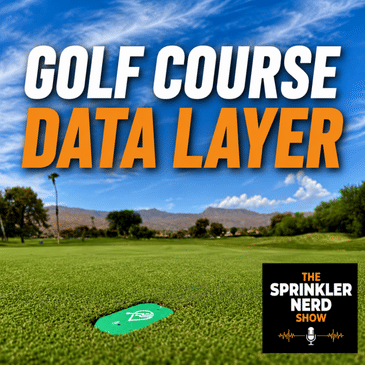
This week, I'm in Palm Springs, California, helping build a LoRaWAN data layer across a private golf course.
The first use case is simple: BLADE soil moisture sensors in the greens, giving the superintendent real-time insight without relying entirely on manual field scouting. But the bigger opportunity is the network itself.
This isn't command and control. The irrigation controller already owns that job. This is a separate, open data layer — one that can support soil moisture, pressure, rainfall, water level, weather, flow, and whatever else we become curious enough to measure.
Every golf course needs a data layer.
And maybe every large landscape does too.
Follow your curiosity. Try something. See what happens.
Stay curious, my friends.
[00:00:04] If you are an irrigation professional, old or new, who designs, installs, or maintains high-end residential, commercial, or municipal properties, and you want to use technology to improve your business, to get a leg up on your competition, even if you're an old school irrigator from the days of hydraulic systems, this show is for you. Hey, it's your friend Andy, The Sprinkler Nerd, and welcome to The Sprinkler Nerd Show.
[00:00:32] This week, I'm out in Palm Springs, California, La Quinta, Palm Desert, staying with my buddy Tyler, and I'm working on an incredible private country club, and there's a lot of them out here. And I gotta say, I'd rather be out here in the wintertime, because 110 degrees is pretty freaking hot, but I'm surviving, and I'm just thankful for the opportunity to be out here.
[00:00:59] And what I'm doing is something that I think might, it might represent a new opportunity for golf. And I'm sure there's other people doing this too, because often you're not the only one. So let's just assume other people are doing this too, and maybe I'm just having this aha realization. But I think it might be something completely new for golf, and that is we're building a data layer across a golf course using LoRaWAN.
[00:01:27] And the first use case for this data layer is pretty simple. It's the Harmony Blade wireless sole moisture sensor installed in the greens. And we could put them completely subsurface, but that does represent the problem of needing to find it, needing to remove it for aeration.
[00:01:49] And so the superintendent has actually elected to just put it directly on the green at surface level in a place on the green that he's also a pro. Doesn't represent a high traffic area or limits the likelihood that it could interfere in with the playability of the greens.
[00:02:10] And so what's interesting is if you think about a golf course, the greens are really one of the highest value assets on the entire property in terms of where do you want to monitor the data. He wants to monitor the greens. It's all about the greens. And so that's what we're doing. And we're going to... And we have finished deploying... I think we put four gateways in strategic locations.
[00:02:40] Two of them are on rooftops. One of them is at a pump station, and the other one is at the maintenance facility with a large antenna. I think we're using four DBI gain antennas. Two devices are on... Actually, one device is on cellular. One is plugged into an existing Ethernet switch at the pump station, and the other two are using Wi-Fi as backhaul to the cloud. But we've pretty much got the whole course covered. And when I say covered, yeah, if you have a device that's in the air or let's say it's going to be a golf cart tracker, that's easy.
[00:03:09] But when you put something at the ground level, it becomes much more difficult, limits your distance quite a bit. So I really feel like we've made a good impact on putting in the data layer across the entire property. So back to that first use case of the high-value asset greens. The superintendent actually carries a field scout, which is a portable soil moisture probe.
[00:03:31] And I don't think he does it daily, but a couple times a week is taking moisture readings from the greens, tracking them by hand. And I know that there's still a lot of value in that. And actually in the Modura app, and just as a reminder, feel free to give the Modura app a try. You can visit monitor.modura.app, monitor.modura.app. And you can get started without a device.
[00:03:58] You can put in your zip code, get a virtual weather station, start tracking ET growing degree days, that sort of thing without having any devices. So if you're curious, give it a try. And because there's still value in taking manual readings, I actually built a little module on the wireless sensor where the superintendent can track and log the human manual readings from the field scout as well.
[00:04:22] But imagine not having to do that anymore and having a wireless sensor in every green recording the soil moisture at three inches, six inches average temperature every 15 minutes. It does this in the day, it does this at night, 24-7, real-time soil moisture sensors, real-time temperature, real-time dry down, irrigation response, patterns over time, without one of his guys having to drive out there all over the cores and collect all the data by hand.
[00:04:51] It's like giving the superintendent his eyes and ears and hands on the greens 24 hours a day, seven days a week. And here, I think, for all you irrigators, is an important distinction. One of the first things people ask me is, well, how do I control the irrigation system with it? And this is not about command and control.
[00:05:15] He is running 6,000 gallons per minute with really sophisticated Rainbird controls, really sophisticated pump stations. He already has flow sensing pressure sensors. He's got all that. He's got command and control dialed in like nothing I've ever seen. The irrigation controller already does that. Rainbird does command and control. Toro does command and control. Hunter does command and control.
[00:05:44] They are incredibly good at building systems that turn irrigation on and off. That is their layer. That is their wheelhouse. That is their lane. They are command and control. But what we're building is something different. It's the data layer. The data layer doesn't need to control anything. The data layer just observes. The data layer measures. The data layer records.
[00:06:12] It's going to give the superintendent and the management team another way to understand what is actually happening across the property. And this is where LoRaWAN gets really interesting because the network isn't proprietary to one manufacturer. The golf course doesn't have to weigh the decision of investing in brand X's only to realize it's proprietary. LoRaWAN is the global communication standard for IoT.
[00:06:40] Once the infrastructure exists across the course, you're no longer going to ask, does my irrigation manufacturer make a sensor for this? Instead, they can start asking, what am I curious about? I want to know about the soil moisture. Is there a sensor for that? What about rainfall over here? Is there a sensor for that? I can put on the Lorowan network. What about the water level? Is there a sensor for that? What if I want to get pressure over here? What if I want to get flow over there?
[00:07:06] What if I want to get temperature, soil temperature here, pump rooms, ponds, equipment? If somebody somewhere makes a Lorowan sensor that solves a particular problem, you can potentially put it on the network. It's not proprietary. I think that changes the conversation because we are no longer going to rely and it no longer matters. And again, I'm just using these brands like descriptively. It no longer matters what Rainbird makes. It no longer matters what Toro makes.
[00:07:35] It no longer matters what Hunter makes. It no longer matters with whatever brand Y makes because that isn't their job. They are the command and control layer. This is new. This is the data layer. And I think this is blue ocean. This is new. What if every golf course had a Lorowan network? What if every HOA had a LoRaWAN network? What if every large scale landscape had a LoRaWAN network?
[00:08:02] Not because we know every sensor we're going to connect it to right now. It's just the potential. It's just the opportunity is that we don't know. And so I want to build infrastructure for curiosity. And that's really what this week was about for me is wanting to challenge myself. Could I build the data layer for this really well-known private country club? Could I give them the data layer?
[00:08:30] Just follow my curiosity. And maybe that's the bigger lesson. You don't always need to know exactly where something is going before you start building it. Sometimes you just need to create the infrastructure that lets you explore.
[00:08:57] So I'll leave this with you for this quickie short episode. What are you curious about? Follow it. Try it. See what happens. Stay curious, my friends. Follow it. Try it. See what happens. Stay curious, my friends. Follow it. Try it. See what happens. Stay curious, my friends. This is Andy, the Sprinkler Nerd, your friend. And I'll see you on the next episode.