
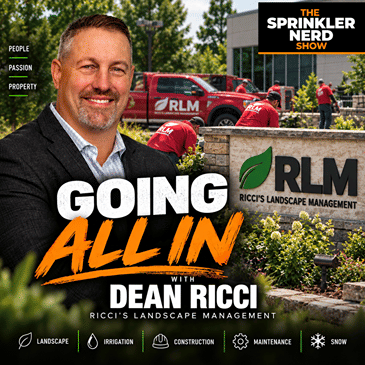
What does it really take to go all in on a landscape business?
Dean Ricci started mowing lawns at just 10 years old, pulling his mower behind a bicycle with a homemade trailer built by his dad. By high school, he had trucks, trailers, equipment, and employees. More than 30 years later, Ricci's Landscape Management has grown into a multimillion-dollar company with more than 65 employees.
But this conversation isn't really about landscaping.
It's about building a business.
Dean and I talk about the transition from doing the work yourself to building a team that can operate without you, creating systems and SOPs, developing leaders, adopting technology, making mistakes, letting go of control, and surviving the growing pains that come with scaling a company.
We also talk about something every contractor eventually has to confront:
At some point, working harder stops working.
If you're an irrigation contractor, landscaper, plumber, electrician, HVAC contractor—or anyone trying to turn a trade into a real business—there's a lot to learn from Dean's journey.
From a lawn mower behind a bicycle to more than three decades in business.
Dean Ricci went all in.
[00:00:00] The focus part was everything for me. I believe that if you don't focus, you can't succeed. You know, I'd rather do one thing really good than have three or four things that I do mediocre. So if you're going to have another job, stick with that job and get good at the job. If you're getting into contracting, you're doing as a side get, grow some cojones and go out there and do it.
[00:00:28] If you are an irrigation professional, old or new, who designs, installs or maintains high end residential, commercial or municipal properties, and you want to use technology to improve your business, to get a leg up on your competition, even if you're an old school irrigator from the days of hydraulic systems, this show is for you. Today, I'm sitting down with Dean Ricci, the founder of Ricci's Landscape Management in
[00:00:57] Northwest Indiana. Dean started mowing lawns when he was 10 years old, pulling a mower behind his bike. By high school, he had trucks, trailers, employees, and a real business. Now more than 30 years later, RLM has grown into a large scale, multi-million dollar landscape company with more than 65 employees.
[00:01:21] And what I'm really curious about isn't what Dean built, it's how he built it and what he had to learn, what he had to change, and possibly in the end, what he had to let go of along the way. Dean, welcome to the Sprinkler Nerd Show. Thank you, Andy. So let's start by me asking you a question that might have to do with landscaping or it might not, and that is, what have you been nerding out on recently?
[00:01:51] Over the last three or four months, learning Italian, the language, because we just did a trip to Italy, and so I made it a point to try and learn the language in six months or less. And so I was constantly using Babbel, Practica, JumpSpeak, you name it. Okay. So what's your advice for someone that wants to learn a language now that you've tried to do it? What worked or didn't work?
[00:02:22] You need more than six months, I think. Okay. Now, does this have anything to do with our age? If we were 18, would it be different? I think it would be. You know, I'm 54, so I work a little bit slower. I process things a little bit slower. But I think, you know, when you're a teenager, or when you're even younger yet, you look at little kids, how fast they pick up a language. I wish my parents would have taught me a secondary language.
[00:02:50] When you went to Italy and you weren't fluent after six months of learning, did you use apps? Were there any other tools you used while you were there to just help you communicate? No, I didn't. I learned enough to know I could read and write Italian a whole lot easier than I could speak it and converse with it. However, being there for 10 days, the immersion effect, you can pick stuff up a little bit quicker.
[00:03:16] And I think if I could do it over again, I think I'd stay in Italy for a month and a half or two months and just try and speak it. And I think that I don't think I'd be fluent, but I would definitely be a little more conversational. All right. Well, I got a bunch of questions, but I think it would be helpful for those listening to get an idea of the type of company that you have today.
[00:03:39] We're Northwest Indiana's largest full-service landscape company. So we do mowing, we do lawn care, we do irrigation and solid service, we do snow services, and we do custom design build projects as well as drainage, planting, pavers, masonry work, outdoor kitchens, stuff around a pool, plantings, lighting, audio, the whole nine yards.
[00:04:07] So we're like the one-stop shop for your outside when it comes to landscape. And this has taken you 30 years to build, and I can't wait to learn more about how you operate today. But if we roll that clock back 30 years ago, what was going through your mind when you were a young boy and you had a bike and you were mowing lawns? What was going through your mind at that time?
[00:04:30] At that time, it was saving up enough money, and I'm going to date myself, to buy an Atari. Nice. Game system. And then, you know, that's when you're younger. And then as you get better, and I think this holds true with anything you do, once you get better at doing something, then the passion starts coming. And when you're passionate, then your skill set improves.
[00:04:58] So, because you want to learn more, you want to do things better. And so those two things went hand in hand. And I pretty much, during my high school, you know, it was all about mowing and maintenance and what we can do to get more accounts, what we can do to do a better job, work on efficiencies and so forth. So, that just kind of fed my drive to do more.
[00:05:27] You know, understanding what to do, have that natural curiosity of the industry. And you got to think this was back in the mid-80s. Our industry is still fairly new. And so competition wasn't there.
[00:05:47] And so when I was done with, by my high school summer, my final high school summer, when I graduated before I went to college, we had almost 200 mowing accounts within the subdivision I grew up in. And so we did like one out of every 10 houses in the subdivision. So that was, route density was huge. Okay.
[00:06:14] So I want to make a mental note to ask you about route density, because I think that might be a key word that you just said that you might not have even known about at that time, but maybe you did. But you also use the word we. Who was we back then? We was my brother and a couple high school buddies. So there was four of us.
[00:06:37] My sister helped for a little bit, part-time in the summer, but that was definitely not her forte. But she mowed lawns grudgingly. Okay. And what was it like to try to work with the four of you? And how did you decide, unless it just was known that this was your company, how did you decide who was going to do what, who's in charge, who's giving orders, who's late for the job? How did all that work at that time?
[00:07:06] I was definitely the driving force, even though my brother and I both started it, my younger brother and I. He's about three years younger than me. He was, you know, he looked at it as just a job. And I was the one that wanted to go out and do more, add more, make more money, was very interested in the industry. Where my brother, Matt, he did it because it was there.
[00:07:34] And I think my parents were like, you got to do this because that's how you're going to make money. And what's Matt doing now? Is he still involved? No, Matt, my brother, Matt, is head of engineering for Chemitron or JNS Fire Suppression Systems, which is a specialty sprinkler system. Yeah. And it is an interesting word because you say, hey, I'm in the sprinkler business.
[00:08:04] If you don't say irrigation and half the people think fire. Yes. And same thing with Google searches. One of those things I learned, you know, years ago, building sprinkler supply stores like, OK, words like fire have to be negative keywords. Otherwise, when someone types in sprinkler and Google's better now, but they didn't always know what someone's search intent was just based on sprinkler alone. So anyway, side side tangent. But yeah.
[00:08:32] So is it safe to say that you started the landscape company with literally like zero money? Absolutely. I, the only thing that was given to me was, I had a couple of things given to me. My dad gave me his push mower when I was 10 and he did help me.
[00:08:52] He built a little, took a Sears dolly, built like a little fifth wheel so I could take the seat off my 10 speed and put it on, put the fifth wheel trailer that I pulled the mower behind my bike. Uh, and he made me that. And then, um, after that I had saved up enough money, bought a new tractor about two seasons later.
[00:09:17] Uh, it was a dynamark 12 horsepower, 36 inch garden tractor for 736 bucks. I was in seventh grade when I bought that. That's a ton of money though. Seventh grade, 736 bucks was probably more like 2,500, you know, in today's dollars or something. Yeah. That's, uh, that was back in 80, 84. So, and then, uh, made enough money that summer.
[00:09:46] Uh, where I saved up enough money. Uh, I was, I bought a used tractor, a bigger tractor, uh, pulled that trailer behind that. Uh, and then when I was able to drive when I was 16, my parents gave me the family station wagon, a 76 Dodge Aspen. And then I bought a trailer for that and put the tractors on there.
[00:10:14] And then the next year I bought a truck and then the next year I bought another truck and another trailer. So we had two crews, but, um, yeah, just kinda, just kinda evolved. And was this, uh, because it is a question I want to ask. And it's, I think it's because, well, I'm curious about it, but I also know that there's a lot of people that either want to start their own business and they're later in their career or they're listening and they're young and they're just getting started.
[00:10:40] And they're thinking, gosh, I'd really like to, you know, own my own business, but I don't have any money. How did you do that? Or what advice would you have for someone that doesn't have much resources, but it still might be possible? Well, um, mowing was a low barrier of entry. I mean, if you had a push more and you had a way to get it there and you had some hand tools, you can cut grass for a living.
[00:11:10] Uh, and I will say this, it was easier for me as a kid, uh, because everyone looked at the neighborhood kid. Hey, look, this guy's cutting grass. I'll go ahead and do, you know, I'll cut grass. Well, you don't have the overhead. Two, I don't have to worry about coming out with the rent payment because I lived at home. You know, when I was up until high school, I lived at home. Uh, it was also a little bit different world back then.
[00:11:37] You know, you can go to college and have, you know, all four years paid for and it costs you less than 25 grand. So, you know, it's a different world we live in now. Now college is what? A hundred, 150, 200,000. And, uh, yeah, it was just a different world back then.
[00:11:58] So I know now you're, uh, I won't say any numbers, but, um, I know that it wouldn't be possible for you alone as a solopreneur to have the type of revenue that you have right now. And so I think it's interesting to hear maybe the trials and tribulations and growth that you had to maybe learn personally. How do you go from being a company of, you know, you to a company of 65?
[00:12:26] Yeah, it's, um, it was a long road, Andy. Let me tell you, um, wasn't an easy road. Uh, I could say that, you know, my, my background, I went to, I went to school for, um, business management and almost got a second degree in accounting. So my degree, I went at a different approach than a lot of people that get in our industry.
[00:12:53] You'll go in for horticulture or architecture or what have you. Uh, they focus on the green side of the trade side. I focused on the business side. Uh, that helped me out a little bit. I mean, I knew I could, I knew what a chart of accounts was. I knew what P and L balance sheet cashflow statement was. Uh, I could put it together. Uh, that's what I got out of college, but college doesn't tell you how to run the business.
[00:13:21] And, you know, college is, it's got its plus points. It's got its negative points. Um, but the, uh, but that theory is only so good. It's the real world experience that you learn from. Um, and when I graduated in college in 94, um, I incorporated into Richie's Land State Management Inc.
[00:13:51] Uh, my fiance and I, who she helped me cut grass throughout college. She worked on a crew. Um, the running joke was it was cheaper to marry her than deal with the sexual abuse, uh, charges. So, sexual harassment charges. Uh, but she, uh, she was very, uh, supportive of me.
[00:14:17] She's an accountant, uh, that went into purchasing later on in her career. But, uh, without her income and her social support, her emotional support, I, there's no way I could have done this by myself. It's just business is hard. Uh, so you need a support system. So my recommendation is if you think you're going to go out, start a business right away, uh, it's all a good idea.
[00:14:46] And then when the bills come due, it's like, man, I don't know if I got enough money or I don't have enough money to pay myself after I pay the bills. Uh, because learning business is a whole different skill set than learning the actual trade, whether it's installing sprinklers or mowing grass or building retaining walls or doing drainage work or whatever it is, uh, business is definitely a different skill set.
[00:15:14] And if you don't know business, it's, it's hard to make money. And I've heard someone else say this before and it definitely resonates is, uh, accounting is the language of success and you really need to know your numbers. So that's, um, I don't know where I got off on that. What was your question? Well, you, you've led right into my next question.
[00:15:42] As I heard you talk and you're talking about support and how hard it is. Are there things that you can remember that scared you the most? Scared me the most was when I had to borrow money for my first, uh, piece of equipment that I had to finance. Everything I did originally, like through high school and through college, uh, I never borrowed
[00:16:07] money until I got out of college and that for, uh, it was actually for two trucks and they were two used trucks and it was 15,000 bucks back in 95. And I could tell you this, talk about scary. Um, was those, was that loan payment? And I'm like, man, I hope I can make this.
[00:16:28] Well, if you plan it out accounting wise, it's okay to borrow money to grow, but you gotta make sure you know your numbers and you're charging enough for your work and you have a good flow of work. Uh, I had plenty of work. I was not charging enough because I did, you know, I'm still learning the trade in the lines
[00:16:54] of how to estimate correctly, how to, uh, to do job costing correctly, how to formulate KPIs in which I can run my business. So it was definitely, uh, an education from the school of hard knocks. Mm-hmm. And if you don't mind, are there, if you don't mind sharing, are there any KPIs now that you look at regularly that you'd be willing to share? Absolutely.
[00:17:24] So, um, the big one in our whole company is we all count hours. That is our basic unit in which we're selling is how many billable hours do we have in a year? This year we, we shoot the hope, we hope to shoot for 110,000 billable hours is what we're trying to accomplish this year. Uh, interesting. So that's different than, I'm going to just interrupt for a second.
[00:17:50] That's different than saying we're going to shoot for 10 million in revenue or 20 million or some revenue number you're shooting for hours. Correct. We don't look, I mean, the top, the top line number is for show. But it's the bottom line, that's the go. That's what you're, that's what you're shooting for. Uh, billable hours is one thing. Counting hours is huge in our business.
[00:18:16] We look at how many hours we have in backlog, how many hours guys complete in a day, how many billable hours, um, a job is. And then we compare the estimated versus the actual. And we do that to where the, all the foremen, the technicians know, uh, technicians know what they need to generate on a per day basis for how many hours. Uh, so we, we count hours. That's the number one KPI.
[00:18:45] The number two KPI. How does the hours correlate to revenue? Or do they? Uh, how do they correlate to revenue? If you're hit, you're. And I have a thought, and that would be like, let's say, well, for like irrigation purposes, let's say you have a job that all of a sudden, uh, you have the opportunity to install a $50,000 pump station on a project.
[00:19:14] So there's like, Hey, 50 grand of top of revenue has some margin on it, but maybe I'm just making this up. Maybe that's going to be 10 man hours. So now you've got 10 man hours and a $50,000 revenue opportunity or product opportunity. But those 10 hours could also be used to install a $5,000 revenue opportunity. Like I just curious how the hours correlate to revenue.
[00:19:43] We, we hold guys accountable to their hours. So if they have a, let's say a hundred hour project to do and it's estimated for a hundred hours and they come in at 110, it's like, well then, Hey, what went wrong? What, um, you know, was there a problem? Was there extra work you did that we need to write a change order for? You know, what's going on? Or likewise, if you've been a hundred hours and you come in at 60, we get nervous too, because it's like 40 hours.
[00:20:13] Like, what did you forget? What did you not do? You know, so, uh, hours is the first thing. And I can say with all these KPIs I want to give you, this is kind of like, um, it's kind of like checking your blood pressure, checking your cholesterol level and checking your, your BMI. You know, if one of those checks out, it doesn't mean you're a healthy person.
[00:20:38] You could have really good cholesterol, but have really high blood pressure and not be very healthy and have a high BMI. Um, and if you have all three that are good, there's other things to be looking for to make sure that you're healthy. Same thing in business. So you had your hours. You, you, we count hours. The second would be gross margin. Uh, and that is basically your direct costs or your costs of goods sold minus your, your revenue.
[00:21:09] And we look at our margin. We look at our margin on, on different services and different jobs. Uh, we look for a certain amount of margin on everything we do.
[00:21:22] And that translates into, if I had a, uh, if I had a chalkboard, I could show you mathematically how this all works. But, uh, but the gross margin, we look at that as your fair share.
[00:21:48] What are you contributing to the fixed overhead, your variable overhead and your minimal profit that we need to have to operate the company? Um, everyone's responsible for their fair share. So if we have one irrigation tech, he's, he's, he's responsible for X amount of tens of thousands of dollars in fair share per year. Landscape crew is different. You know, they, that they have this many hundreds of thousands of dollars required for their fair
[00:22:17] share because it takes money to run the business. So, uh, there makes me, because you offer so many different services and as a full, uh, full scale, or I don't know what the word is, um, full scope, you offer everything because a new build might need every service. Correct. I'm going to assume that some parts of your business, some services are going to be more profitable with a higher gross margin and maybe less hours than others.
[00:22:47] And so how do you as a business decide, Hey, you know, we, we, we should keep doing it all or maybe we should do more of this high dollar profit division and then sub out the other one. Or how do you decide what to do if some are more profitable than others and not just chase the money?
[00:23:17] For one, we, that's a good question, by the way. Uh, so we look at it. It's easy to feel greedy and be like, Oh my God, this one is so profitable. We should just do this. Yeah. We, we look at several factors. Okay. One, we look at the talent level of our workers, our work, uh, our workforce. Obviously the more talented workforce you have, the more high end, difficult, high profitable work you can do.
[00:23:46] Um, but that also like on these, I'll say something that's going to contradict with what I just said on some of these very large, complicated landscape jobs, we make a little less money margin wise than what we would do on, let's say, uh, a two to three day job. We might have, let's say a, a 50% margin on a two to three day job.
[00:24:11] Uh, but on a four month million dollar landscape job, we might be at 42%. But, you know, there's a certain quality about quantity, you know, a million dollar job is a million dollar job. And if I did, did 43 points on that, that's $430,000 that I probably wouldn't have made. Uh, if, you know, we didn't sell that.
[00:24:36] Um, and you're not having to set up, set up new projects, build, bill new clients, close new clients, the whole setup and takedown of a project, having to repeat that cost time and energy versus just load, go, and then be done over a long time. Uh, and a lot of it has to do with, uh, selling too. You know, if we don't have, if we have less management time or less selling time on something,
[00:25:02] you could take a little less like mowing, you know, mowing is very simple. It's very repetitive. Uh, we have a 95% retention rate. It's easy to add mowing clients. We build route density. Uh, but our margins on mowing might only be 35%, you know?
[00:25:25] So, but I can't have all my mo guys do high end, uh, construction, uh, jobs because they just, they're not trained. There's the talent isn't there for that. Not saying that maintenance people don't have, are not talented. It's just, it's a different skillset. So we look at who, you know, who are our players and then where can we maximize their revenue?
[00:25:52] And some stuff is just not, uh, some stuff is just easier to sell. And so you end up doing more of that. Now, if you only have so much, if we only had three or four guys, or if I only had five or six guys, then I would be very selective on what I pick and make sure everything on
[00:26:17] that we did was had a high margin or high SPH, which is the third KPI we, we measure. Okay. S and then the H SPH. It's sales per hour. And it's to be kind of a little more descriptive. It's more like net sales per hour, which is the sales price minus your materials, your
[00:26:41] special job costs or rental costs or permits minus your subs and divided by the number of hours that it took for you to do the job. And I wish I, you know, I wish I came up with that formula, but this is from a consultant that we've been in a consulting group for 25 years, which is one of our reasons of why we're so successful.
[00:27:07] Monroe Porter from ProSalt Consulting Proof Management has taught me that, has taught me a lot about business. I actually learned more from business from him than I did with four years of college. And sales per hour is huge. It tells the efficiency in which your guys are producing.
[00:27:31] So it takes a look at everything like markups, the equipment, all that stuff. And you take it over the number of hours you, you were able to produce that and divide it by the number of hours it took to produce that to get a SPH. So like you can bid at, let's say 150 bucks an hour for an irrigation tech.
[00:27:53] But when you look at his materials and the time he spent traveling and everything, his true SPH is more like maybe 115 or 120 an hour. So the guys are measured on their SPH, they're measured on their margin, and they're also measured on how many hours they bill out. Okay.
[00:28:20] And would it be, I got a lot of things I'm thinking about here, but let's say you're, you've got some estimates and some sales opportunities and you've got three of them. Would this be like looking at them ahead of time and you've got three opportunities, but if you were to look at it from an SPH perspective, you might have, I'm just going to make this up. Let's say you have a $10,000 opportunity and that has an SPH of, again, just using a round
[00:28:48] number of $100 per man hour return. And you got another opportunity that's only, it's $8,000. So it's a smaller job, but maybe it's SPH is 150. Would you then take the smaller job that is looking like it would be more profitable over the higher revenue job? It depends on how many hours it is. I'm assuming the hour number is the same, right? The number of hours is the same.
[00:29:14] Well, if you only had so much capacity to do one job and you can do the $100 job, $100 an hour SPH job or the $150 SPH job, assuming that the risk is the same because you want to bid for risk, which could be another question, then by all means, do the more profitable work because time is the one thing that we can't create. All we can do is manage it.
[00:29:44] And we're only given so much time on this earth. So you want to maximize your time. And you see a lot of contractors, you see this all the time. And unfortunately, you see this a lot with Hispanic contractors too. Um, it's just because they're working and keeping busy doesn't mean that they're making money. And, um, it's funny. It's psychologically people think they're doing well because they've been working all day
[00:30:14] and they got a lot of stuff done, but they were busy. They weren't productive and they didn't price that job outright. So they're making substandard wages or not having a, not having a good enough SPH. And that's why we, that's why we measure SPH. We want to make sure that our guys are. And do you do it on the front side too? I mean, I know you're doing it on the job costing, but it's also something you look at on the front end during the estimating sales bidding side.
[00:30:44] If it's a, if it's a big one-off job, absolutely. We do that. Uh, for the most part though, we don't, our pricing structure. So tuned in our pricing strategy and everything. We're, we know we're going to hit our numbers using the pricing that we have. Um, if you follow the, the after action report, as long as you're managing the job and you're getting the job done on the time you're allotted, you will hit your numbers.
[00:31:14] And so let, you mentioned it just a second ago for the second time. So this is, I think the right time to have you talk about it. And that is route density because I think there's new construction irrigation contractors, service people. And I think that potentially route density can be incorporated by all kinds of contractors. So I'd love to have you explain it and how you utilize it. Okay.
[00:31:38] Um, so route density, just to kind of explain it to your audience is, um, you're taking your, you have craft time, which you do the job. And then you have non-craft time, which is, is time that you spend working, but you're not billing for, or it's not actually doing the job. So sitting in a truck, going from job site to job site is non-craft time.
[00:32:05] Um, going to the gas station, non-craft time, uh, going to the warehouse to pick up a part is non-craft time. Uh, craft time is changing out the irrigation head, adjusting the sprinklers, doing the backflow test, changing out the controller, et cetera, et cetera. Um, route density reduces non-craft time.
[00:32:30] So let's say we're mowing lawns and Mrs. Smith, you're doing Mrs. Smith house. Well, if you can get Mrs. Jones to next door, well, you can actually do that job, do both jobs for 10% less and make twice as much money because you don't have to travel any further for Mrs. Jones. You don't have to load and unload the trailer to do Mrs. Jones.
[00:32:57] Cause you're already doing Mrs. Smith and everything is just a little more efficient. You know, and if you can get three or four accounts in a row, then that's just that much more money. Now you can't like charge half price just because you got one next door, but you know, I don't
[00:33:21] want to say you want to get in the bidding war, but you make considerably more money doing what, you know, if you could do 20 lawns in a row and they guys unload and don't load back up until the end of the day, that's a lot of money. I mean, you have a lot of craft time there and I'm construction jobs. Route density is usually not the, you're there at the job all day or several days.
[00:33:48] Uh, it's when you have multiple stops in a day. So like irrigation service appointments, mowing, lawn care, um, pest control, any of those reoccurring services where you have to go back and go back and go back. You always want to route tightly. And when you deal with services like that, route density is the name of the game.
[00:34:18] Got it. And so I'm just thinking about my own house and, uh, different neighbors having different lawn care companies. I can't remember the last time if ever one of the lawn care companies knocked on my door, hung something on the door, did something to try to, you know, obtain my business. And so I'm just having this thought like, well, how do you, I know you can route to the right place, but how are there any strategies for picking up new customers in the neighborhood
[00:34:47] that you can either obtain through your crews or through a salesperson, anything like that? Well, assuming that a contractor does the basics, let's say this, uh, your truck is well marked. Okay. Your employees are uniformed. They have business cards. This is all the basics. You gotta, you gotta have that.
[00:35:13] If you want to make it, if you're serious about this, you need to be identified. It does you no good coming into a neighborhood and doing the stealth bomber, uh, service. You know, you come in, they didn't even know you were there and you're gone. I honestly, I think I see that all the time. Yeah. It's, and I don't get it. I mean, guys have their pickup. It's not, it's not lettered. It looks like their regular pickup, like they drove to their other job.
[00:35:42] Uh, the trailer is not marked. They're wearing regular shirts or worse yet, they're, they're, they're bare chested. Yeah. No one wants to see that. Um, if you look at our organization, it's red trucks, white writing, the two colors contrast. It's a very simple logo. We don't get crazy with the designs. You know, that's actually counterproductive. People don't remember that. They're like, what was that?
[00:36:12] But they couldn't read what was on it. I mean, it looked like pictures of murals of, uh, different landscape projects. Um, but people couldn't see where the phone number was or who it was. Um, ours are very clearly identified, very easy to see, very easy to read, not a lot of lettering. Um, and our employees are uniformed.
[00:36:38] So when they see the red trucks with the white writing, they just automatically, you know, just go to, Hey, that's our LM. Hmm. Okay. Yeah. I mean, it's, it's funny. They always recognize our trucks and our guys. And then they're like, what do you guys do? But we have, you know, we have 43 trucks on the road. So they're always seeing one of our trucks. And when people see you and they see you doing the neighbors, they're going to ask.
[00:37:08] Um, and then to go build route density. What we do is in the spring, uh, we sometimes send along a second guy and have them do door haters, proximity door haters, or go talk to people next door of the accounts that we're already doing. So if we're doing that, yeah, it's simple marketing. Um, it's, it's, it's not, it's not a hundred percent effective, but at least you're doing something.
[00:37:38] And if you could pick up another 10%, that's great. And then of course, word of mouth is huge. And a lot of our work, we have about 15, 1600 clients. So we grow organically with, you know, if everyone just said to their friend and said, Hey, look, you should use Richie's landscape management for your, for your irrigation. And we got 700 irrigation clients.
[00:38:06] Well, that's another 700 irrigation clients that we could possibly have. So we do a referral, um, referral program to our clients. If they refer a friend, we do something for them. Okay. And now that you're talking about referrals, I would put that in the marketing bucket. Correct. Are there any marketing, uh, avenues that are working for you guys right now?
[00:38:29] We, um, outside of strategic advertising, like if we have clients that have belonged to an organization, they want advertisement. Let's say it's, we have a good client that has a softball team that their daughter's on and they, they approach us to a sponsorship. We'll do that. Um, we just don't sponsor all the softball teams just because we're nice. It's like, no, there's a connection there with the client.
[00:38:58] Um, we do strategic marketing for, um, we do things like, um, for these, uh, underprivileged schools. We have a couple of them in our community, uh, that a lot of business owners are tied to. So we get into there, we donate to them either services or money or, or both, um, because our clients are there. And if they see us giving back to the community, they're going to use us.
[00:39:26] So we shoot for them. Um, and overall, are you, are you marketing for new construction, landscape renovation, new construction, or are you doing more marketing for lawn care service? Mowing irrigation. Mowing irrigation. Uh, yes. We do.
[00:39:50] Our marketing is, uh, for the most part is non-specific unless we're trying to grow lawn care or irrigation. And then there's certain times of year we'll, we'll do the door hearers. We'll do the mailers. We, we do the social media. Like lawn care is huge in the spring. But then after that, it's like, you're done. You're done until almost the fall. Cause people are locked into whoever they're using.
[00:40:17] They're not going to switch in July from company A to then using company B. Is that what you're saying? Correct. I mean, you get the one client that's pissed off and looking for someone else. Hey, can you take more clients on? It's like, absolutely. Or maybe they're doing it themselves and they're like, I'm done. I'm not doing this anymore. I'm hiring somebody. Yes. But, uh, most part you're catching everybody in February, March, and April for lawn care.
[00:40:41] And, and with the, um, the irrigation service, you try to capture people in March and April, uh, trying to get that, uh, get a program set up for them for irrigation service. And then for all these services, are you doing a seasonal contracts? Is it per mo? How do you set that up? Uh, we do a mixed bag. We do some seasonal contracts. Most of these are on a per cut, per visit basis or per application.
[00:41:12] I'm, lawn care is kind of like for the season. You pay this, but we do have a few people that do a la carte. And then does that relate to, or how does that relate to a new construction client and then becoming a maintenance client? Um, well, we don't do a lot of new construction. If we do, it's high end construction. Uh, so like they start at $60,000 packages, go up to a quarter million.
[00:41:41] Uh, those clients automatically get free lawn care. You know, we put in a lawn, we're going to treat the lawn for the rest of the year. We're going to, we put the irrigation in. Hey, we're going to blow you out. We're going to start you up next year. Once you start doing it that one time, it's, we do automatic renewals or we just, you know, the office calls and say, hey, would you like us to continue? This is what it's going to be. Uh, we're all about ease of business.
[00:42:08] And that's something that if there's one thing you got out of this whole thing on this podcast would be ease of business. I can't believe the number of contractors out there that make it so hard for people to buy from them. And we get a lot of people, uh, that were like, you know, I called this guy. He never called me back. Or yeah, this guy wants me to go ahead and fill this out online and I got to do this and that.
[00:42:38] They just want to pick up the phone. This is, hey, go ahead and do it. Uh, that was my question is what does, how do you define ease of business for your company? What, and what does that mean or what does that look like to the customer? To the client? I want the client to, to make, to make it as easy for them to buy from us as possible. I don't want them, they don't want to sign a contract. That's fine. Just give me a credit card number. We'll put it on file.
[00:43:09] We'll send you the bill. We'll charge your card on the, on the, on the last day of the month. Um, you can quit at any time. And we won't bother you unless you have a question. Uh, we're all about, uh, we're delighted to do your work. Okay. And that's huge. A lot of people, especially contractors are doing everything themselves.
[00:43:38] They, they got a bill. They got a job costs. They got to fix the truck. They got to go out and do the work. They got to schedule it. They got to call people back. They get a little sour after a while. And to a point where it's like, you know, it's more, they lost the, the passion because they're so down in the trenches.
[00:44:00] And, um, that sour taste or that sour feeling really, uh, clients will pick up on that. And our, our whole thing is like, Hey, we would be delighted to do this for you, Mrs. Jones. Hey, we would love to do that for you. We can help you out. Mrs. Jones. I could send over a salesperson over there tomorrow to take a look at it. We'll come up with a solution.
[00:44:28] We can get you on the books and we'll get it done and taken care of for you. And Pete, that's all people want. They want to be serviced. Amazing. Amazing. So we were just talking about a lot of times guys get, uh, if they're overwhelmed, they have a lot to do. So they're not, uh, if a client asks them, asks them for something, they're not going to say what you just said is we'd be delighted to do that. We would love to do that for you. They might be thinking, ah, shit, more work. I got to get this other invoice done. I don't know how I can do that extra thing.
[00:44:58] And that's going to come across to the client. And that just made me think, you know, you are not in the field anymore. And I was talking to a woman recently on the podcast and she was talking about the struggle of putting down the tool bag when you go into the office. And at one point, what point in your career did you, let's say, put the mower down and you stopped doing the work and you started leading the work? Uh, that was probably.
[00:45:27] I was eight years in nine years in. And, um, I were, I loved working with the guys. I love the work itself, but you can't go out, work an eight hour day or a nine hour day, come in and do three hours of paperwork and then expect to go see clients and do estimates and too much stop and go, you know, different tasks.
[00:45:55] Um, I let everyone know in my office and this is huge. Um, I'm kind of getting off a tangent here, but, um, there's slow brain activity and there's, there's fast brain activity. And fast brain is like returning a phone call, replying to an email, uh, filing something away or making a copy or, or, or, or, you know, running a quick errand.
[00:46:23] Slow brain is, um, like doing a heavy duty design or a really nasty estimate or having to figure out a tough bill or learning a secondary language. That's all slow brain activity. And for the, for most people, it takes between five to 20 minutes to get into slow brain activity mode.
[00:46:48] But once you're in there, you know, you're good for, you know, two or three hours. But if you stop to do a fast brain activity, you got to reset and it takes you another five to 20 minutes to get back in the slow brain. So imagine you're working on a book report and you're reading this book and you're into it. And then someone stops you say, Hey, can you answer this phone call? 10 minute phone call. You come back. Now you got to restart everything.
[00:47:18] And it takes time to do that. Where I'm going with this is that contractors are, that's all we do is switch between fast brain and slow brain. And the slow brain is like for field guys is the paperwork end of it. That's why they, they, they don't want to do it. They avoid it.
[00:47:46] They don't want to do that estimate. They don't want to come home at night after working hard all day to go ahead and do that. On top of them being tired, it's a different way of thinking. And, um, that's tough. Um, how did you know that it was time for you to put down the mower?
[00:48:10] Um, when I wasn't getting the actual business stuff done and it was impeding, it was impeding the business. I'm like, there's no one doing this that I need them to do. So the, the, the part-time office gal I had in there was, I don't care what you do. Your first hire in the office is always the wrong hire.
[00:48:35] Um, and it, it's getting even worse because the talent level of office help is just at an all time low. Um, but the, when estimates were getting done, cash flow was tough. Um, we had trouble making payroll, stuff like that. It's like, you know, I can't be out in the field working. I gotta be getting this stuff ready to let the guys work.
[00:49:05] The problem is, and a lot of, every contractor runs into this. It's like, well, if I step out of the field, who's going to lead the field? Well, you gotta train up your guys. And if you're not good at training, then my suggestion is don't build a business. Go work for somebody, it's a lot less headache. Mm-hmm. Good advice. Good advice.
[00:49:31] It's, it's not a, this is not an easy sport. Contracting's hard. So, speaking of not easy and speaking of hard and risk, are there any, I want to say war stories, but are there any moments over your career that either you almost went out of business, someone almost died, something really scared you and you said, I'm almost done.
[00:49:57] Like, are there any moments that stand out as like, oh, shit. Um, this is going back 30 years, 96. 96 was my worst year. Two years after I graduated, um, or two years after I incorporated. And I grew too quick, didn't have the controls in place.
[00:50:25] I had a real, really, uh, really hard, um, non-talented, difficult workforce that I was dealing with. Um, I didn't have any good office help. I didn't have good, I was doing all the sales. I was doing all the estimates. I couldn't leave the field out on their own because I couldn't trust them to get the job done and I had no help in the office.
[00:50:50] So it was just, and I, bad cashflow, uh, didn't make any money, wasn't pricing things outright. Uh, it, basically I was growing myself into bankruptcy and that's when I was like, I gotta stop this. I gotta, I gotta retool. Um, that spring.
[00:51:14] Um, my dad was actually retiring from remodeler, um, residential remodeler. He said, I'll come and help you. I went through, we fired everybody except for one guy. So we had like 12 people, 13 people fired everybody except for one guy. And we hired over noon and got a new office manager or a new bookkeeper. And it was a rebuild year.
[00:51:43] But that 96 was horrible. If I, I said to my wife, I'm like, you know, if I'm gonna have another year like this, I'm out. Do you think that, that enabled you to have the company today? In other words, if that hadn't happened to you and you, you did something and you learned from it, would you have the company you have today? Good question. Um, I did learn from that. That was one of the steps of learning.
[00:52:12] Hey, you know, I'm doing something wrong. I worked this hard and I have no money. There's something wrong here. So that was, yes, that was the year that's like, I gotta, I gotta do something different. And I know some contractors that they'll, they'll go their whole life like that. They're high, very high threshold of pain. And, uh, they think they're helpless or there's no way out. So they're just gonna grind every day.
[00:52:43] And it, this is an easy work. I'm not saying it should be a cakewalk, but if you're working hard and you're not making any money, you need to stop to reevaluate. What am I doing wrong? So that's, that was 96 for me. I looked at that. I go, what did I do wrong? And then it was the wrong employees. It was no systems.
[00:53:12] It was bad bidding. It was not knowing how to bid. I, no better way to learn than be out in the field when you said field office, just actually doing the work. But when you say this, I'm thinking, man, I don't think you would have built a company you built today without that. Cause you needed that in order to figure out how to not have that again. And the opposite of not having that again is growing your company that you grew. Yep. Uh, I will say this.
[00:53:41] I mean, that was, that was the beginning of a turning point. Um, but it wasn't the turning point that I really needed, um, to make a huge difference. And, and basically it was in 2002, I joined this consulting group. So this is eight years after doing everything my way. I think at that time I was, I probably made $32,000 a year.
[00:54:09] I could have gone and work any place else in construction and made probably at least 30% more. And you were probably working twice the number of hours. It's your company. You take it home with you. You can't go to sleep at night. You know, you name it. And the stress and everything. It's just, it was, it wasn't worth it. Um, you need to, um, well, we joined, I joined that business group.
[00:54:36] And then that pretty much some of the best business advice I ever gotten was, uh, Monroe Porter told me, this is on the very first meeting. And we're looking at our numbers and we're looking at our goals and we're going over stuff. He goes, you got to raise your price up 10%. He didn't know how I priced. He goes, whatever you do, just raise your price up 10%.
[00:55:03] And I think at that time I did seven, 800,000 in sales. Um, he goes, if you did 800,000, you raise your price up 10%, did everything exactly the same. And you just made another 80 grand and that's enough to make a difference in your life. For a guy that was making 32,000, well, that just got, I just got a, a triple, uh, raise. You know, I'm now I'm making $112,000 on, you know, with the 80.
[00:55:32] And so that was a huge impact for me. I came back that following, I'd followed his instructions because the pain was hurting. I was still having trouble with cash. I was still trying, trying to grow the business. I was still like looking for good employees. I was still trying to figure out the office. And it was just one of those things where, uh, I came back the following year.
[00:55:59] I think I made a hundred grand that, that second year, uh, just by doing what he had told me. And that was the catalyst. It's, Hey, we got to start doing this. We got to start doing that.
[00:56:14] And at the time I was, I was just at the beginning stages of, um, an owner driven business, which is, um, you know, there's four tiers to a business. Uh, you have the craftsman, which is the guy that does it himself, the home alone contractor. He's probably got four to six guys, has a part-time bookkeeper, might run it out of his house.
[00:56:45] Um, you got that level. Then the owner driven is usually the owners out there project managing, selling, uh, and they have three to four really good foremen. And they have a really strong office manager and maybe an assistant. And then now you saw what we have, um, we got a management team. So it's, uh, I got middle management. So. Okay.
[00:57:13] We may have answered some of this last question that I have for you. Okay. And this would be, let's say that there's a, a younger contractor. We could pick an age, 25 year old contractor out there. They have a mower. Maybe they have a trencher and some equipment. Let's say they're doing a hundred thousand dollars and it's like a part-time side thing. Maybe they even have another full-time job. They really want to do this landscaping thing. What advice would you have for them to get from that?
[00:57:41] What they have now in that a hundred thousand dollars in revenue, you know, how do they, how do they grow from there? What would I, what would I recommend? I would probably. What would you tell them to focus on? How about that? Um, well, I'll back up and say, I've never had another job. So this was it. So the focus part was everything for me.
[00:58:09] Uh, I believe that if you don't focus, you can't succeed. Uh, you know, I'd rather do one thing really good than have three or four things that I do mediocre. So if you're going to have another job, stick with that job and get good at the job. If you're getting into contracting, you're doing as a side kid, grow some cojones and go out there and do it.
[00:58:34] Now, when you do that, you got to make sure you're, you know, you get your house in order in the lines of finances and so forth. If, uh, if, uh, if you have a spouse that can help support you, that's a big leg up because there's no way I could have done what I did without my spouse.
[00:58:59] Um, but I would probably go look, um, at consulting companies. And there's a lot of bad ones out there, unfortunately. Uh, but there are some good ones. Um, the one I belong to is proof management. I'll throw in this. This will be the, uh, this is the, this is the, uh, commercial. And, um, I do proof management.
[00:59:26] Steven Quaife, um, bought the business from Monroe Porter, my old consultant. He was actually a landscape contractor that became a consultant. Very sharp guy, does a lot of research. Um, I would join a business group like that. And that would definitely cut the learning curve down immensely. Save you hundreds of thousands, if not millions of dollars in a long-term career.
[00:59:55] So you can learn without the timing being correct. You can learn in a year where it took someone 10 years. Absolutely. I look at my first eight years and that was nothing but a, that was a grudge match. Um, and when I joined that consulting group, I saw immediate results. Um, unfortunately there's a lot out there that are garbage and they give out bad advice. And so I would just beware. Okay.
[01:00:24] Very good. And that, uh, I hear focus a lot. I'm going to take that advice myself and focus. I do a lot of different things. So maybe I should spend some time thinking about focus. And I like how you said, um, you know, grow some cojones and I'll just say it another way. Maybe what you're saying is go all in. If you want to have a contracting company, then do the freaking contracting company. Put, get your ducks in a row, get your finances in order and go all in. Yeah. I've never seen anyone do two things.
[01:00:54] You know, they got a job and they're running a landscape business or an irrigation business. It's like, what kind of business is that? Are you afraid to take it on full time? Why do you got to work up at the, wherever, the mill or at a different company and you do this on the side? It's like, um, focus, man. Very good. And if you're that crappy of a business owner where you can't have it to where it can support you, then maybe you shouldn't be doing it. Mm-hmm.
[01:01:22] As a business owner, uh, you got to make at least $150,000 a year. At least. Uh, it's, if not, it's not worth the risk. So if you're not making that at least, you're doing something wrong. Yeah. So, uh, I didn't know if I overspoke with talking those kind of numbers, but. Nope. Uh, I mean, it's 2026. Things are expensive. And if you're the owner, you are not just working nine to five, turning it off. It's not possible.
[01:01:51] You can't even count the hours. Yeah. You deserve, you deserve $150,000 because you're working 3,000 hours a, uh, a year. Plus you have all that risk and exposure. You know, you, you're the one that's going to get sued when an employee doesn't do something. Or if the employee wrecks your truck and kills a little, you know, kills a little girl on the side of the road.
[01:02:17] I mean, you got insurance, but ultimately it's the insurance, you know, after insurance, they'll come after you and your house. Mm-hmm. So there's risk involved. You need to get compensated for that. Yeah. Awesome. Well, thank you, uh, for, for sharing everything, even going way back and sharing some things that scared you and what didn't work. I think those things that, uh, that people are willing to share like yourself and what doesn't work really helps people understand maybe what they should focus on.
[01:02:43] And again, that focus and going all in, that's really valuable information and, uh, super, uh, you know, proud to have a, uh, top notch landscape company. Join me on the podcast today. Really appreciate it. Good questions, by the way. Very good questions. Thank you. And can't wait to see where you go or grow from here. Uh, yeah. Thank you so much, Dean.
[01:03:06] And I should ask if somebody, if you're willing or they want to learn more about your company or, uh, proof management, like what's a good way for someone to either contact you or your company or learn more? I would, um, definitely call my office and tell them that you, they saw you on the show.
[01:03:23] Our phone number is 219-996-2682, or you can email me direct at dean, that's D-E-A-N, at R-L-M-I-N-C.com. Awesome. Thank you, Dean. Have a great rest of your day and I really appreciate your time. All right. Thanks, Andy. Thanks, Andy.