
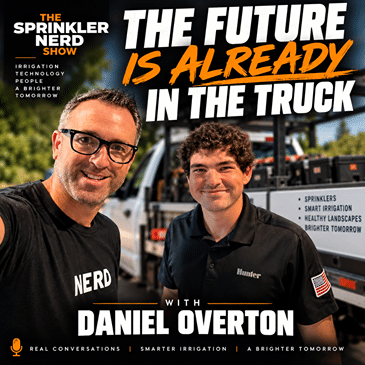
Daniel Overton is 25 and already has 8 years in irrigation. He works for Ricci's Landscape Management in northwest Indiana, listens to the podcast, and reached out to me back in July. We've stayed in touch, I sent him a soil moisture sensor to experiment with, and I wanted to get him on the show to hear what he's seeing in the field.
We talk about learning the trade, the hardest parts of being an irrigation technician, and why your troubleshooting process matters more than the tools you carry.
I'm curious what keeps people like Daniel excited about this work, what technology they see coming, and what they wish the industry would do differently. There's a lot we can learn by asking the younger people already doing the job.
[00:00:00] And there's a little bit of a flip side of that is I've noticed this as I grow more and more in my career that that very first step is just talking to the customer. You're helping yourself to troubleshoot that, but you're also building that relationship with the customer. So they're going to want Daniel to come back and troubleshoot their irrigation. A lot of technicians, I feel like quick ninjas in the night and in and out and you never even see them. It's like almost the most important part of the job is actually spending that time with the customer and showing them the value that you're providing.
[00:00:34] If you are an irrigation professional, old or new, who designs, installs or maintains high end residential, commercial or municipal properties and you want to use technology to improve your business, to get a leg up on your competition, even if you're an old school irrigator from the days of hydraulic systems, this show is for you. Welcome back to The Sprinkler Nerd Show. I decided to call today's episode the
[00:01:03] The Future is Already in the Truck. And my guest is Dustin Neeson from Ricci's Landscape Management in Northwest Indiana. Daniel is 25 and he already has eight years of irrigation experience.
[00:01:17] He reached out to me this past July after listening to the podcast and we've kept in touch. I sent him a couple of soil moisture sensors to experiment with and he's been sharing his ideas about diagnostics and monitoring and almost something that he calls water protection. And I did have an opportunity a couple of soil moisture sensors to experiment with and I did have an opportunity a couple of weeks ago to visit with Daniel and Dean Richie at their company.
[00:01:40] And we spent the morning doing some training and then we went out to a project and installed a wireless pressure transducer and really just got to be got to nerd out together on some really cool stuff. So I wanted to have Daniel on the show because I'm curious about what this industry looks like from his perspective. What does he enjoy? What's difficult? And what does he think we should be doing differently? So Daniel, thanks for coming on today.
[00:02:10] Thank you for having me, Andy. It's a pleasure as a long time listener. So I'm very excited to be on here and to chat with you. Yeah, I appreciate the opportunity to speak with those who listen because most of the time, well, it's either me with a guest or it's me just talking into outer space, so to speak. So it means so much to me that you actually did reach out. And what I'm curious about first is what have you been nerding out on?
[00:02:33] What I've been nerding out on recently is it's a work related thing, but I'm very passionate about it as well as irrigation is building water features, you know, setting wrong, controlling the flow of water and making things look as natural and kind of replicating nature as much as possible. So that's something I've been nerding out a lot on recently. Awesome. So you say nature. Tell us more about what these water features are.
[00:02:59] Yeah. So like when we're setting the water, what would the water do to the rock that, you know, it's going by? So we use like a lot of rocks that maybe can't lever over to make it look like the water is actually eroded away at the rock and little codes and things like that to make a waterfall that then goes into a self-circulating system. Very cool. Kind of making it look like or it sounds like making it look like it was just naturally there, so to speak. Exactly.
[00:03:27] Very cool. Yeah. And that's something I don't talk much about, but it's another aspect of, you know, not necessarily the irrigation industry, but it is water, right? It is something that uses water. It's something that could leak. It's something that brings pleasure to people. And maybe I should start talking more about water features, something I don't really know some about it, but no expert for sure. So that's cool, man. Take this as a compliment.
[00:03:48] You're young, but you have already eight years of experience in irrigation. So I think it might be interesting just to kind of learn and understand how you got started in this industry and, you know, maybe when you thought you might want to make it a career. So I started away, I think a lot of other technicians have started from, you know, listening to different podcasts and stuff. It's just a family member's like, hey, you're going to come work for me. You need to start making some money.
[00:04:16] So they did irrigation. I started going out there and I was digging holes, you know, dig a hole, fill it back in there. We called it a character building is what I was doing. And I did that. Did you start in landscape first or just go right into irrigation? Right into irrigation. So I joined right on to a irrigation install crew. And I was a part of that crew for about three years before I became a foreman and was in charge of that.
[00:04:44] And for my first full year, I actually did nothing but dig holes. And that I'm going to assume that wasn't for Richie Landscape. That was maybe a different company. That was a different company that I am no longer with. It was a good experience, but I needed to go somewhere to push myself and my skills to the next level. What does that mean more specifically? You see a lot of contractors that are just okay with doing the same thing over and over year in, year out.
[00:05:12] And I kind of got to the point where it was like, why aren't we doing stuff to make it better? Why do we always do the exact same thing? You know, what can we do better? You know, whether that's looking at new products, doing more training, getting involved with the IA. So I kind of butt-headed with the company there because they just never wanted to advance. And I did. So I ended up having to separate from the company.
[00:05:37] And then I found RLM, which has been a great pleasure to work for. And they've been fully open to letting me explore my ideas and training and all that. Yeah, I would love to. It's kind of hard to maybe go deeper into that. But I feel like that those comments are not, let's say, exclusive to you and your experience.
[00:06:02] I feel like that is something that's more common, you know, broadly across not just irrigation companies or landscape, but maybe companies in general. Is there any sort of like broad strokes you can identify on why you think the culture was different at that other company versus your current company? A willingness to grow as a company and not just be, we have it all figured out.
[00:06:27] You know, that have that curiosity moving deep inside the company is, I think, the key to moving forward and putting things in the industry to let your guys grow and grow as a company. Where do you think that comes from in a company?
[00:06:44] It starts internally, I think, with Dean and then with, you know, key people like myself and other people that just come in and they're very passionate about it and kind of keeping them and harboring them and giving them a place to grow. And if you could, do you know, do you have any examples of maybe something you've wanted to learn about, wanted to change, wanted to try that RLM was open to allowing you to do?
[00:07:14] I do have a number. The sensors, we are currently working with Harmony Analytica sensors. So they were open to letting me have you come out and explore the sensor realm and what that could look like for our customer. A big one for us was when I first got here, we were in a colder climate and RLM was doing full PVC systems, which isn't the biggest deal in the world.
[00:07:38] But I feel like moving over to a polyethylene system is a better, more secure system for our customer and kind of gives them more of a cushion and less chance of potential breaks from winterizations and stuff like that. Mm-hmm. So, and that was within four or five months of me working here that they decided to trust me and go and do that. So right off the get-go, there was trust and like, we believe in you and what you have to put out. Wow. Wow.
[00:08:08] And that just reminds me that it sounds like they weren't, this is how we do it, Daniel. Nope. This is how we do it. They were a little bit more open to, well, I don't know, talk, tell us about that, Daniel. What are your thoughts? What do you think? What could happen? What could be different? What's the risk? And then let you go run with it. Yeah. And it is very important that they do ask me those questions because it's all the time I get, we all get hyped up on some idea we have and it's like, oh, nobody asked me that question. I didn't think about it like that or I didn't look at that part of it.
[00:08:38] So it is important that they ask those questions, but they still show me the trust to make a decision. Excellent. So what is a typical day in the life of Daniel at RLM in your current role? My current role is a senior irrigation technician. So I come in and I get an iPad where I have a route. So typically the more tricky problems that we have coming in, two-wire systems and stuff like that.
[00:09:06] I go and do startups, mid-seasons. I also, I'm in the process of moving this responsibility over to somebody else, but I did a lot of irrigation installs. So basically I would come in at 630 in the morning. That's when we start, find out what I'm doing for that day, mobilize in a van and go and conquer the task, whether that's a service call or an install or even building a water feature right on.
[00:09:33] And of all those things, what makes your job the most difficult? What makes my job the most difficult? Customer communication, I think is the one that is the most difficult, especially being by the Great Lakes. Water conservation is not as much of a issue for them. So it's like you got to take the, turn this into money into dollar perspective. And then for me myself, I was actually homeschooled growing up.
[00:10:01] So I missed a lot of interaction with people and talking. So I find a hard time to find the right word to say in certain situations sometimes. So that's kind of something that I find difficult and have to overcome day to day. Is there anything you can think of that comes to mind that's harder for you to want to say or to say when, in terms of finding the right words? To even just start the conversation, I think is always the hardest thing to do.
[00:10:28] And is this a conversation that is like bad news? What types of conversations are hard to start? Just in general. I don't like this, but I'm a very awkward person sometimes. So just to find a segue into what needs to be talked about, whether that, hey, we should upgrade your controller or replace these, you know, head. It's hard to just bring that up sometime. Especially if you know there may be a difficult client or not.
[00:10:57] And are there any tricks that you tell yourself to try to make it easier? Just do it. It's like I was really close and I've actually thought about texting you, Andy, multiple times and I haven't. And it had happened that the day I was listening to your podcast that I had heard something earlier that day in another podcast and it was to just do it. And I was like, you know what? I'm just going to listen to that advice from my previous podcast and I'm just going to text Andy.
[00:11:24] And so that's been a big thing is just do it. Just start the conversation. It doesn't necessarily have to go anywhere, but bring it up and see if someone has interest, you know? Yeah. Love that. Take a little bit of a chance. And I think, you know, that can mean a lot of different things to a lot of different people.
[00:11:43] So whatever it is that feels like it might be scary, risky, uncomfortable, nervous, whatever the whatever those feelings are, you just leaned into it and you got to just do it. And I can tell you that after communicating with you, your communication is excellent. So I think if you are nervous ahead of time and you're working on that, you're going to you're like probably very close to just like opening the doors to a whole new level of communication because you can communicate.
[00:12:13] So it's probably just some story in your head and you're working on it. And I think that's awesome. It goes to your growth mindset, all these things you're talking about right now. One of the things I think I had a note and I think you mentioned this to me and it was something about how your process matters more than like the multimeter or the pressure gauge. Like you the way you go about diagnosing a system matters.
[00:12:41] And I'm curious when you pull up to a system, let's say that's not working, you know, where do you start? What do you do when you pull up to a system that's not working? The best thing to do is, well, someone called in obviously or else I wouldn't be there. So I need to talk to that person to find out what the actual like what what's the problem? What's going on? Because I could go and look at the system and I might find a different problem that they maybe weren't even aware of.
[00:13:06] So I think it's important to get a backstory and then pay attention to what you're surrounding. Like, did you notice something that's new on that property that wasn't there, like a new, you know, commercial sign or did they just get the deck redone? And it surprises me a lot of the time that customers can't put the two and two together because they're not looking at their irrigation every day. They just notice it, you know, two, three weeks later that it's not working.
[00:13:33] So get the backstory, pay attention to your surroundings. And then I would say going into your testing. Trust what the customer says, but verify the problem, you know, go and see what's actually happening for yourself. Don't just jump into into fixing things. So if a customer says that zone seven is not working and they think something's stuck in the valve, sounds like what you're saying is one path would be just go, go take the valve apart. That's what the customer said.
[00:14:04] And maybe that's true. Some percentage of the time, even if it's 80 percent of the time. But it doesn't take very long to do what you just said and kind of observe other things around what's going on, what happened, all those sorts of things. Yeah. And and there's a little bit of a flip side of that is I've noticed this as I grow more and more in my career that that very first step is just talking to the customer. You're helping yourself to troubleshoot that. But you're also building that relationship with the customer.
[00:14:33] So they're going to want Daniel to come back and troubleshoot their irrigation. I love a lot of technicians. I feel like don't they're quick ninjas in the ninjas in the night and in and out. I mean, never even see them. It's like almost the most important part of the job. It is actually spending that time with the customer and showing them the value that you're providing.
[00:14:52] Do you think that and I'm just I'm just saying this because I've heard it, that some techs don't want the customer around, don't want the customer standing over their shoulder while they do the work. And they're not wrong. And they've probably had bad experiences with that. But I have heard that. So how does that sort of mentality fit in? I've heard that, too, plenty of times. I've got technicians that feel the same way. I used to feel the same way.
[00:15:19] And I feel like it all boils down to that communication. If it's awkward between you guys and you can't carry a conversation through it, then, yeah, it feels a little weird while you're doing the work and stuff like that. And you feel like they're watching you when really it might be, you know, an older folk that wants to talk.
[00:15:42] Do you think that a skill a tech should have is that ability to just carry and hold a conversation with the customer? Because in my mind, I'm thinking there could be the best tech the industry's ever seen. But if they piss off a customer, if they can't communicate with a customer, if they don't make the customer feel heard, seen, validated, cared for, then they can still be the world's best irrigation tech.
[00:16:10] But maybe they're going to be limited in their, well, I should say earning potential because they're only going to be the guy going to fix the problem, but not one that has any communication with the customer, which might mean they have to sit shotgun, per se, and let someone else work with the customer. And then they just come in and, you know, like a bullet and fix whatever no one else knows how to fix. Yeah.
[00:16:35] No, I would say that that's a 50-50 kind of skill set. Like you need to be 50% as the trade and 50% as communicating that trade. Because if you can't talk to the customer and they just don't like you because they never get to talk to you and you're just there in and out and then, sorry, I need $125, the customers aren't going to like that. They don't like that.
[00:17:00] And so that's just, that's half of the battle is talking to the customers and communicating. The other half is actually doing work. Mm-hmm. How does a tech, old or new, learn and improve on those skills that aren't related to irrigation or irrigation repair? You just have to practice it a lot. You have to go out there and just do it, you know?
[00:17:27] There's tons of podcasts and things about communication. I know Kevin Battistoni put on some books that were about communication. Because communication is verbal, but it's also physical. You could tell a lot from someone by, you know, their body language. So if you can get those two down, then you can conquer any conversation.
[00:17:48] Do you think, well, first I should ask if RLM offers, provides any sort of training or guidance on customer communication? Yes, they do. Yeah, we do training on that. And that's something that we're kind of, as I recognize that it's an important thing, we're bringing it out more and more to our technicians to practice that. Talking to customers and interacting with them.
[00:18:15] Whereas before it was kind of the ninjas in the night and the salespeople worried about all the communication. Now we're kind of bringing it to our technicians, whether that's fur or irrigation. What sort of, without sounding like it's all about making money, because it's not, but you have to, right? That's the purpose of a business is to earn a profit. But first and foremost, I would say it's about making that customer super happy so that, you know, you provide more value than you charge or at least it's as close to even as possible.
[00:18:45] If, let's say, all the techs at RLM or all the techs at any irrigation company were amazing communicators with their customers, how much do you think that that would be almost better for the company than if they all had every IA certification? I think it would be.
[00:19:10] Because you don't need an IA certification to necessarily know, like, hey, you should get a hydrolyzed or a smart controller, you know? And that's a big selling point for most contractors is, hey, we should upgrade your controller. And I think if you can't communicate that, that any IA certification is not going to mean anything. Because it does mean that to us, but it doesn't mean it to the customer. Yeah, good feedback.
[00:19:42] Let's see. So I want to ask you a question about the sensor that I sent you and kind of thinking back before you had it, like, what were you hoping to learn from it? And what have you learned from it? I've learned ET. It's interesting to watch the ET and the soil moisture correlate with each other. I feel like soil moisture actually doesn't go down.
[00:20:11] It could just be this time of the year. It doesn't go down at that I thought it would. Unless you have a, you know, super porous soil, like potting mix almost. So it's really interesting because we had one in one of our planners out front and it was like the girls had to water it almost every day. And it's like, now I hung it out in a landscape bed with clay soil and it's like, we haven't watered in forever now.
[00:20:38] Since the last time you came out and it hasn't still dried up yet. And it's still green, right? So that's the other question is, okay, is it still green? Yeah. So it's still green. And it's just really interesting to now see the difference, the real difference between soil and soil.
[00:21:01] And how did you, well, you might know that you have clay because you live in that area, but have you been able to learn by observation what different soil types look like relative to soil moisture? Yeah. Yeah, I have been able to. I could tell by the way that it, how fast it depletes. I wouldn't say I've factored all of them yet because I got a few other soils I got to test it out on.
[00:21:27] But yeah, I've tested it on a couple of different ones that are on the opposite ends of the spectrum and I can definitely tell a difference. Has it, have you made any observations in terms of scheduling, run times, start times, those sorts of things? I would say that I haven't done much with start times and run times yet, but I have been using it almost as like a, once this is ready for water, let's water it.
[00:21:55] You know, not Monday, Wednesday, Friday, let's wait until the plants actually need the water, then water them. It's much better to have a plant on closer to being drought than it is to wet. And speaking of this year, what was the weather and frequency of rain like in northwest Indiana? We've had a lot of crazy storms in northwest Indiana this year. A lot of windstorm.
[00:22:26] I would say at the beginning of the year, we were getting a lot of rain. Once it got towards July, it kind of dried out and we only got rain a handful of times. But I do want to say I remember back in, I want to say April or May, we got a flash drought, I think they called it. So that was really interesting. And that only lasted maybe a week. So we didn't see, since it was still cooler temperatures, we didn't really see that in the lawns or anything.
[00:22:54] But it was interesting to kind of get that weather alert for a flash drought. And I was kind of poking because, you know, every season can be a little bit different. But if there happens to be more rainfall, I feel like that is one of the values of having a soil moisture sensor is to be able to tell, you know, how long is that soil really holding on to that rain event? And did that rain event actually make it into the soil?
[00:23:24] Right. Was it a slow rain event over time or was it just two inches that came in two hours? And a lot of parts, and this is, I guess, going to be my own, my own opinion, a lot of parts in the country, the controller could literally just stay in the off position, right? Until you know that there's a drought situation, maybe like you just mentioned. Then you could flip it back to auto and maybe it runs every day. If it's only in auto for two weeks, that's only two weeks of potential overwatering if you have your schedule wrong.
[00:23:52] And then flip it back to off once, you know, the rain comes back. Yeah, you know, totally. And that's where I see a lot of the value in the soil moisture sensor is because that's just healthy. You know, sometimes like we put this in the hands of homeowners and they can't tell the difference, but I'm not there every day to see the home. So to be able to monitor that, that would be huge. Yeah.
[00:24:22] And let's continue on the technology side of things, assuming that we're going to consider soil moisture sensing a technology. What do you think might be part of a normal part of an irrigation technician's job or what tools might they be using that don't exist today? Let's say in five years from now. I know they exist, but they're more in the golf course realm. But I could see more of like a portable soil moisture sensor.
[00:24:50] And I could see value in that because sometimes you get these yellow spots in a lawn and it's like the customer just jumps to say, hey, it's dry or, you know, it's dry enough. And that's not always the case. So to be able to stick, like, say a soil moisture sensor in there and get a reading right away and show the customer like, hey, this is not because of water.
[00:25:12] You know, that could be I could see that being valuable because a lot of homeowners today, it always helps if you show them and not just tell them what it is. Yeah, I did not probe you to use to say what you just said, but I'm actually surprised that you that you said it. And I was a couple of days ago or day before yesterday was down outside of Nashville and went to a customer's house with a with a with a tech.
[00:25:42] And the tech was called out there because the homeowner thought that the sprinkler coverage wasn't good because the grass wasn't green everywhere. And the customer had apparently put some catch cans out, didn't get even distribution, but it's hard to know how they did it and if it was windy. And, you know, it's hard to know how that went. But walking the site. And I'm no turf expert, but I'm pretty sure because, you know, put screwdrivers in the ground, so to speak. It was very wet. It was clay soil.
[00:26:12] The soil, the turf kind of just like pulled back like it was almost like root rot. And so it's I'm almost certain they were way over watering it and they're watering at four to five days a week. And they thought it was because the sprinklers didn't have good coverage. But in fact, pretty sure they had a turf disease because they've been over watering it. And there wasn't any pattern in terms of where the turf looked bad relative to where the sprinklers were. Could not connect those dots.
[00:26:42] And so it just got me thinking that one of the things that I want to learn about that you just mentioned would be, you know, showing them with. And I actually had that same thought. Man, if I could just walk around here and probe the soil in different spots and show, hey, you got even coverage. But I'd love to learn more about turf and disease because until water is eliminated as the problem, it is the problem. Irrigation is always the problem until proven otherwise. But it's it could be the problem, but it's not because of lack of water.
[00:27:11] It's because they just turned it up. Turn it up, baby. And that goes back to the communication thing is communicating how to use the irrigation to the client, not just turn it on and let it do its thing. How do you use the sprinklers? Yeah. And I mean, I know you guys offer full service, so it's easier for your company to maybe if there is a situation like that, you could you have people on staff that might be able to look at the turf grass and whatnot. But a regular just irrigation only company.
[00:27:40] It's just interesting that irrigation techs get called for sprinklers, but there's soil, there's plants, there's all these other aspects that can be the problem. Yet the customer is oftentimes asking the irrigation company to solve a landscape health problem. Yeah, it's funny. We're always the last thought for the install. And then we're always the first thought when there's a problem. Mm-hmm.
[00:28:07] I'd like to ask you about, because I'd like to see the industry more through your lens at someone who's 25. And let's just say for purposes of this conversation, starting your career, it'd be different if you were 40. But I think someone who's even 16, 16 to 25, you're in that first stage of your career. What do you think would make more people interested in irrigation as a profession? So look at it from a larger scope than what it is.
[00:28:37] It's not just sprinklers in the ground. You have, I like to think that I work in all trades. You know, I'm a plumber. I'm an electrician. I deal with all that. We got communications with two wire. We have backflow prevention. I throw that kind of hand in hand with irrigation. And then that leads you into other things like lighting and stuff like that. So it's like if you can't choose between being an electrician and a plumber, well, you can do both by being an irrigation technician.
[00:29:07] What I'm hearing, too, without you saying it, going back to what you said earlier in our conversation, is always wanting to learn something new and grow. And you just mentioned about four things, right? Plants and pipe and electrician and backflow that there's so much to learn, so much to know. Once somebody's in this career and they think they like it, what do you think would encourage them to want to stay longer and really make a career out of it? Be curious about it.
[00:29:35] Every time I think I know everything, I find a whole other avenue that I can learn. Like three, when I first started after that first three years before I came to RLM, I thought I knew everything. And then I came to RLM and I started, I found out about the irrigation association. I found out about backflow. I found out about soil science and plant health. And it's like, now I've got like 12 different things I need to learn about.
[00:30:03] And I'm knowing what I know now, like I'm never going to stop learning because now I've got centers to learn with the LORIWAN. So I want to say you're never going to be the best because you're always going to have something to learn. Hmm, that's awesome. Yeah, there's a lot. There's a lot in there that is perhaps specific to your personality, which is probably similar to mine, which is probably much of the reason that we both like this industry.
[00:30:28] So maybe that is almost a prerequisite for liking this industry is that diversity in skill sets and what you can learn, broadly speaking, versus just electric. Boom, just electric only. Yeah. You can't get bored because there's always something new. Totally. Oh, thanks for the reminder. No wonder I like this industry because I get bored easily and I need lots of things to redirect my focus.
[00:30:55] And there's also a lot of, you know, business owners and such that listen to this show. And I think it would be interesting and important to them because we're speaking to, you know, with you and someone who's younger and someone that probably represents many other people that work for many other companies. You know, if the people that own or are running irrigation companies spent more time riding in the truck with you and other young techs, what might they learn by doing that?
[00:31:22] I think being, being the business owner, you maybe don't always recognize all those different parts of irrigation that we just talked about being, you know, nerds about the subject. And I think a lot of business owners maybe miss that mark. Like, oh, hey, they got to recognize plant health, soil science, sensors, controllers, valves, plumbing. I think that's something that they could recognize and catch more of. Mm-hmm.
[00:31:51] What are you most excited about? Let's say, I'm not going to project too far out. What are you most excited about in the next one to two years? I'm very excited about this Laura Rann technology and these different sensors. I like the idea of being able to monitor a pump. I think a pump is a huge investment. And to be able to provide a service like, hey, we can keep an eye on this pump could be a big upsell. Yeah.
[00:32:20] Now pumps come in all different shapes and sizes and, you know, a $50,000 pump probably has some kind of package on it or can be added onto. So when you say a pump, what, frame that up for us. I'm thinking of like a ventricle pump standard for a lot of residential irrigation. Because customers don't always have another $1,000, $2,000 to go and get a pump if it, you know, the pump was running but the water was flowing.
[00:32:47] So I see like an opportunity to put a protection plan around that. Are there other areas of the country that you're interested in to learn more about irrigation and how it's done? I would say every part of the country I would love to see. And I totally plan on, you know, venturing out and meeting other contractors at some point. But not quite yet.
[00:33:12] I would even like to see some irrigation contractors outside of the country I think would be very interesting. Yeah. Definitely. I know that there's similarities, but there's more similarities inside the U.S. I think than when you compare it to how they do it in other countries. Yeah. Let's see. What kind of advice would you have for other new techs that are just starting out and are looking to, you know, learn, advance their career? What kind of advice would you have for them? Be hungry.
[00:33:42] Be curious. Be curious. There's lots of resources out there that you can look into to learn more about it. And then it kind of prompts you to think about other things and kind of go down these bradette holes per se of learning. But I would say that, I mean, first and foremost, I would say stay in this industry only if you want to be here. I mean, don't stay somewhere in an industry you don't want to be in.
[00:34:09] I mean, if you're young, I got lucky. I'll say that. But if I didn't like irrigation, I would have tried being a mechanic, an electrician, a plumber. You know, try a lot of different career paths, I'd say. And that's just general advice. Mm-hmm. And you mentioned be hungry. Where does your hunger come from? I said that I'll never be the best, but I'm always going to try to be the best.
[00:34:36] I really want to be a recognized member of the industry per se. I want people to look at me as a Andy Humphrey or a Justin Richard Sprinkler dude, you know, come to me with questions or problems, things like that. Okay. And do you think that you've always, where do you think that came from? How old were you when you wanted to be the best?
[00:35:04] When you figured out, wow, that makes me happy or whatever that might be? I would say I was probably about 19 or 20 when I was like, I just want to be the best. And as far as where that comes from, I think I just come from a very competitive family. So we're always competing on different things and that's just kind of in me and who I am. So I'm always there. I got to be the best.
[00:35:27] And are you, again, I'm going down a rabbit hole right now that is fun to go down because it's sort of things that I think about that I had no notes on for this episode. Being the best and competing, competitive family, do you think that is being the best that you can be or competing against someone else? I have two answers to that question.
[00:35:50] I know I'll never be the best, but it's the idea of who that person is to go and meet who the best is per se. And then there is the competitive side of being a senior technician. It does push me having guys that are under me that are always learning and pushing themselves. So it's like, it's having a bar that's pushing me because I feel as a leader, I need to know the most and be the best, even though I don't necessarily need to be.
[00:36:19] But they're just this inherent thing inside of me. It's like, I got to learn more because those guys are learning more, even though they're learning things that maybe either would be new. Because it often we're competing against ourselves with ourselves, I guess, is where my thought was going. And I think you kind of, you know, leaned into that is that we're all on, you're on your journey, right? So you can be and you get to decide what best is. No one else gets to decide what best is.
[00:36:48] And I think that's kind of cool that you're taking that approach because then there's only this path of learning. And you can learn as fast as you want or as slow as you want because you get to decide what that looks like. And someone else might not want to learn at all because they haven't even learned necessarily how to learn or learning to that might not even be fun. There's all kinds of psychology that we could probably learn about why that is.
[00:37:13] I think that's one of the things I value about my conversations with you is just being open, you know, to learning and growing because anything becomes possible. But I think it's a good reminder that we're only competing with ourselves. It's Daniel's journey and my journey and, you know, Mark and Sam and Bob, everybody has their own be the best. Yeah. Yeah. Very good.
[00:37:37] So as we wrap up, if you'd like to share some contact information, if somebody is also young in their career and they want to connect with you, you know, totally open platform here. If you want to share any contact information, you're welcome to. Okay. Yeah. You can email me at Daniel, D-A-N-I-E-L, at R-L-M. And is there anything that we haven't talked about that you think would be that you've maybe learned or you're curious about or you'd like to, you know, say to anyone else that's listening?
[00:38:07] I'll just leave one little bit of trouble doing thing that's been kind of on my mind recently because I, I did this on Saturday, last Saturday, and I should not have is don't go down a rabbit hole that you're doing because you could waste a lot of time and a problem could be way more simple than it might seem. So kind of take a step back and, and reset and look at things from a, from a systematic approach. Okay. Well, you can't leave us hanging.
[00:38:35] What, what rabbit hole and why'd you go down it? We, we assumed a solenoid was bad on a large HOA system and we spent hours and hours trying to locate it. And after hours of locating and not finding the valve, I, it turns out that there was just a wire disconnected in one of the splice boxes. So I should have done that of just jumping to, oh, the solenoid is bad. I should have followed the voltage from splice boxes, splice boxes, see where.
[00:39:05] So if you were to roll the clock back and stop yourself in that moment, what would you have told yourself to do instead? Take a step back. Remember what you learned and go from step by step process. I don't have power. Where's the power gone? Awesome. Thanks for sharing. I might have to take that and put it in the beginning of this episode. Cause that's some, that is some really good advice. And we're all guilty of going, I know what it is.
[00:39:34] And then you just, you're not going to give up because you think you know what it is. And that could take two hours, but instead probably could have said, what are the five things this could be? Let me pick one of them. I think it is. And if it's not like that, I'll check this and check this and check this. Yeah. It's really easy to go down a rabbit hole when you're troubleshooting. Yeah. Yeah.
[00:39:54] Well, Daniel, thank you so much for just being open to share your experience and all the success that you've had, you know, so young in your career to learn and to grow and to get into these new, exciting parts of the industry. And I can't wait to see where you are in five, 10, 15, 30, 40 years, man. I'm excited to see it too. It would be very interesting to, you know, in 10 and 15 years, look back at the things that I've said today and be like, do I still feel that way? Yeah. Write it down, man.
[00:40:25] Writer Downers. Awesome. Well, have a great day. We'll catch up soon. Thank you. You too.