
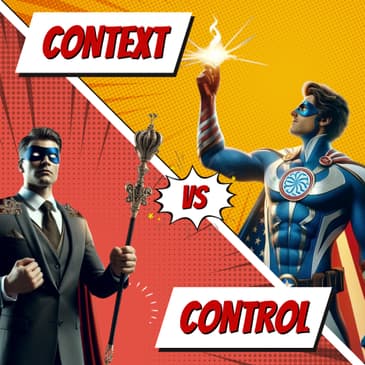
In this episode, Andy, delves into the nuanced debate of context versus control within the realm of management, particularly focusing on the irrigation industry. This concept, inspired by an episode of the Tim Ferriss show featuring Reed Hastings, co-founder and former CEO of Netflix, challenges traditional management styles by advocating for a more empowered approach to leadership. Through Reed Hastings' insights and his own reflections, Andy explores how setting clear contexts rather than imposing strict controls can lead to more innovative and motivated teams.
Highlights
- Inspiration from Reed Hastings: The idea of context vs. control was sparked by Reed Hastings' discussion on the Tim Ferriss show, emphasizing creative management styles over conventional, control-based approaches.
- Definition of Context vs. Control: Control is described as a rigid, micromanagement style, whereas context provides goals and empowers employees to achieve them in their own way.
- Impact on the Irrigation Industry: Andy applies these concepts to the irrigation industry, suggesting that understanding the 'why' behind actions can lead to more engaged and self-sufficient teams.
- Reed Hastings' Metaphor: The comparison of industrial and creative companies illustrates how context-driven management can lead to innovation and unique customer experiences.
- Management Philosophy: Andy expresses his preference for a management style that sets a clear context, allowing for autonomy and self-guided decision-making within teams.
Key Takeaways
- Setting the context in management involves clearly defining the goals and the 'why' behind tasks, and empowering team members to make decisions that align with company objectives.
- Context-driven management can foster a culture of innovation and flexibility, particularly beneficial in creative or service-oriented industries.
- Understanding and implementing the context vs. control management style can enhance team motivation, satisfaction, and overall performance.
[00:00:00] Hello my friends, welcome back to The Sprinkler Nerd Show.
[00:00:02] I'm your host Andy Humphrey.
[00:00:04] This is episode 162 and the topic for today is context versus control.
[00:00:12] And when I say contact versus control it is in, it is through the frame and in the lens
[00:00:18] of management, managing company, the people, the staff, context versus control.
[00:00:25] And this is, I didn't come up with this idea so I just wanted to mention that.
[00:00:28] I heard it this week on an episode of the Tim Ferriss show.
[00:00:33] I think if you're a listener of this show you know that I'm fond of the Tim Ferriss show
[00:00:37] and although I don't listen to every episode because I either not interested in the subject
[00:00:41] matter or the episode is just too long and too tedious, but I probably listen to, well
[00:00:48] if I say listen to half of them I probably listen to a quarter of them.
[00:00:52] However, I saw the title of the episode this week and that it was with Reed Hastings.
[00:01:00] And Reed Hastings is one of the co-founders of Netflix, former CEO of Netflix and he
[00:01:06] is a tech billionaire.
[00:01:09] And I thought there was a snippet in the episode where Reed talks about his management
[00:01:17] style and a couple different management styles as it relates to different types of companies.
[00:01:23] And it just resonated with me.
[00:01:25] It stood out.
[00:01:26] I took notes right then and there because I thought that if it struck a chord with
[00:01:32] me maybe it will strike a chord with you as well.
[00:01:35] So I'm going to roll the intro and then share my thoughts with you here in just
[00:01:38] a minute.
[00:01:39] Stay tuned.
[00:01:41] If you are an irrigation professional, old or new, who designs, installs or maintains
[00:01:51] high end residential commercial or municipal properties and you want to use technology
[00:01:56] to improve your business to get a leg up on your competition even if you're an old
[00:02:01] school irrigator from the days of hydraulic systems this show is for you.
[00:02:08] All right.
[00:02:09] So let's start with context.
[00:02:11] What is context and how is it different than control?
[00:02:15] We know what control looks like.
[00:02:16] We'll talk about here in just a minute, but control is a very exact set of operating
[00:02:21] procedures and exact set of rules.
[00:02:24] A one way to do something mentality micromanaging and kind of like an assembly line worker
[00:02:31] if you will.
[00:02:33] Context on the other hand is a bit the opposite of that.
[00:02:39] Context is to set the expectation, define the goal and empower your people to make it happen.
[00:02:47] So how do you set the context?
[00:02:49] And I'm going to use some of Reed Hastings.
[00:02:51] I don't know if I'm going to use his exact words but I took notes so whether
[00:02:55] he said it or I wrote it down in a moment I can't remember but Reed says that
[00:02:58] the typical metaphor is to use industrial companies and that we've had 200 years of the
[00:03:06] industrial revolution and factories that make things and the boss tells everyone what to
[00:03:13] do and management was really trying to drive consistency and process.
[00:03:21] Consistency process rules procedures marching orders you can come up with a lot of other
[00:03:28] creative words to describe that but because of that and because it was the industrial revolution
[00:03:36] that is essentially how we have let's for example millions of antibiotics that are all very good.
[00:03:45] Millions of them all produced and they're all very good.
[00:03:47] And then we have airplanes that are mostly good he's joking but we have to build things
[00:03:52] that are very repeatable, very replicable, very safe, they're standard and it takes sort
[00:04:01] of the boss telling people what to do setting the procedures, the policies, the rules to
[00:04:05] do that kind of thing.
[00:04:07] And we have that in our industry as well if you are installing a new irrigation system
[00:04:13] with your company you probably have a procedure.
[00:04:17] This is how you install a system.
[00:04:20] It might be the same way as a competitor it might not but over time you develop your own
[00:04:25] set of rules and guidelines.
[00:04:28] Now what Reed says is that creative companies which you could probably I would say you should
[00:04:36] divine your company as a creative company because it could be.
[00:04:40] So creative companies like Powder Mountain and Powder Mountain is the resort that
[00:04:43] Reed invested a hundred million dollars in in Utah where he is trying to create an experience
[00:04:51] of wonder for his customers.
[00:04:54] It's an experience of wonderment for his customers and I think sometimes you nail that your
[00:05:04] customers are wowed they're left wondering how you did this and sometimes you miss
[00:05:09] it but what's important to do is when you're thinking of context is that can be the only
[00:05:15] needed culture within the company to guide your staff on their decision making.
[00:05:23] So in other words if they run into a scenario that doesn't fit within the guidelines that
[00:05:27] have been provided to them within the policies procedures rules etc then they should go
[00:05:32] back and ask themselves the question how do I provide wonderment to my customer
[00:05:37] or whatever it is that you want to be your guiding light in your company doesn't have
[00:05:42] to be wonderment it could be it could be anything but making that clear that's setting the context
[00:05:47] this is the goal this is what we're doing this is why we're doing it and I would
[00:05:51] make the case that perhaps yes you are installing an irrigation system yes you're
[00:05:57] putting in a patio yes you're fertilizing somebody's lawn.
[00:06:02] But what else are you doing what are you really doing how are you doing it differently
[00:06:07] what is your customer going to remember about you that is different from them looking at the patio
[00:06:16] and wondering or thinking about how all of the pavers are lined up so perfectly.
[00:06:22] Everybody can do that so what is different about your company what value or experience
[00:06:29] are you going to provide your customer and documenting it and then setting that as a
[00:06:33] context within your company so that if your staff is in a situation where they're with
[00:06:38] the client or they have to make a decision then they can go back to the context
[00:06:42] versus what is the rule or the procedure.
[00:06:47] And so I think that there is I think this resonates with me because that's how
[00:06:55] I like to operate I don't like someone to be telling me everything that I need
[00:06:58] to do I think that yes certainly there is probably one way to build a valve manifold
[00:07:04] within your company.
[00:07:09] But if you can set the context of why you're doing it the way that you're doing it
[00:07:15] and you can set the context for maybe how to teach and train and guide and lead
[00:07:22] your staff to think so that they could they could think like you if they could
[00:07:26] think like you your life would be so much easier.
[00:07:31] So so I think when I heard Reid talk about this context philosophy it it hits with
[00:07:37] me because it kind of answers the why and I always like to know the why why am
[00:07:41] I doing something.
[00:07:43] And I think the more that the manager management owner et cetera can share
[00:07:47] the why the more the context becomes set and then the more the staff and
[00:07:53] the team can make their own decisions based on knowing why it's done that way
[00:07:59] to begin with.
[00:08:00] So if they come up with a different way of doing something it still is aligned
[00:08:05] with the context for the company and what the goal is of the company.
[00:08:10] So I think that you know as I wrap up here on this on this short episode
[00:08:17] it's it's it's important to have guidelines and best practices and
[00:08:22] systems and processes absolutely.
[00:08:25] And I think that maybe we don't give enough time to trying to lead someone
[00:08:33] to think like you might think by setting the context so that if the team
[00:08:38] is faced with a situation that there hasn't been a policy or procedure
[00:08:45] implemented yet they can think for themselves and execute on on a
[00:08:51] decision that meets your goals if you are the manager or are the owner.
[00:08:56] So I'll drop a link to the Tim Ferriss show episode and there was a bunch
[00:09:03] of other nuggets in the episode.
[00:09:06] This just happens to be the one that stuck out to me again it might be
[00:09:10] because that's how I like to be managed and how I like to manage even
[00:09:16] though those words don't go together because I don't like to manage
[00:09:19] I would much rather come up with the context and the goal and then let
[00:09:24] people do what they want to do as long as it fits with that.
[00:09:29] So thank you as always for listening.
[00:09:33] I hope you have a great weekend especially as we are starting to ramp
[00:09:37] up for the spring.
[00:09:38] If if you can take a breather over the weekend highly recommend you do
[00:09:42] it it's going to be a very busy spring and summer so things haven't
[00:09:46] already started to take off for you enjoy a little downtime with your
[00:09:51] friends family outdoor activity relaxation whatever that looks like
[00:09:55] for you as we prep for a very busy season and till the next episode.
[00:10:02] Happy sprinkling.
[00:10:02] We'll see you then.