
This episode is brought to you by, PHISH, and the letter 'S'.
'S' is for SPLIT.
Split Open and Melt.
[00:00:00] Music
[00:00:28] Hello, water wizards and lawn lovers. I'm your host, Andy Humphrey, and you're listening
[00:00:33] to The Sprinklin' Nerd Show. Today's episode is going to be a real gusher titled...
[00:00:41] Split Open. Let's keep listening. Split Open. The reason I chose this song for the intro.
[00:00:50] Okay, here you go. You ready? Ready? Ready? Ready?
[00:00:55] Oh, that was a fake intro. That was fake. That's a fake one. We gotta wait just a little bit more.
[00:01:00] Split Open. Who's a fan of fish? Anybody fish lovers? Here we go. It's a good song.
[00:01:06] It's from the Lawn Boy album. That's why I like it. We're all a bunch of Lawn Boys and girls.
[00:01:12] This is very apropos for what we're going to talk about today. Here we go.
[00:01:19] A little more. A little more. Here we go. Here we go.
[00:01:37] Alright. Split Open. I chose this just simply because the song is Split Open and Melt,
[00:01:45] and what I want to talk about today is Split, not Split Open, perhaps, but really splitting the pulse of a flow sensor or a water meter.
[00:01:57] And I wanted to mention this because we're working on a little product as part of our project with IoT
[00:02:06] to develop a pulse splitter. And we've got a couple. So I'll say that if somebody would like to demo a beta test,
[00:02:16] a pulse splitter, and even actual application, I have five units. So the first five people that want to text me,
[00:02:25] my number is 208-908-3229. I will send you a beta sample, a sample beta product of the pulse splitter.
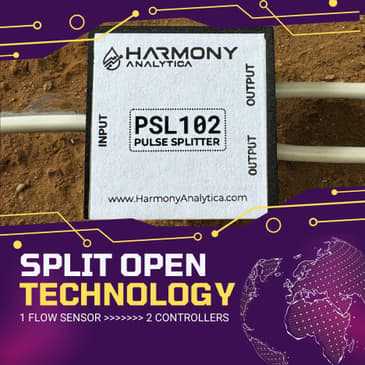
[00:02:39] And what the pulse splitter is designed to do is take one pulse signal, let's say from a flow sensor or a utility water meter
[00:02:49] and split it to two output devices. So you could have one flow sensor coming in,
[00:02:56] and you could split that pulse to two controllers. So a scenario might be you have two controllers
[00:03:07] because you ran out of station counts and the system expanded and you just added another controller,
[00:03:12] but there's only one flow sensor and you want to share the flow between the devices.
[00:03:16] That would be an application for the pulse splitter, or maybe you have a pump station and the pump station needs to know the flow,
[00:03:26] but you also want that flow to go to the irrigation controller. Well, you could split the flow and send one input into the pump station,
[00:03:34] the other input into the irrigation controller. So that's what I mean when I'm talking about pulse splitting.
[00:03:40] And this pulse splitter that we are working on doesn't require batteries or power, it's kind of a passive,
[00:03:48] if that's the right way to describe it. It's a passive pulse splitter, 100% waterproof IP68 fully submersible potted device,
[00:03:58] very simple, very, very small, kind of niche. You know, really I don't know how many,
[00:04:05] like there's 50,000 of these opportunities out there. But when you do venture into the commercial control space and you are working on retrofit,
[00:04:15] sometimes these funky scenarios appear where you want to do something like split a flow sensor from the single source into two controllers
[00:04:27] or one controller and a data logger. Or maybe there is a city utility meter that you want to split the flow and share it with an irrigation controller.
[00:04:40] So I don't want to talk too much detail about how it works or the types of sensors, but it would be a non-powered pulse type flow sensor
[00:04:51] that we're familiar with in this industry. And if you would like to try one, I have a couple beta units happy to send somebody a beta unit
[00:04:59] who is interested who will use it, who will provide some feedback. So I think that's all for this week guys.
[00:05:09] Just a short little blurb on a piece of tech, the pulse splitter where you might use it, why you might use it
[00:05:20] if you want to test one out. And as I continue to work on this IoT project, product-project business future stuff, all of that,
[00:05:30] it's just you find these little unique scenarios where there just isn't an existing tool that does the job and so sometimes you have to find one,
[00:05:41] take your own, etc. I will mention that did have a little bit of experience this week working on another wireless weather station,
[00:05:52] solar powered and yeah set it up here at my office filled a Home Depot bucket with concrete and a pole
[00:06:04] and put the weather station out there and I have the weather station reporting back wirelessly every one minute
[00:06:12] and we are capturing things like wind speed which actually comes out of the device in meters per second
[00:06:20] and then we are converting it to miles per hour, wind direction, solar, actually it's light in the form of lux
[00:06:29] which you can convert to solar radiation. Then of course we have temperature and humidity and pressure and rainfall
[00:06:42] so we are also using one of the new optical rain, we call it rain sensor but it actually measures the rain
[00:06:52] and it measures the rain as a form of intensity which is measured in millimeters per hour which is like a rate
[00:07:00] so it's actually the rain intensity of the rain rate at which you can convert it to a volume
[00:07:06] so it's highly sensitive, much more sensitive than a tipping rain bucket style device
[00:07:13] which requires a known volume in order to tip the seesaw if you will inside the bucket to measure
[00:07:23] so these are very sensitive but can also give you the volume. Let's see what else did I miss?
[00:07:28] Wind speed, wind direction, temperature, humidity, barometric pressure, light, rain, yeah all wireless coming into a data logger
[00:07:40] that we have which then connects back through our hub up to the cloud and then you can start overlaying the data
[00:07:48] and this is just interesting kind of putting these tools together working in the lab if you will
[00:07:55] so that you can see things like what happens to the soil moisture for instance if you overlay humidity
[00:08:04] or if you overlay solar radiation or if you overlay temperature
[00:08:10] how do each one of those environmental variables affect the soil moisture and there's really not a known good system out there that allows you to do that
[00:08:19] so that's why we're kind of building our own analytics and our own dashboards and bringing tools in in order to learn really
[00:08:27] in order to have better eyes on to the irrigation system so we're kind of setting to the side command and control
[00:08:36] okay we've been commanding and controlling irrigation systems forever that is what an automatic irrigation system does right
[00:08:45] it turns the valve on for a period of time then it turns the valve off
[00:08:51] command and control but what's been missing are all of the analytic data points to decide when and how long
[00:09:00] so that's where this is getting really interesting is that we can now the tools are now available to overlay
[00:09:08] different types of data that hasn't been able to be seen before on to that irrigation system
[00:09:18] on to that command and control let's take these data points let's capture more data different types of data
[00:09:25] start overlaying it onto the irrigation system so we can really start seeing the effects of our management practices
[00:09:32] is 30 minutes every other day the right choice how often is it right how often is it wrong why is it right
[00:09:41] why is it wrong and it's a hell of a lot of fun so anyway here we go that's what we had going on this week
[00:09:50] and very excited to just put a couple of these pulse splitters out into the wild so if you're interested please
[00:09:56] you know send me a text message 2089083229 I will put one in a box and send it to you all you have to do is
[00:10:07] install it and provide some feedback alright sounds simple enough cool so that's what I have for you this week
[00:10:14] hope everybody has a fantastic weekend I hope your spring is off to a fantastic start and everything is good in your world
[00:10:24] so thank you always for listening have an awesome weekend we'll catch you next week on another episode of the
[00:10:29] sprinkler show happy sprinkling